

You’ve decided you want to buy a home in Arizona. Maybe you’re eyeing a neighborhood in Mesa, considering the suburbs east of Tucson, or watching listings in the East Valley. Before you get attached to any particular property, one question needs a clear answer: what can you actually afford to spend?
The answer isn’t just your income divided by some round number. It depends on your debt load, credit profile, down payment, the type of loan you use, and Arizona-specific costs that don’t show up in a basic income calculation. This guide walks through each factor, gives you a realistic way to estimate your number, and explains what Arizona lenders will actually evaluate when you apply.
Quick Answer: How Much House Can I Afford in Arizona?
The Income Rules Lenders Use
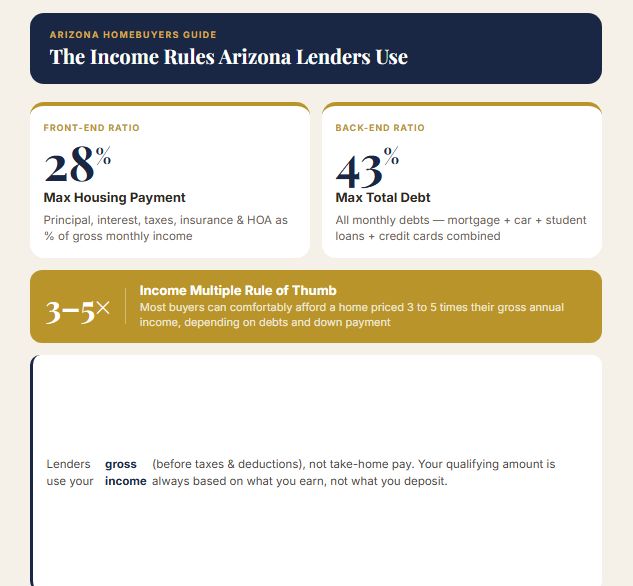
Mortgage lenders use debt-to-income ratios, not just income, to determine what you can borrow. Two thresholds matter most.
These ratios are guidelines, not absolutes. Fannie Mae and Freddie Mac guidelines generally cap the back-end DTI at 45% for conventional loans, with automated underwriting systems sometimes approving up to 50% for borrowers with strong credit and reserves. FHA loans can go higher still. The front-end ratio receives less scrutiny in practice than the back-end ratio, though lenders still use it as a check.
The important thing to understand is that lenders use gross income, not take-home pay. Your qualifying income is what you earn before taxes, retirement contributions, and health insurance premiums are deducted. What you actually see in your bank account each month will be meaningfully less.
A Real Arizona Affordability Example
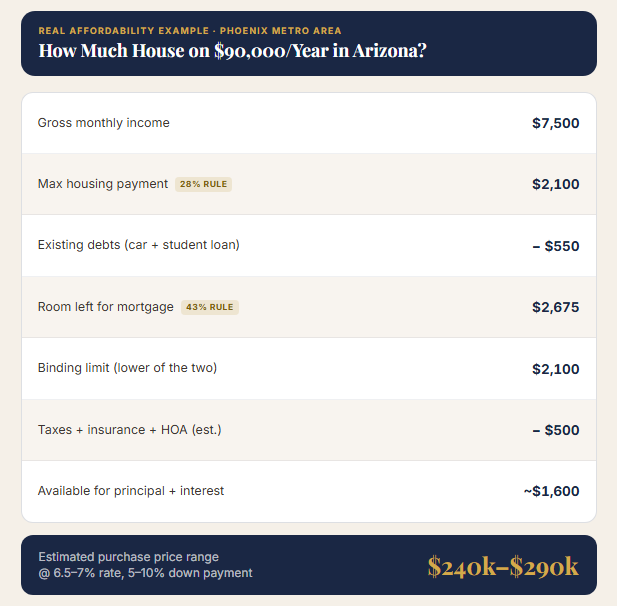
Abstract ratios are easier to understand with actual numbers. Here’s how affordability looks for a household earning $90,000 per year in Arizona.
This example is illustrative. The actual number shifts with interest rates, down payment size, credit score, and whether you carry more or less debt than assumed here. Use a home affordability calculator with your own figures to get a more precise starting point before contacting lenders.
What Actually Drives Your Affordability Number
Five factors interact to determine how much home you can qualify for. Changing any one of them can meaningfully shift the result.
1. Gross Income
Lenders count income that is stable, documentable, and expected to continue. W-2 employees can typically use base salary and consistent overtime or bonus income with two years of history. Self-employed borrowers use net income from tax returns, which is often lower than gross revenue because of business deductions. Part-time income, rental income, Social Security, and alimony can all count, each with its own documentation requirements.
2. Existing Debts
This is the most underestimated factor. A $400 monthly car payment is roughly equivalent to removing $50,000 to $60,000 from your purchasing power at current rates. Minimum credit card payments, student loan payments (even income-based repayment minimums), personal loans, and any other monthly obligations all reduce the mortgage payment you can qualify for. Paying off a high-payment debt before applying for a mortgage can meaningfully increase your budget.
3. Down Payment
A larger down payment does two things: it reduces the loan amount (and therefore the monthly payment), and on conventional loans, it eventually eliminates private mortgage insurance (PMI) once you reach 20% equity. PMI typically adds 0.5%–1.5% of the loan amount per year to your costs, which on a $300,000 loan means $125–$375 per month.
Down payment minimums vary by loan type. Conventional loans currently allow as little as 3% down for first-time buyers through programs like Fannie Mae’s HomeReady. FHA loans require 3.5% with a credit score of 580 or above. VA and USDA loans allow zero down for eligible borrowers. Arizona’s Home Plus program from the Arizona Industrial Development Authority provides down payment assistance of up to 5% of the loan amount statewide, with no first-time buyer requirement.
4. Credit Score
Your credit score affects your interest rate, which directly affects your monthly payment and purchasing power. The difference between a 680 and a 760 score on a $300,000 loan can easily be 0.5–1.0 percentage points, translating to $90–$190 per month and tens of thousands of dollars over the life of the loan.
Credit score minimums also determine which loan programs you can access. Most conventional lenders require a 620 minimum. FHA loans allow 580 with 3.5% down, or 500 with 10% down. Arizona’s Home Plus program generally requires a 640 minimum score. VA loans have no official minimum, though individual lenders set their own thresholds, often around 620. Review your credit report at AnnualCreditReport.com before applying, since errors are common and can be disputed before they affect your rate.
5. Interest Rate
Mortgage rates move with broader economic conditions and vary by loan type, term, down payment, and credit profile. A 1% increase in the interest rate on a $300,000 loan adds roughly $185–$200 per month to your payment. Over 30 years, that’s more than $67,000 in additional interest. This is why comparing multiple lenders matters: even a 0.25% difference in rate has meaningful long-term consequences. Shopping multiple lenders within a 45-day window counts as a single credit inquiry for scoring purposes, so rate shopping doesn’t significantly impact your score.
Arizona-Specific Costs That Affect Affordability
Affordability calculators that only look at purchase price and income miss costs that vary significantly by location. In Arizona, several local factors affect your real monthly payment.
Property Taxes
Arizona’s property tax rates are generally lower than the national average, but they vary considerably by county. Maricopa County (Phoenix metro) has an average effective rate around 0.5–0.6% of assessed value. Pima County (Tucson area) is similar. Pinal County, which covers much of the growing east Valley and areas like Queen Creek and San Tan Valley, can run slightly higher. On a $350,000 home, annual property taxes might range from $1,700 to $2,500 depending on location. Because lenders include property taxes in your monthly escrow payment, a higher-tax property directly reduces how much of your payment goes toward principal and interest.
Note that Arizona assesses residential property at 10% of its full cash value, and the tax is then applied to that assessed value, not the full purchase price. Verify the actual tax bill for any property you’re considering rather than estimating from purchase price alone.
Homeowners Insurance
Arizona’s desert climate creates specific insurance considerations. Extreme heat, dust storms (haboobs), and in some areas, flooding near river basins and monsoon flood zones, can affect premiums. Areas near wildland-urban interface zones in northern Arizona face higher fire risk premiums. Typical homeowners insurance in Phoenix metro runs $1,000–$2,000 per year, but premiums vary significantly by property age, construction type, location, and coverage level. Get quotes before making an offer on any home, and budget the actual premium rather than a generic estimate.
HOA Fees
Homeowners association fees are common in Arizona, particularly in master-planned communities in the Phoenix metro, Scottsdale, Chandler, Gilbert, and Peoria. Monthly HOA dues range from $50 to $500 or more, with high-amenity communities on the higher end. Lenders include HOA fees in your front-end ratio calculation. A $300 monthly HOA reduces your available mortgage payment by $300, which at current rates is equivalent to roughly $45,000 in purchasing power. Always factor HOA dues into your affordability math before falling in love with a community.
Utilities and Climate Costs
Lenders don’t include utilities in the DTI calculation, but they affect real affordability. Arizona’s heat means cooling costs are substantial, especially in older homes with less efficient HVAC systems. Summer electric bills of $200–$400 per month are common in Phoenix-area homes without newer insulation and windows. Ask about average utility costs, and consider requesting 12 months of utility bills from the seller during due diligence.
Arizona’s Home Plus program offers down payment assistance of up to 5% of the loan amount with no first-time buyer requirement. Combined with a competitive interest rate, this can meaningfully shift your affordability range. See current eligibility requirements at the Arizona Industrial Development Authority or the Arizona Department of Housing.
DTI Limits by Loan Type
Different loan programs allow different debt-to-income ratios. Knowing which program fits your situation can open up more purchasing power.
| Loan Type | Typical Max DTI | Min Credit Score | Min Down Payment | Notes |
|---|---|---|---|---|
| Conventional | 45–50% | 620 | 3–5% | PMI required under 20% down; best rates for 740+ scores |
| FHA | 50–57% | 580 (3.5% down) / 500 (10% down) | 3.5% | Mortgage insurance premium for life of loan unless refinanced |
| VA | 41–50%+ | None official (lenders often 620) | 0% | Eligible veterans and active-duty only; no PMI |
| USDA | 41–44% | 640 recommended | 0% | Rural and suburban Arizona properties in eligible areas only |
| AZ Home Plus | Follows underlying loan | 640 | 0% (with DPA) | Down payment assistance up to 5%; no first-time buyer required |
DTI limits above reflect general guidelines; individual lenders may be more conservative. Automated underwriting systems (Fannie Mae’s DU, Freddie Mac’s LPA) can approve higher ratios than manual guidelines when other factors are strong, such as high credit scores, substantial reserves, or a long employment history.
How to Use a Home Affordability Calculator in Arizona
A home affordability calculator for Arizona is most useful when you input your actual numbers rather than rough estimates. Here’s what to have ready:
- Gross annual income for all borrowers on the loan, before deductions
- Monthly debt payments: car loans, student loans, minimum credit card payments, personal loans, child support, alimony
- Estimated down payment in dollars, not percentage
- Credit score range (pull your free annual report if you haven’t recently)
- Estimated property tax rate for the area you’re considering (your county assessor’s website lists current rates)
- Estimated HOA dues if the communities you’re targeting have them
- Current interest rate or a rate range from recent lender quotes
A calculator using all these inputs will give you a purchase price range, not a single number. That range is your real budget. Working with the lower end of the range leaves room for unexpected costs; pushing toward the upper end requires everything to go right.
Common Affordability Mistakes Arizona Buyers Make
- Using the lender’s maximum as your target. Qualifying for $400,000 doesn’t mean $400,000 is comfortable. Your mortgage payment will be the largest fixed expense in your budget. Build in room for savings, travel, repairs, and life events.
- Forgetting closing costs. Arizona buyers typically pay 2–5% of the loan amount in closing costs. On a $320,000 loan, that’s $6,400–$16,000 cash needed at closing, separate from the down payment. Plan for this before you start shopping.
- Underestimating HOA and Arizona utility costs. A community with a $350 monthly HOA and $300 average summer electric bill adds $650/month to your real housing cost. This matters both for qualification and for day-to-day affordability.
- Not accounting for rate changes. If you’re pre-approved at one rate and rates move before you close, your payment changes. Understand the direction rates are moving, and consider rate lock options once you’re under contract.
- Skipping the preapproval step before shopping seriously. An estimate from a calculator is a planning tool. A preapproval from a lender, based on verified income and credit, is what tells you your actual budget. Getting preapproved with your documents in hand before you make offers avoids surprises later.
- Ignoring long-term costs of adjustable-rate mortgages. ARMs often advertise lower initial rates, which can make a more expensive home look affordable. Understand the adjustment caps and worst-case scenarios before choosing one over a fixed-rate loan.
Steps to Find Your Actual Affordability Number
- Pull your credit report. Go to AnnualCreditReport.com and get reports from all three bureaus. Dispute any errors. Know your approximate score range before you talk to lenders.
- List every monthly debt payment. Be precise: minimum payments on all credit cards, car loans, student loans, personal loans, any other obligations. This is the back-end DTI input that most affects your qualifying amount.
- Calculate your gross monthly income. Annual salary divided by 12. For variable income (commissions, bonuses, self-employment), use a two-year average from tax returns.
- Research costs in your target area. Look up property tax rates in the county you’re considering. Check average HOA fees in communities you like. Get a quick insurance quote on a representative property.
- Run numbers through an affordability calculator. Use your real inputs, not estimates, to get a purchase price range built for Arizona costs.
- Get preapproved before shopping seriously. A lender will verify your income, assets, and credit and give you a preapproval letter for a specific loan amount. Review our mortgage preapproval checklist to gather documents in advance. This step turns an estimate into a real number you can act on.
- Compare at least three lenders. Rate differences of 0.25–0.5% are common among lenders quoting the same borrower. Compare total costs, not just rates. Multiple applications within 45 days count as a single credit inquiry.
Frequently Asked Questions
How much house can I afford on a $60,000 salary in Arizona?
How much house can I afford on a $100,000 salary in Arizona?
What credit score do I need to buy a house in Arizona?
What is a good debt-to-income ratio to buy a home in Arizona?
Are there first-time homebuyer programs in Arizona that improve affordability?
How much do I need for a down payment in Arizona?
Does HOA affect how much house I can afford in Arizona?
Should I get preapproved before using a home affordability calculator?
Conclusion
Figuring out how much house you can afford in Arizona isn’t a single calculation. It’s the intersection of your income, your debts, your credit score, your down payment, the type of loan you use, and the specific costs of the communities and homes you’re considering. Understanding each of those factors before you start making offers protects you from surprises and puts you in a stronger position with sellers.
The 28/43 rule gives you a starting range. A home affordability calculator with Arizona-specific inputs refines it. And a preapproval from a lender, based on verified documents, turns the estimate into a real number you can act on with confidence. Arizona also has real assistance programs available to buyers across a range of incomes and experience levels, and those programs can meaningfully shift your affordability range if you qualify.
Take the time to run your actual numbers, compare at least three lenders, and get preapproved before you fall in love with a property. That sequence makes the rest of the process much smoother.