

You’ve spent three weekends at open houses in Chandler and Scottsdale. You’ve saved for a down payment, and you’ve started daydreaming about paint colors. Then a listing agent asks whether you’re preapproved or prequalified, and suddenly the two terms feel like they mean something very different.
They do. The distinction matters not just as terminology, but as a practical matter that can affect whether a seller takes your offer seriously, how accurate your budget estimate is, and how quickly you can move when you find the right home. For Arizona homebuyers shopping in a market where inventory can move quickly, understanding this difference before you make an offer isn’t just helpful. It’s necessary.
Quick Answer: Mortgage Preapproval vs. Prequalification in Arizona
What Is Mortgage Prequalification?
Mortgage prequalification is the first, lighter step in the home loan eligibility process. You provide a lender with basic financial information: your estimated income, approximate monthly debts, and a rough sense of your assets. The lender then returns an estimate of what you might qualify to borrow.
The key word is “estimate.” Because prequalification is generally based on information you report rather than documents you submit, the result is directional, not definitive. The Consumer Financial Protection Bureau describes prequalification as essentially a starting point: the lender has not verified your information, so any figures could change materially once real paperwork is reviewed.
In terms of credit, some lenders use a soft credit pull during prequalification, while others skip the credit check entirely. A soft inquiry does not affect your credit score and is not visible to other lenders reviewing your report. However, practices vary. The CFPB explicitly notes that lenders do not always use the terms “prequalification” and “preapproval” the same way. It’s worth asking your lender exactly what they’re reviewing before you consent to anything.
When prequalification is genuinely useful:
- You’re six months or more from buying and want a rough sense of your budget before seriously shopping
- You want to compare a few lenders on rates and general responsiveness without yet triggering hard credit inquiries
- You’re exploring first-time homebuyer programs and want to gauge eligibility before committing to one lender
When you’re ready to get prequalified for a mortgage, you’ll typically provide your estimated gross income, monthly debt payments (car loans, student loans, credit cards), your approximate credit score range, and any assets you plan to put toward a down payment. The entire process often takes minutes through a lender’s online portal.
The limitation is straightforward: a prequalification letter tells a seller very little about whether your financing is solid. In a competitive market, that can be a meaningful disadvantage.
What Is Mortgage Preapproval?
Mortgage preapproval is a more formal, documented review of your finances. Rather than taking your word for your income and debts, the lender verifies what you’ve reported. The process typically includes reviewing pay stubs, W-2s or tax returns, bank statements, and employment records, as well as pulling your full credit report through a hard inquiry.
The result is a preapproval letter that specifies a maximum loan amount the lender is conditionally willing to extend, usually at a stated interest rate or rate range. Because the lender has actually reviewed your documents, the figures in a preapproval letter are far more reliable than a prequalification estimate.
That said, “conditionally” is doing important work in that sentence. A preapproval letter is not a guarantee of final loan approval. It reflects your finances as of a specific date, against a loan amount and program type. If your income, employment, or debt load changes before closing, or if the property doesn’t appraise at the purchase price, the lender’s offer can change. Full underwriting and final approval happen later, once you have a signed purchase contract and a property under review.
Preapproval also varies by lender. Some conduct a thorough upfront review and run the application through automated underwriting systems. Others issue a preapproval based on a lighter review. The strongest preapprovals, sometimes called “credit-approved” or “verified preapprovals” by certain lenders, involve a more complete review of your file before you even make an offer. It’s reasonable to ask any lender exactly what their preapproval process covers.
Mortgage Preapproval vs. Prequalification: Key Differences
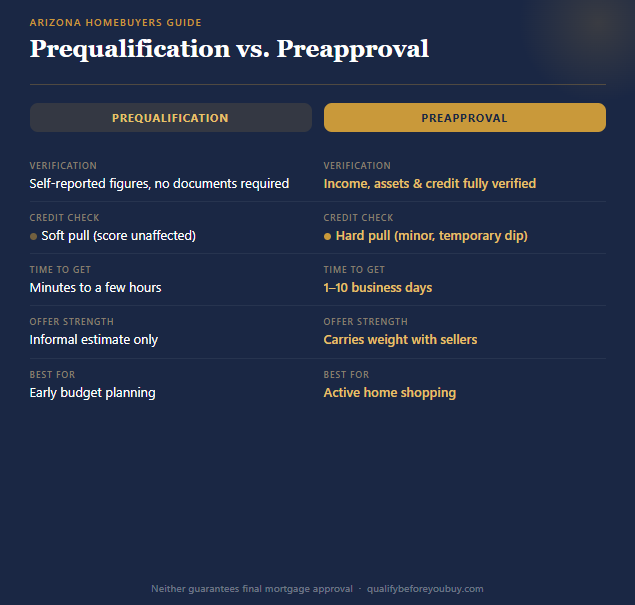
| Factor | Prequalification | Preapproval |
|---|---|---|
| Purpose | Rough estimate of borrowing range | Conditional commitment for a specific amount |
| Financial information | Self-reported | Verified through documents |
| Documentation required | None or minimal | Pay stubs, W-2s, bank statements, tax returns, ID |
| Credit inquiry | Usually a soft pull or none | Typically a hard inquiry |
| Impact on credit score | None or negligible | Minor, temporary; shopping multiple lenders within 45 days usually counts as one inquiry |
| Typical timeline | Minutes to 24 hours | 1–3 business days (varies by lender and borrower complexity) |
| Reliability of figure | Estimate based on unverified data | More reliable, subject to documented financials |
| Weight with sellers | Limited | Substantially stronger |
| Letter received | Prequalification letter (informal) | Preapproval letter (conditional, dollar-specific) |
| Guarantees final approval? | No | No |
Which Option Should Arizona Homebuyers Choose?
The right answer depends on where you are in the process.
Choose prequalification if:
- You’re exploring whether homeownership is feasible in the next six to twelve months
- You want to understand how much buying in Phoenix or Tucson realistically fits your budget before committing to a lender relationship
- You’re still working on your credit or saving toward a down payment and need a directional number
Choose preapproval if:
- You’re actively touring homes and expect to make an offer in the next few months
- You’re considering a home in a competitive area where multiple offers are common
- A listing agent or seller is asking for proof of financing ability
For first-time buyers in Arizona, starting with prequalification to understand your budget, then moving to preapproval once you’re actively searching, is a common and sensible approach. An Arizona mortgage preapproval checklist can help you gather the right documents before you contact lenders.
Relocating buyers moving to the Phoenix metro or Tucson from another state benefit especially from early preapproval. You may be competing with local buyers who already know the market, and a documented preapproval signals financial readiness without requiring you to be on the ground yet.
Self-employed applicants face a more involved process either way. Lenders typically want to see two years of tax returns, a profit and loss statement, and business bank statements to determine qualifying income. Self-employed buyers should give themselves extra lead time and consider beginning the preapproval process earlier than traditionally employed buyers. An experienced lender familiar with Arizona’s market will know which loan programs work best for your documentation type.
How to Get Prequalified for a Mortgage in Arizona
Getting prequalified is straightforward. Here’s a practical sequence:
- Review your finances honestly. Pull your credit report at AnnualCreditReport.com before contacting any lender. Identify any accounts in collections, incorrect balances, or credit inquiries that need addressing. You’re entitled to free weekly reports from all three bureaus.
- Estimate your income and debts. Know your gross monthly income and your current monthly debt payments, including car loans, student loans, credit cards, and any other obligations. This forms the basis of what lenders will use to calculate your debt-to-income ratio.
- Compare at least three lenders. Contact multiple lenders, including banks, credit unions, and mortgage companies. Rates, fees, and service quality vary. Prequalification-level quotes are generally available without a hard credit pull, letting you compare options before committing to one.
- Ask what the estimate covers. Before proceeding, ask whether the lender is reviewing verified information or working from self-reported data, and whether a credit check is involved. The answers shape how much weight to give the result.
- Request a written prequalification letter. Even an informal estimate is more useful in writing. It gives you a document to reference as you begin budgeting and comparing homes.
- Understand estimated payments, not just loan amounts. Ask how the estimate translates to monthly payments at different interest rate scenarios. Arizona homebuyers should factor in property taxes, homeowners insurance, and HOA dues where applicable, since these costs vary by property and location and meaningfully affect affordability. Use a mortgage affordability calculator to model different scenarios.
Documents You May Need for Mortgage Preapproval
Lenders need to verify that your income is stable, your debts are manageable, and your assets are real. Here’s what most lenders request:
Income
- Recent pay stubs (typically the last 30 days)
- W-2 forms from the past two years
- Federal tax returns from the past two years (especially important for bonus, commission, or self-employment income)
- Most recent profit and loss statement (for self-employed applicants)
Assets
- Bank statements from the past two to three months (checking, savings, investment accounts)
- Retirement account statements, if those funds are relevant to down payment or reserves
- Gift letter and proof of transfer, if any portion of your down payment is a gift
Employment
- Employer contact information for verification (some lenders verify employment via a third-party service)
- Two-year employment history (gaps or recent changes may require a written explanation)
Identity
- Government-issued photo ID
- Social Security number for credit verification
Debt
- Account numbers and balances for existing loans, credit cards, and any other obligations
- Documentation of any large deposits in your bank accounts (lenders may ask you to explain the source)
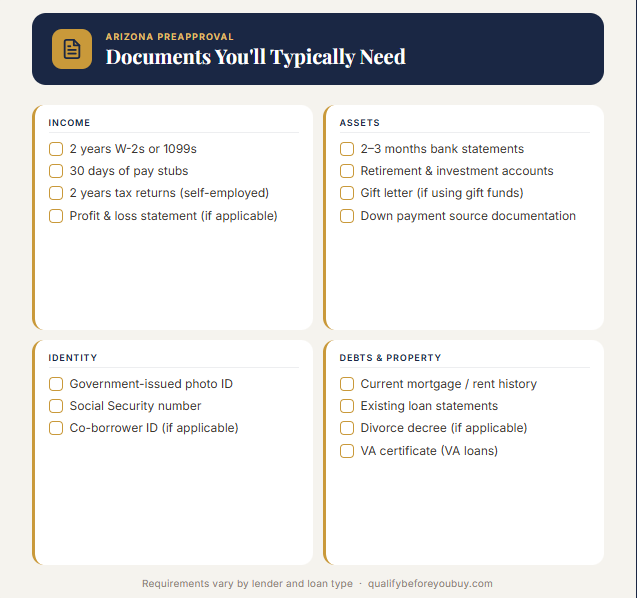
Additional documents may be required for VA loans (Certificate of Eligibility, DD-214), FHA loans, or if you have rental income, alimony, child support, or other non-W-2 income sources. For an organized view of what to gather, see our full mortgage preapproval document checklist.
Does Mortgage Preapproval Affect Your Credit Score?

Yes, in most cases, though less than you might expect.
Mortgage preapproval typically involves a hard credit inquiry, which may lower your credit score by a few points temporarily. Hard inquiries remain on your credit report for two years, but their scoring impact is generally small and short-lived.
The practical question is what happens when you’re comparing multiple lenders. According to CFPB guidance, multiple mortgage-related credit inquiries within a short shopping window are typically treated as a single inquiry for scoring purposes. The window is commonly cited as 14 to 45 days, depending on the scoring model in use. The CFPB also notes that inquiries less than 30 days old are ignored entirely for scoring purposes at the moment they occur. Shopping multiple Arizona mortgage lenders during a condensed period is credit-smart, not credit-damaging.
Prequalification, by contrast, generally uses a soft pull or no credit check at all. Soft inquiries have no effect on your score and are not visible to other lenders reviewing your file. That said, practices vary by lender, and some lenders run a hard pull even during what they call “prequalification.” Ask before you consent.
How Long Does Mortgage Preapproval Take, and How Long Does It Last?
Timeline: Once you submit your documents, most lenders issue a preapproval decision within one to three business days. Some lenders with efficient digital platforms can turn around preapproval in as little as 24 hours. More complex situations, such as self-employed income, multiple properties, or gaps in employment history, typically take longer. For a detailed breakdown, see our guide on mortgage preapproval timelines.
Validity: Preapproval letters are not indefinite. Most are valid for 60 to 90 days, though specific periods vary by lender. If yours expires before you find a home, the lender will typically re-verify your income, credit, and assets before issuing an updated letter. Refreshing a preapproval usually requires another hard credit inquiry.
The practical implication: don’t start the preapproval process six months before you plan to buy unless you’re prepared to renew it. Get preapproved when you’re genuinely ready to make offers within the letter’s validity window.
Does Preapproval Guarantee Mortgage Approval?
No, and this is one of the most important things to understand.
Preapproval is conditional. It means the lender reviewed your financial profile on a specific date and found it acceptable for a specific loan amount and program. Final mortgage approval depends on additional steps that happen after you’re under contract:
- Full underwriting: The lender’s underwriter reviews your complete file against program guidelines. This review is more detailed than the preapproval process.
- Property appraisal: The lender orders an independent appraisal to confirm the home is worth at least the purchase price. If the appraisal comes in low, it can affect your loan terms or require renegotiation.
- Title search and insurance: Any title issues, including liens, ownership disputes, or unpaid taxes, must be resolved before the loan can close.
- Updated verification: Lenders typically re-verify your income, employment, and credit shortly before closing. Changes in any of these areas, such as a job change, new debt, or a missed payment, can affect your final approval.
This is why experienced real estate agents and lenders consistently advise buyers: don’t make major financial changes after preapproval. Avoid opening new credit accounts, financing a car, changing jobs without consulting your lender, or making large undocumented deposits while your loan is in process.
Arizona-Specific Considerations for Homebuyers
A few factors are worth understanding as you navigate the homebuying process in Arizona.
Property taxes: Arizona’s property tax rates are generally lower than the national average, but they vary by county and school district. The effective tax rate on a given property affects your total monthly housing payment, since most lenders include property taxes in an escrow account. Verify the actual tax figure for any home you’re considering rather than relying on a prior year’s figure without checking for reassessment.
Homeowners insurance: Arizona’s desert climate creates specific insurance considerations, including heat-related risks and, in some areas, flood zones near river basins. Costs vary by property location. Get insurance quotes early in the process, since the annual premium will affect your debt-to-income calculation.
HOA dues: Many communities in the Phoenix metro, Scottsdale, and surrounding areas have homeowners association fees. These are factored into your qualifying payment by lenders. Some HOAs have transfer fees, initiation fees, and rules about rentals, so review HOA documents carefully during your due diligence period.
Closing costs: Arizona buyers typically pay between 2% and 5% of the loan amount in closing costs, which include lender fees, title insurance, recording fees, and prepaid items. These costs don’t appear in your preapproval letter but must be planned for separately.
Homebuyer assistance programs: Arizona has several state-level programs designed to help buyers with down payments and closing costs. The Arizona Industrial Development Authority’s Home Plus program offers down payment and closing cost assistance of up to 5% of the loan amount statewide, and notably does not require first-time buyer status. The Arizona Is Home program, a collaboration between the Governor’s Office and the Arizona Department of Housing, provides down payment assistance and mortgage rate relief for qualifying first-time buyers, with expanded funding available in 2025–2026 that includes up to $9,000 for eligible buyers in Pima County. Eligibility criteria, income limits, and program availability can change; verify current details directly through the Arizona Department of Housing before relying on any specific figures. Explore Arizona first-time homebuyer programs for a current overview.
Lender familiarity with the market: Arizona has a mix of large national lenders, regional banks, credit unions, and local mortgage brokers. Lenders who actively work in Arizona’s market may be more familiar with local appraisal challenges, common HOA structures, and the timing of transactions, and those factors can matter more than small rate differences. Compare at least three lenders before choosing.
Common Mistakes to Avoid
- Treating prequalification as preapproval. Sellers and listing agents know the difference. Offering a prequalification letter in a competitive market may put you at a disadvantage compared to buyers who submitted a documented preapproval.
- Spending up to the maximum estimated loan amount. Both prequalification estimates and preapproval letters reflect the maximum you might qualify to borrow, not what you should borrow. Your actual comfortable monthly payment depends on your full financial picture, including savings, job stability, and other goals.
- Overlooking closing costs. Preapproval letters address loan amounts, not the cash you’ll need at closing. Budget separately for closing costs, which can add several thousand dollars to what you need to bring to the table.
- Skipping lender comparison. Rates, origination fees, and service quality vary meaningfully among lenders. Getting multiple preapproval estimates within a short window has limited credit score impact and could save you significantly over the life of the loan.
- Waiting too long to gather documents. Document collection is where preapproval timelines usually get extended. Missing W-2s, outdated bank statements, or incomplete tax returns cause delays. Gather everything before you contact lenders, not after.
- Making financial changes mid-process. Opening a new credit account, making a large purchase on credit, or changing jobs after preapproval can disrupt your final approval. Stay financially stable from preapproval through closing.
Frequently Asked Questions
Is mortgage preapproval better than prequalification in Arizona?
Can I make an offer with a prequalification letter?
Does getting prequalified for a mortgage affect my credit score?
How much does mortgage preapproval cost?
Can I get prequalified before finding a house?
How long does mortgage preapproval take?
Can self-employed buyers get mortgage preapproval?
Should I compare multiple mortgage lenders in Arizona?
Conclusion
The difference between mortgage preapproval and prequalification isn’t just semantics. It affects how sellers read your offer, how accurate your budget is, and how prepared you are for the steps ahead. Prequalification is a useful starting point for early planning. Preapproval is what you need when you’re ready to compete for a home.
For Arizona homebuyers, the practical advice is consistent: understand your finances before you fall in love with a property, compare lenders before committing to one, and get preapproved before you make an offer. Programs through the Arizona Department of Housing and the Arizona Industrial Development Authority may help with down payment costs, though those programs also have eligibility requirements and documentation needs that your lender can help you navigate.
Neither preapproval nor prequalification is a guarantee of final approval. The cleaner your financial picture and the more complete your documentation, the smoother the process tends to go. Take some time to review your credit report, gather your income documents, and talk to a few lenders before you get serious about the search.