

Buying a home in Phoenix is one of the most significant financial decisions you will make, and the process has a lot of moving parts. The Phoenix metro area is one of the largest and most active real estate markets in the United States, with dozens of distinct communities ranging from walkable central Phoenix neighborhoods to master-planned suburbs in Peoria, Chandler, Gilbert, and Buckeye.
Whether you are a first-time buyer or have purchased before, this guide walks you through every step of how to buy a house in Phoenix in 2026, from setting your budget to getting the keys at closing.
Quick Answer: How to Buy a Home in Phoenix
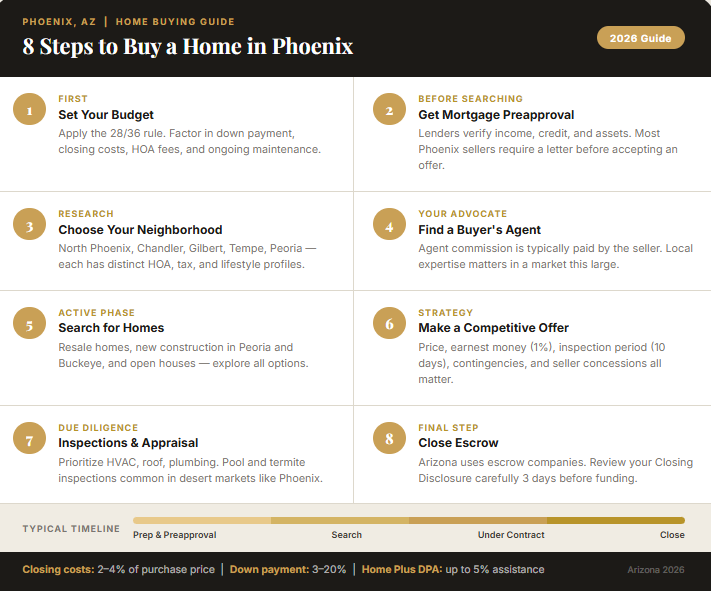
To buy a home in Phoenix in 2026, the process has eight main steps: set your budget, get mortgage preapproval, choose your Phoenix neighborhood, find a buyer’s agent, search for homes, make an offer, complete inspections and appraisal, and close on the property. The full process from preapproval to closing typically takes 30 to 60 days once you have an accepted offer. Budget for a down payment of 3% to 20% of the purchase price plus closing costs of 2% to 4%. Arizona’s Home Plus program provides up to 5% in down payment assistance for qualifying buyers across the Phoenix metro area.
People Also Ask About Buying a Home in Phoenix
How much do I need to buy a home in Phoenix? On a $400,000 home, plan for $12,000 to $28,000 in upfront costs depending on your loan type and down payment. Down payment assistance programs can reduce this significantly.
What credit score do I need to buy a house in Phoenix? A minimum of 580 for an FHA loan with 3.5% down, or 620 for a conventional loan. Best rates are available at 740 and above.
Is Phoenix a buyers or sellers market in 2026? The Phoenix market has moderated from its peak years, giving buyers more negotiating room in many price ranges, though well-priced homes in desirable areas still move quickly.
Step 1: Set Your Home Buying Budget
Most lenders use the 28/36 rule: your monthly housing payment should be no more than 28% of your gross monthly income, and total monthly debt payments should not exceed 36%. FHA loans allow higher debt ratios, sometimes up to 57% total DTI with strong compensating factors.
Before you start searching for homes in Phoenix, you need a realistic picture of what you can afford. This means looking at three numbers: your gross monthly income, your existing monthly debts, and the cash you have available for a down payment and closing costs.
In the Phoenix metro, the median home price varies significantly by area. North Phoenix neighborhoods like Desert Ridge and Tatum Ranch tend to run higher, while communities in Peoria, Avondale, and south Phoenix offer more affordable entry points. Setting your budget before you fall in love with a home keeps you focused and protects you from overextending.
Do not forget to factor in costs beyond the mortgage payment. Phoenix homeownership comes with property taxes, homeowner’s insurance, HOA fees in many communities (commonly $100 to $250 per month in north Phoenix), utilities, and maintenance. In older central Phoenix neighborhoods, aging electrical, plumbing, and HVAC systems can mean higher maintenance costs in the early years of ownership.
Use a mortgage calculator to test different purchase prices, down payment amounts, and interest rates. Running these numbers before you talk to a lender helps you walk into the preapproval conversation already knowing what monthly payment range works for your budget.
Step 2: Get Mortgage Preapproval
In the Phoenix market, submitting an offer without a preapproval letter puts you at a serious disadvantage. Most sellers and listing agents will not consider an offer that does not include documented mortgage preapproval, and some Phoenix neighborhoods move fast enough that you will miss homes entirely if you are not ready.
Mortgage preapproval is different from prequalification. Prequalification is an estimate based on self-reported information. Preapproval involves a lender verifying your income, employment, assets, and credit, and giving you a conditional commitment for a specific loan amount. This is what sellers in Phoenix want to see attached to your offer.
What You Need for Preapproval
Gathering your documents before you apply speeds up the process significantly. The standard items a Phoenix mortgage lender will request include the last two years of tax returns and W-2s, the last 30 days of pay stubs, the last two to three months of bank statements, a government-issued photo ID, and information on any existing debts or monthly obligations. The mortgage preapproval checklist breaks down exactly what to prepare so nothing slows down your application.
FHA vs. Conventional in Phoenix
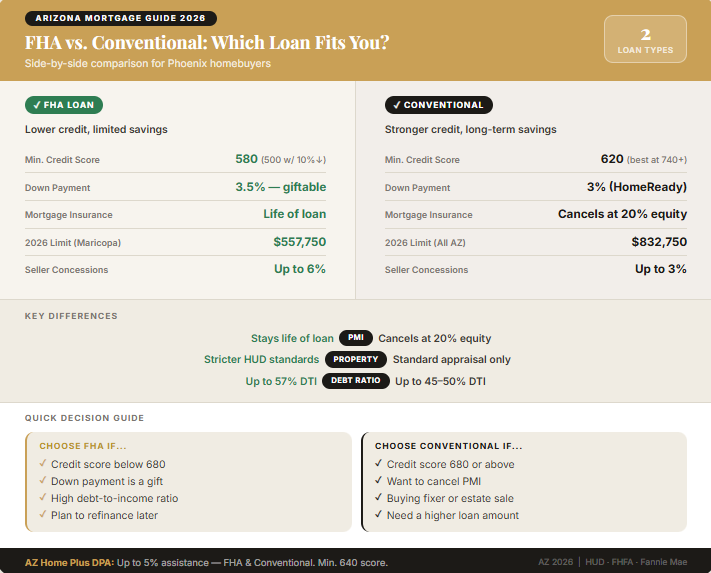
Phoenix buyers commonly use either FHA loans or conventional loans. FHA loans work well for buyers with credit scores as low as 580 and allow down payments of 3.5%. Conventional loans require a minimum 620 score and offer the advantage of cancellable mortgage insurance once you reach 20% equity. Your lender can show you both options with your actual numbers so you can compare the total cost over time.
Arizona Home Plus DPA
Arizona’s Home Plus down payment assistance program through the Arizona Industrial Development Authority offers up to 5% of the loan amount toward your down payment and closing costs. It works with both FHA and conventional loans, has no first-time buyer requirement, and is available to buyers across the Phoenix metro. Minimum credit score is 640 and income limits apply. Ask your lender specifically about AZIDA-approved programs when you apply.
Step 3: Choose Your Phoenix Neighborhood
The Phoenix metro is massive, covering more than 14,000 square miles with dozens of distinct cities and communities. Your commute, school district, HOA structure, property tax rate, and long-term appreciation potential all depend heavily on which part of the metro you choose.
The Phoenix community page covers what buyers should weigh when choosing between central Phoenix, north Phoenix, and the surrounding suburbs. Here is a breakdown of the most popular areas for homebuyers in the Phoenix metro.
Think Beyond the Purchase Price
Two homes at the same price in different Phoenix neighborhoods can have dramatically different total costs of ownership. HOA fees, property tax assessment timing, insurance rates tied to home age, commute distance, and water costs all affect your monthly budget. Research the full cost picture before committing to an area.
Step 4: Find a Buyer’s Agent in Phoenix
In Arizona, a buyer’s agent represents your interests throughout the transaction. The seller typically pays the buyer’s agent commission, meaning you get professional representation at no direct cost to you. In a market as active and geographically varied as Phoenix, having an agent who knows specific neighborhoods, builder reputations, and HOA nuances gives you a real advantage.
Look for an agent who specializes in the part of the Phoenix metro you are targeting. An agent who primarily works in Chandler will know that market’s comps, inventory patterns, and negotiation norms far better than a generalist. Ask potential agents how many homes they have closed in your target area in the last 12 months and what their average list-to-sale price ratio looks like for buyers they represent.
If you want to understand what financial protection comes with working with a dedicated buyer’s team, ask your agent about their buyer savings guarantee — an experienced Phoenix buyer’s agent can offer meaningful negotiated savings and buyer protections throughout the transaction.
Step 5: Search for Homes in Phoenix
With your preapproval letter in hand and your target neighborhood identified, you are ready to start actively searching. Phoenix has a large inventory of active listings across resale homes, new construction communities, and open houses.
The Phoenix area homes for sale search lets you browse active listings by area, price, and property type. You can also view featured listings curated for buyers, or check open homes in Phoenix if you want to tour properties without scheduling a private showing first.
New Construction vs. Resale in Phoenix
Phoenix has one of the most active new construction markets in the country. Builders are active in communities across the metro, including Peoria, Buckeye, Queen Creek, and north Phoenix. New construction homes in Phoenix offer modern floor plans, energy efficiency, and builder warranties, but they can come with longer wait times and less room for price negotiation compared to resale. Your buyer’s agent should accompany you on any builder visit and review the contract before you sign, since builder contracts are written to protect the builder.
What to Look for in Phoenix Home Inspections
Phoenix’s desert climate creates some inspection priorities that differ from other markets. Pay close attention to HVAC systems, since Arizona’s summer heat puts enormous strain on air conditioning units. Roof condition is critical given monsoon season and intense UV exposure. In older central Phoenix homes, check for polybutylene plumbing, outdated electrical panels, and evaporative cooler infrastructure that may need upgrading.
Step 6: Make a Competitive Offer
In the Phoenix market, the purchase price matters, but so does the structure of your offer. Sellers look at the net proceeds, the likelihood of the deal closing, and the timeline. A well-written offer with a clean preapproval letter, reasonable contingency periods, and a flexible closing date can win over a slightly higher offer that looks riskier on paper.
Your buyer’s agent will pull recent comparable sales (comps) in the neighborhood to help you determine the right offer price. In a standard Phoenix transaction, you will also need to determine your earnest money deposit (typically 1% of the purchase price), your inspection period (usually 10 days in Arizona), and whether you are asking the seller for any concessions toward closing costs.
Key Elements of a Phoenix Home Purchase Offer
- Purchase price: Based on comparable sales and current market conditions in the specific neighborhood
- Earnest money deposit: Typically 1% of the purchase price, held in escrow
- Inspection period: Usually 10 days in Arizona — time to investigate the property and negotiate repairs
- Loan contingency: Protects you if financing falls through after the inspection period
- Appraisal contingency: Protects you if the home appraises below the purchase price
- Closing date: Typically 30 to 45 days from acceptance, aligned with your lender’s timeline
- Seller concessions: Optional request for the seller to contribute toward your closing costs
Step 7: Inspections, Appraisal, and Final Loan Approval
Once your offer is accepted, the Arizona Residential Purchase Contract gives you an inspection period to investigate the property thoroughly. This is your chance to identify any material defects, negotiate repairs or price reductions, and confirm the home meets your lender’s requirements before you remove contingencies.
Hire a licensed Arizona home inspector to conduct a full inspection. In Phoenix, a standard inspection covers the structure, roof, HVAC, plumbing, electrical, and appliances. For older homes, you may also want a separate sewer scope inspection, a pool inspection if the property has one, and a termite inspection, which is common in desert markets.
Your lender will order an appraisal to confirm the home’s value supports the loan amount. If the appraisal comes in below the purchase price, you have several options: negotiate a price reduction with the seller, make up the difference in cash, or walk away using your appraisal contingency. Your buyer’s agent should guide you through whichever path makes the most sense.
During this period, your lender’s underwriting team will issue a conditional approval and then a clear-to-close once all conditions are satisfied. Stay responsive to any document requests from your lender and avoid making major financial changes like opening new credit accounts or making large deposits without documenting the source.
Step 8: Close on Your Phoenix Home
Arizona is an escrow state, meaning a neutral third-party escrow company handles the closing process. You will typically sign documents either at the escrow office or through a remote online notarization process. The seller signs separately. Funding and recording happen once all documents are executed and verified.
Three business days before closing, you will receive a Closing Disclosure from your lender showing the final loan terms, interest rate, monthly payment, and itemized closing costs. Review it carefully and compare it against your Loan Estimate from the beginning of the process. Contact your lender immediately if any numbers differ significantly from what you were told.
On closing day or the day before, do a final walkthrough of the home to confirm it is in the agreed-upon condition, any negotiated repairs have been completed, and the seller’s personal property has been removed. Once escrow records the deed with Maricopa County (or the relevant county), the home is officially yours.
Closing Cost Estimate for Phoenix Buyers
Expect to bring between 2% and 4% of the purchase price to closing in addition to your down payment. On a $400,000 home, that is $8,000 to $16,000. Closing costs in Arizona include lender fees, title insurance, escrow fees, prepaid property taxes, homeowner’s insurance, and prepaid mortgage interest. Your lender is required to provide a Loan Estimate within three business days of your application showing the breakdown.
Phoenix Metro Neighborhoods Worth Knowing
The Phoenix metro includes dozens of established communities beyond the city limits, each with its own character, price range, and lifestyle profile. You will find options that range from gated luxury enclaves to affordable first-time buyer neighborhoods with strong long-term fundamentals.
Some communities that consistently attract buyers relocating to Phoenix include Sky Crossing and Fireside at Norterra in north Phoenix, Vistancia in Peoria, and Aviano at Desert Ridge for buyers who want resort-style living with close proximity to the Desert Ridge Marketplace corridor. For buyers who want a more rural feel at the edge of the metro, Cave Creek offers horse properties and larger lots with mountain views.
Frequently Asked Questions: Buying a Home in Phoenix
How much do I need to buy a home in Phoenix?
What credit score do I need to buy a house in Phoenix?
How long does it take to buy a home in Phoenix?
Is Phoenix a good place to buy a home in 2026?
What are the best neighborhoods to buy a home in Phoenix in 2026?
Do I need a buyer’s agent to buy a home in Phoenix?
Ready to Buy a Home in Phoenix?
Buying a home in Phoenix is a process that rewards preparation. Buyers who know their budget, have their mortgage preapproval in hand, and understand the neighborhood they are targeting before they start touring homes are in a much stronger position than buyers who are figuring it all out as they go.
The Phoenix market has something for nearly every buyer profile: first-time buyers using down payment assistance, move-up buyers looking for more space in a master-planned community, investors seeking rental properties, and retirees searching for low-maintenance living near top-tier amenities. Understanding which category you fall into helps you focus your search and make faster, more confident decisions when the right home comes along.
Start by getting pre-qualified today to find out exactly what loan amount and monthly payment you qualify for. Then use the mortgage preapproval checklist to gather your documents, and browse active Phoenix area listings to get a feel for what is available in your price range right now.