
Yes, some Arizona buyers can buy a house with no money down, but the phrase is doing a lot of quiet work. Certain loan programs allow a zero down payment for eligible borrowers, and assistance programs, seller credits and lender credits can cover part or all of the remaining costs. That is not the same as buying with nothing in the bank. Most transactions still involve earnest money, an inspection and prepaid items before you get the keys.
Here is what actually goes into a low or zero cash purchase in Arizona, and how to find out whether your situation fits.
Can you buy a house with no money down in Arizona?
For eligible buyers, yes. The realistic paths are:
- VA loans for qualifying veterans, active duty service members and some surviving spouses
- USDA loans in eligible rural and some qualifying suburban areas
- Arizona down payment assistance layered on top of an FHA or conventional loan
- Grants or forgivable second liens through state or local programs
- Seller concessions negotiated into the purchase contract
- Lender credits, which trade a different rate structure for reduced upfront cost
- Gift funds from an approved donor, where the loan program permits them
Most of the “zero down” purchases I see in practice are not one clean program. They are a combination: a low or no down payment loan, plus a negotiated seller contribution, plus sometimes an assistance program. Availability depends on your eligibility, the property, and the current rules of each program.
What “no money down” actually means
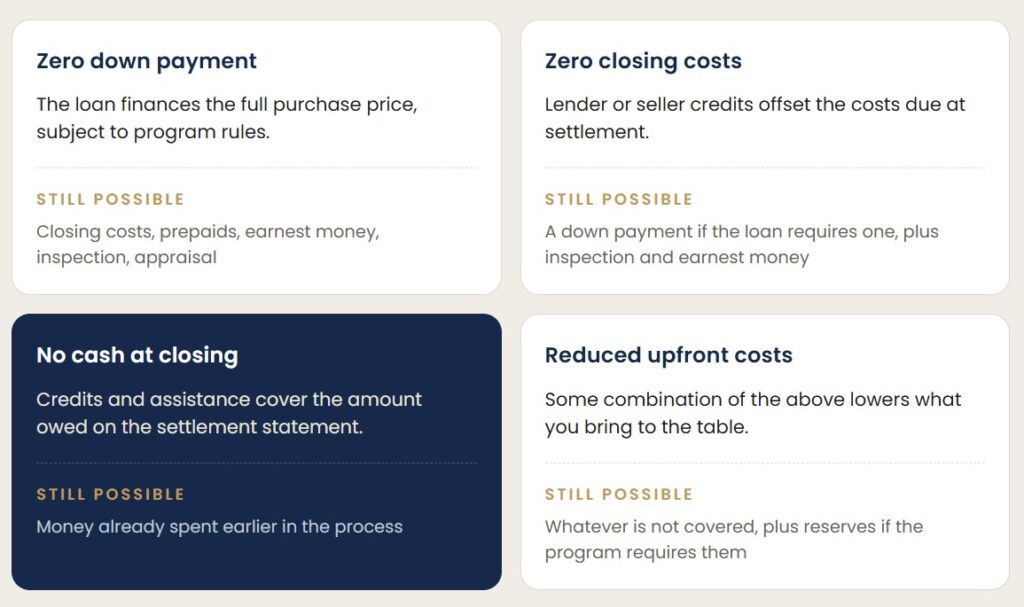
Buyers often hear zero down and assume zero cost. Those are separate ideas, and mixing them up is the single most common reason a homebuying plan falls apart three weeks before closing.
| Term | What it usually means | Costs that may remain |
|---|---|---|
| Zero down payment | The loan finances the full purchase price, subject to program rules | Closing costs, prepaids, earnest money, inspection, appraisal |
| Zero closing costs | Lender or seller credits offset closing costs | Down payment if the loan requires one, inspection, earnest money |
| No cash at closing | Credits and assistance cover the amount due on the settlement statement | Money spent earlier, such as earnest money and inspection fees |
| Reduced upfront costs | Some combination of the above lowers the total you bring | Whatever is not covered, plus reserves if the program requires them |
You can qualify for a zero down loan and still need a few thousand dollars along the way. Plan for that, and the process gets much less stressful.
Arizona home loan options with no down payment
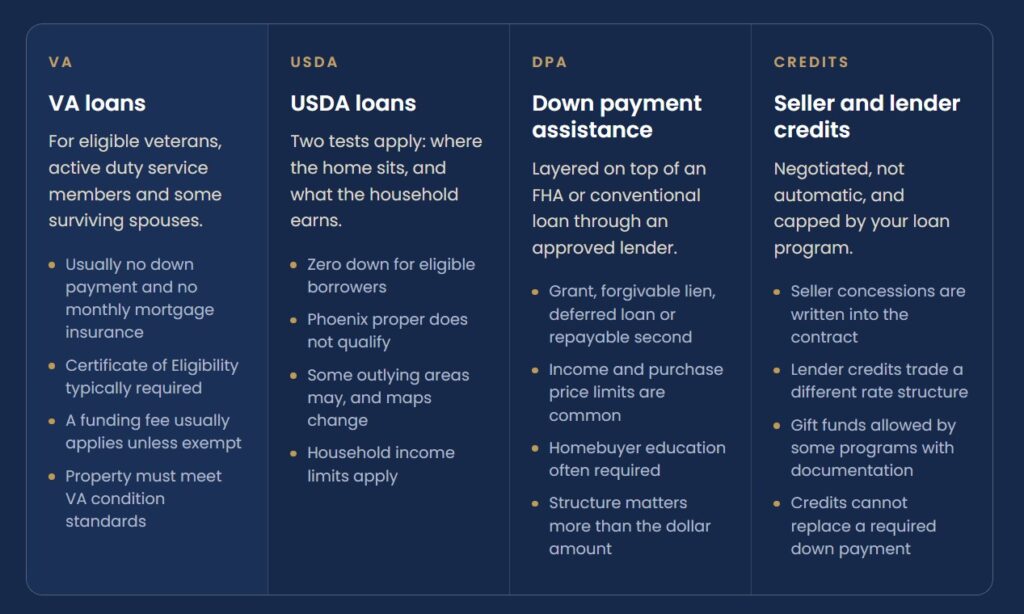
VA loans
VA financing is the closest thing to a true zero down loan. It is available to eligible veterans, active duty service members and certain surviving spouses, and it generally does not require a down payment or monthly mortgage insurance.
You will typically need a Certificate of Eligibility, and a VA funding fee usually applies unless you are exempt. The property has to meet VA condition and appraisal standards, which matters in Arizona where older West Valley homes sometimes have roof or HVAC issues that surface during the appraisal.
Being VA eligible is not the same as being approved. Income, credit and debt still get underwritten. [Verify current VA funding fee amounts and exemption rules with the U.S. Department of Veterans Affairs.]
USDA loans
USDA Rural Development loans also allow zero down for eligible buyers, but two separate tests apply: the property has to sit in an eligible area, and your household income has to fall under the applicable limit.
This is where Arizona buyers get tripped up. Phoenix proper does not qualify. Some outlying communities on the edges of the Valley and in the surrounding counties may, and eligibility maps change. Check the address before you fall in love with the house, not after. [Verify current USDA property eligibility and Arizona income limits with USDA Rural Development.]
Arizona down payment assistance
If VA and USDA are off the table, assistance is usually the next place to look. Arizona has a statewide program, HOME Plus, administered through the Arizona Industrial Development Authority and available in every county through approved participating lenders. Local and county level programs also exist in parts of the Phoenix metro.
Assistance can be structured as:
- A grant that is not repaid
- A forgivable second lien that disappears after you stay in the home for a set period
- A deferred loan repaid when you sell or refinance
- A repayable second mortgage with its own monthly payment
The structure matters more than the dollar amount. A forgivable lien with a five year occupancy requirement is a very different commitment than a grant.
Common conditions include income limits, purchase price limits, a minimum credit score, primary residence occupancy, a homebuyer education course, and the requirement that you use a participating lender. Funding levels and limits are updated periodically, so treat any figure you read online as a starting point rather than a rule. [Verify current HOME Plus assistance percentages, income limits, purchase price limits and credit requirements with the Arizona Department of Housing and the Arizona IDA, and confirm the year of any figure used.]
Seller concessions
A seller can agree to pay some of your closing costs. This is negotiated in the contract, capped by your loan program, and constrained by what the appraisal supports and how much competition the listing has.
Concessions generally cannot substitute for a required down payment, and they cannot exceed program limits. On a home that has been sitting for 60 days, a concession request is often reasonable. On a well priced new listing with multiple offers, it may cost you the house. Your agent should be pricing that tradeoff with you, not just filling in a number.
Lender credits
A lender credit reduces what you owe at closing in exchange for a different interest rate structure. It is a real tool, and it is not free money. You are paying for it over time through the rate. Whether that math works depends on how long you plan to keep the loan.
Gift funds
Many programs allow gift funds from an approved donor, usually a family member. Expect documentation: a gift letter, proof the donor had the funds, and a paper trail showing the transfer. Do not deposit cash from a relative into your account and hope nobody asks.
Costs you may still need to pay
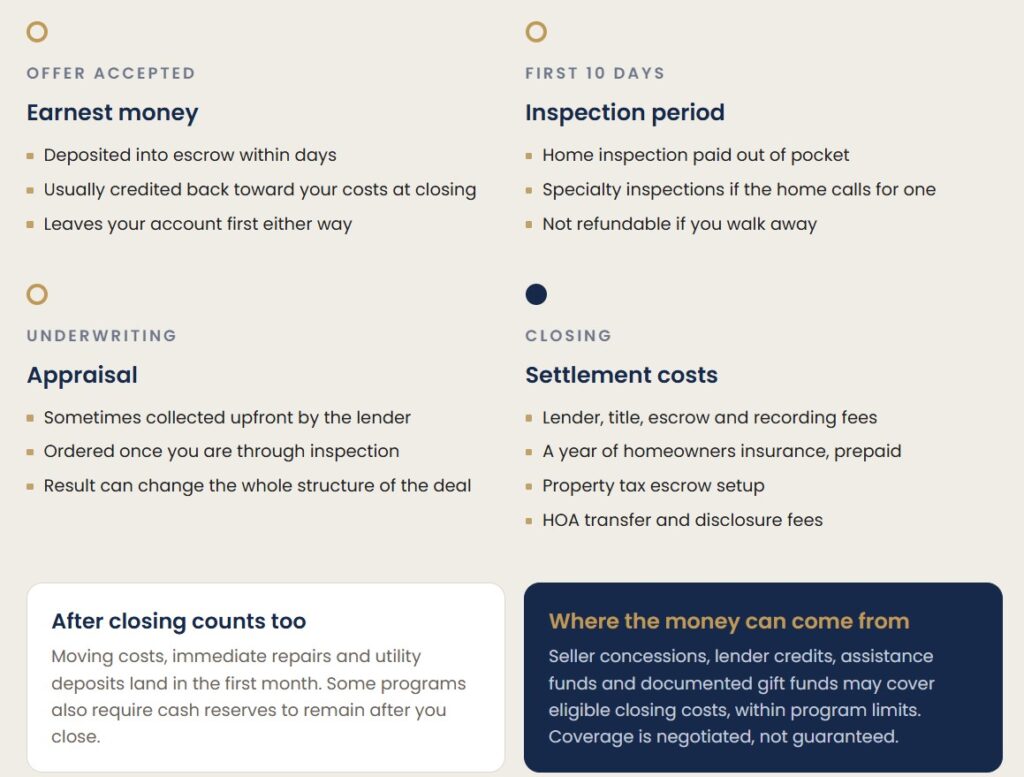
Even on a zero down purchase, budget for:
- Earnest money, held in escrow after your offer is accepted. It is usually credited back toward your costs at closing, but it leaves your account first.
- Home inspection, paid out of pocket, usually within days of going under contract.
- Appraisal, sometimes paid upfront depending on the lender.
- Closing costs, including lender fees, title, escrow and recording charges.
- Prepaid homeowners insurance, often a full year at closing.
- Property tax escrows, set up so the lender can pay taxes on your behalf.
- HOA transfer and disclosure fees, which are common across Phoenix area communities.
- Moving costs, immediate repairs and reserves. Some programs require you to have a few months of payments left after closing.
Can you buy a house with no money down with FHA?
Not on its own. FHA is a low down payment program, not a zero down program. It is popular with Arizona first-time buyers because the down payment requirement is modest and the credit guidelines are more flexible than conventional financing.
Where FHA becomes a near zero cash purchase is when it is combined with down payment assistance, seller concessions or documented gift funds. That combination is common in the Valley, and it is usually the practical route for buyers who are not VA or USDA eligible. [Verify the current FHA minimum down payment percentage and credit thresholds with current HUD guidance before publishing any figure.]
Credit and income requirements
There is no single number that gets you approved. Underwriting looks at the whole file:
- Credit history and score, including how recent any derogatory items are
- Income stability and employment history
- Debt-to-income ratio, meaning your monthly debts compared to your gross monthly income
- Assets and reserves
- Property type, condition and eligibility
- Occupancy, since these programs are for primary residences
- The specific loan program’s guidelines, plus any lender overlays
Two buyers with identical credit scores can get very different answers. A score tells you which programs are worth exploring. It does not decide the outcome.
Step by step: how to purchase a home with no money down
- Take stock first. Pull together your income, monthly debts, an estimate of your credit position and whatever savings you have.
- Talk to a mortgage professional early. Before you tour anything.
- Complete prequalification or preapproval. This is where guesswork turns into a number you can plan around.
- Compare the options you actually qualify for. VA, USDA, FHA with assistance, or a conventional structure with credits.
- Confirm property and location eligibility, especially for USDA and for any assistance program with area restrictions.
- Estimate every upfront cost, not just the down payment.
- Search within a realistic price range. Assistance programs often cap purchase price, which narrows the search.
- Prepare the offer with a buyer representative who understands how your financing is structured.
- Negotiate seller concessions where the situation supports it.
- Get through underwriting, appraisal and closing without changing anything about your financial picture.
Example scenario
A buyer qualifies for a zero down loan program. The home is priced at $400,000. The seller agrees to contribute toward eligible closing costs, and a lender credit covers part of the remainder.
Before closing, the buyer pays $2,000 in earnest money and about $500 for a home inspection. At closing, the combination of the seller contribution and the lender credit covers the remaining costs, and the earnest money is credited back toward the amount due. The buyer brings little or nothing to the closing table but has spent roughly $2,500 along the way.
This is a hypothetical illustration only. Actual figures depend on the loan program, purchase price, property, taxes, insurance, HOA charges, lender fees, program limits, negotiation and underwriting. Not every transaction can be structured this way.
Common mistakes to avoid
- Assuming no down payment means no expenses
- Touring homes before getting preapproved, then discovering the price range was wrong
- Counting on an assistance program without confirming current funding and eligibility
- Skipping the property eligibility check on a USDA purchase
- Draining savings between contract and closing
- Opening a new credit card or financing furniture during underwriting
- Changing jobs mid process without telling your loan officer
- Leaving HOA dues, insurance and property taxes out of the monthly budget
- Writing an offer that only works if the seller agrees to an unrealistic concession
Is a no money down purchase right for you?
It can be a good fit. You keep your savings, you stop paying rent sooner, and you keep cash available for emergencies. For buyers who have steady income but have not been able to save a large lump sum, it removes the main barrier.
The tradeoffs are real too. Financing more of the purchase means a higher monthly payment and more interest over the life of the loan. Mortgage insurance or a funding fee may apply. You start with little equity, which limits your options if you need to sell in the first couple of years. Some assistance carries repayment or recapture conditions. And property eligibility can restrict where you shop.
Zero down is a tool, not automatically the best choice. Run the monthly number both ways before deciding.
How mortgage preapproval helps
Preapproval is where this stops being theoretical. It tells you which programs you may qualify for, what price range is realistic, roughly what the monthly payment looks like, how much cash you will need to close, and whether an assistance program is worth pursuing. It also surfaces credit or documentation issues while there is still time to fix them.
Preapproval is not final approval. Financing still depends on the property, the appraisal, updated documentation and underwriting. But walking into a showing with a clear picture beats guessing.
If you want to see how different price points affect the payment, the mortgage calculator is a reasonable starting point, and you can start the preapproval process here.
Final takeaway
You may be able to buy a house with no money down in Arizona if you qualify for VA or USDA financing, or if you combine a low down payment loan with assistance, seller concessions or lender credits. What you cannot do is skip the planning. The buyers who succeed are the ones who know their numbers before they start looking.
Before you search Arizona homes for sale or tour a new construction community, find out which financing paths are open to you and what cash you should have set aside. Qualify Before You Buy can walk you through your estimated buying range, likely upfront costs and next steps. Get in touch when you are ready to map it out.
FAQs
Can a first-time buyer purchase a home with no money down in Arizona?
It is possible for eligible buyers. First-time buyers commonly reach a low or zero cash purchase by combining a low down payment loan with down payment assistance or negotiated seller credits. Eligibility depends on income, credit, the property and current program rules.
What credit score is needed for a no money down mortgage?
There is no universal number. Programs set minimums, and individual lenders may apply stricter overlays on top of them. Approval depends on your full profile, including debt-to-income ratio, employment history and the property itself.
Can closing costs also be covered?
Sometimes. Seller concessions, lender credits and certain assistance programs can be applied toward eligible closing costs, within program limits. Coverage is not guaranteed and depends on negotiation and what the loan program allows.
Can I use down payment assistance with an FHA loan?
Many Arizona assistance programs are designed to pair with FHA financing, and the funds can often go toward the down payment, closing costs or both. You typically have to use an approved participating lender and meet income, purchase price and education requirements.
Are zero down loans available in Phoenix?
VA financing is available anywhere in the state for eligible borrowers, including Phoenix. USDA loans are not available in Phoenix proper because of property eligibility rules, though some outlying areas may qualify. Assistance programs are generally available statewide, subject to their own limits.
Do I need savings if I qualify for a no down payment loan?
Yes, plan on some. Earnest money and the home inspection are usually paid before closing, and some programs require cash reserves after closing. Having a cushion also protects you if the appraisal or inspection changes the deal.