

Arizona has more down payment assistance available than most buyers realize, but the programs are not interchangeable. The right option depends on where you plan to buy, your income, your military status, whether you meet the first-time buyer definition, and which loan type fits your financial profile.
This guide breaks down the major programs available in 2026, explains who actually qualifies for each, and covers the details that most program summaries leave out, like repayment rules, funding limits, and the difference between “no down payment” and “no cash needed at closing.”
If you are not sure where you stand financially, the smartest move is to find out what you may qualify for before you start shopping. That means knowing your estimated price range, your monthly payment, your cash-to-close figure, and which programs you are actually eligible for. That is exactly what the preapproval process at Qualify Before You Buy is designed to clarify.
What are the best first-time home buyer programs in Arizona in 2026?
Arizona’s primary statewide down payment assistance program is Home Plus, administered by the Arizona Industrial Development Authority (Arizona IDA). It offers up to 4% of the loan amount toward the down payment and closing costs, works with FHA, VA, USDA, and conventional loans, and does not require first-time buyer status. For buyers outside Maricopa and Pima counties, Arizona Is Home provides 4% assistance through a below-market-rate mortgage, though 2026 assistance is non-forgivable. Maricopa County buyers may also qualify for Home in Five Advantage, which offers up to 6.5% total assistance. Beyond state programs, VA loans offer zero-down financing for eligible veterans and service members, and USDA loans cover eligible rural areas with no down payment required. The best fit depends on your income, county, military eligibility, credit profile, and how long you plan to stay in the home.
Because most of these programs require working with an approved participating lender, starting the process with a mortgage professional who already handles DPA programs saves time and avoids surprises. Qualify Before You Buy works with multiple lenders and can help you compare which programs fit your situation.
Arizona first-time home buyer programs at a glance
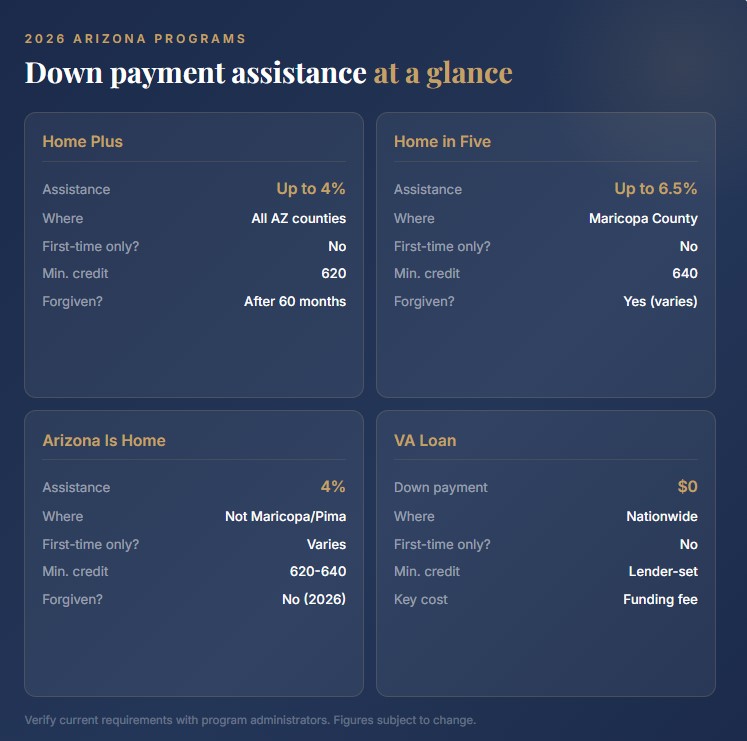
| Program | Assistance available | First-time buyer required? | Where available | Minimum credit score | Key condition |
|---|---|---|---|---|---|
| Home Plus (Arizona IDA) | Up to 4% of loan amount | No | All Arizona counties | 620 | Forgiven after 60 months |
| Arizona Is Home | 4% of loan amount | Varies by version | All counties except Maricopa, Pima, and Chino Valley | 620-640 (varies) | 2026 DPA is non-forgivable; due on sale or refinance |
| Home in Five Advantage | Up to 5% (up to 6.5% with bonuses) | No | Maricopa County only | 640 | Forgivable second mortgage |
| VA loan | No down payment required | No | Nationwide | Lender-set (often 580-620) | Must have qualifying military service |
| USDA loan | No down payment required | No | Eligible rural areas only | Lender-set (often 620-640) | Property and household income limits apply |
| HomeReady (Fannie Mae) | 3% down (compatible with DPA) | No | Nationwide | 620 | Income at or below 80% AMI |
| Home Possible (Freddie Mac) | 3% down (compatible with DPA) | No | Nationwide | 660 | Income at or below 80% AMI |
Program requirements can change during the year. Verify current figures with the administering agency or an approved lender.
Home Plus: Arizona’s flagship statewide program
Home Plus is the program most Arizona buyers will encounter first, and for good reason. It is available in every county, every city, and every zip code in Arizona. You do not need to be a first-time buyer.
How it works: Home Plus pairs a 30-year fixed-rate first mortgage with a deferred second mortgage that provides down payment and closing cost assistance. The assistance is structured as a no-interest, no-payment soft second lien. If you remain in the home for 60 months (five years), the second mortgage is fully forgiven. Sell or refinance before those five years are up, and you repay the balance.
Assistance amounts: Buyers using FHA, VA, or USDA financing can receive 0%, 2%, 3%, or 4% of the loan amount. Buyers using a Fannie Mae or Freddie Mac conventional loan can receive 0%, 3%, or 4%. The exact percentage depends on the mortgage product you select and the interest rate tier.
Income limit: Borrower annual income cannot exceed $155,386 as of April 6, 2026. When paired with FHA, VA, USDA, or conventional HFA loan products, the cap may be lower ($146,503 has been cited for certain products). Confirm the limit for your specific loan type with a participating lender.
Credit score: Home Plus reduced its minimum credit score to 620 effective March 2025. Some lender and product combinations may require higher scores, but the program floor is 620.
Homebuyer education: At least one borrower must complete an approved pre-purchase homebuyer education course before closing. Online courses through Home Plus-approved providers are accepted, or you can attend in person through a HUD-certified agency.
Funding: Unlike programs that rely on annual appropriations, Home Plus is self-funded through capital markets. The program does not deplete its funding annually, which means it stays available year-round without a hard cutoff date.
One thing to understand about Home Plus: the 60-month forgiveness period means your five-year plan matters. If you are likely to sell or refinance within the first few years, that assistance becomes a repayable obligation, not a gift. That does not make it a bad deal, but it changes the math for buyers who see the home as a short-term purchase.
If you are getting close to making an offer, reviewing the Arizona mortgage pre-approval checklist can help you get your documents organized before contacting a participating lender. Qualify Before You Buy can walk you through the Home Plus application as part of your preapproval, so you know exactly how much assistance you may receive before you start touring homes.
Arizona Is Home
Arizona Is Home is the second program run by the Arizona IDA, and it operates differently from Home Plus. The most consequential change for 2026 is that the down payment assistance is now non-forgivable. The full balance is due when you sell or refinance, regardless of how long you stay in the home.
Where it is available: Arizona Is Home covers all Arizona counties except Maricopa County, Pima County, and Chino Valley. If you are buying in Phoenix, Tucson, or their surrounding suburbs, this program is not an option. Buyers in those areas should look at Home Plus or Home in Five instead.
Assistance: 4% of the loan amount, delivered as a below-market-rate 30-year fixed mortgage combined with a non-forgivable deferred second lien. No monthly payment is required on the second lien, but the entire balance comes due at sale or refinance.
Income limits: Household income must fall at or below 100% of the area median income (AMI) for the county where the property is located. These limits vary by county and were updated effective July 1, 2026. They are typically lower than the Home Plus statewide cap.
Funding: Annual funding for 2026 is capped at $55 million. Once reservations exhaust that allocation, the program closes for the year. This is a meaningful difference from Home Plus, which does not run out of money.
First-time buyer requirement: Some versions of Arizona Is Home require first-time buyer status, defined as not having owned a primary residence in the past three years. Veterans and buyers purchasing in targeted areas may be exempt from this requirement.
The non-forgivable structure is worth thinking about carefully. Under the old forgivable terms, the assistance essentially became free money after a set period. With 2026 rules, you will repay that 4% whenever you sell or refinance. On a $350,000 loan, that is $14,000 you need to account for in your future plans. It is still interest-free and payment-free while you live there, which has real value, but it is not the same deal that older articles describe.
Home in Five Advantage: Maricopa County buyers
If you are purchasing in Maricopa County, which covers Phoenix, Scottsdale, Mesa, Chandler, Gilbert, Glendale, Peoria, Surprise, Goodyear, Buckeye, and surrounding cities, Home in Five Advantage is worth comparing against Home Plus.
Assistance: Up to 5% of the loan amount, structured as a forgivable second mortgage. Qualifying K-12 teachers, first responders, military personnel, and veterans may receive an additional 1% bonus. Income-qualified buyers earning up to approximately $36,450 annually may also qualify for a 0.5% boost, bringing the maximum to 6.5%.
Income limit: Maximum household income of approximately $138,600 to $157,360, depending on the specific product variant. Confirm the current figure with a participating lender, as this limit has been updated during 2026.
Credit score: Minimum 640 FICO.
Debt-to-income: Maximum 45% to 50%, depending on credit score and product variant.
Homebuyer education: Required. Home in Five uses Arizona-based HUD-approved housing counseling agencies, including some online courses. The requirement is an 8-hour course, which is more involved than some other programs.
Eligible loans: FHA, VA, USDA, and conventional (Fannie Mae HFA Preferred or Freddie Mac HFA Advantage).
One detail that catches people off guard: the forgivable second mortgage forgives over a set period (commonly 36 months for the 3% option and 84 months for larger amounts). If you sell or refinance before the forgiveness period ends, you repay the remaining pro-rated balance. So while the forgiveness terms are more favorable than Arizona Is Home’s 2026 structure, they still require you to stay in the home for a certain period.
Home in Five and Home Plus cannot be stacked. You pick one DPA program per purchase. Figuring out which one puts more money in your pocket requires comparing the interest rate, assistance amount, and forgiveness timeline side by side. This is the kind of comparison a Qualify Before You Buy mortgage consultant can run for you during the preapproval process, so you do not have to guess.
VA home loans for Arizona buyers
VA loans are not an Arizona-specific program and not limited to first-time buyers, but they are one of the strongest financing tools available to Arizona veterans and active-duty service members.
No down payment: VA loans allow eligible borrowers to finance 100% of the purchase price with no down payment required. There is no private mortgage insurance (PMI).
Who qualifies: Eligible veterans, active-duty service members, National Guard and Reserve members with qualifying service, and certain surviving spouses. You will need a Certificate of Eligibility (COE) from the VA.
Funding fee: Most VA borrowers pay a one-time funding fee. For 2026, first-time use with no down payment is 2.15% of the loan amount. Subsequent use with no down payment increases to 3.3%. Veterans with a service-connected disability rating of 10% or higher are exempt from the funding fee entirely. The fee can be financed into the loan.
Loan limits: For borrowers with full entitlement (no active VA loans, no prior VA loan default), there is no VA loan limit. The 2026 conforming loan limit is $832,750 in all Arizona counties, which matters only for borrowers with reduced entitlement.
Closing costs still apply. A zero-down-payment VA loan does not mean zero cash at closing. Expect closing costs in the range of 2% to 5% of the loan amount, which may be partially offset by seller concessions, lender credits, or the VA funding fee exemption.
VA financing can also be combined with Home Plus. An Arizona veteran could potentially use a VA first mortgage with Home Plus DPA to reduce or cover the remaining closing costs. That combination is worth discussing with a mortgage pre-approval specialist who handles both programs. The team at Qualify Before You Buy works with VA-approved lenders and can help you layer Home Plus assistance on top of your VA loan to reduce what you bring to the closing table.
USDA loans in Arizona
USDA Rural Development loans offer 100% financing with no down payment, but the geographic restrictions are strict. The Phoenix metro area, Tucson, and most larger Arizona cities are ineligible. By land area, roughly 96% of Arizona is USDA-eligible, but that includes large stretches of desert, forest, and tribal land where few homes are available.
Where it works in Arizona: Smaller towns and communities outside metro centers. Places like Payson, Prescott Valley outskirts, Sierra Vista, Safford, Show Low, and parts of Pinal County have historically included eligible areas. Eligibility is determined address by address using the USDA’s interactive map, and boundaries change periodically.
Income limits: USDA uses household income (not just borrower income) and caps it based on area median income and household size. For a 1-4 person household in most non-metro Arizona areas, the standard limit is approximately $119,850 for 2026. Larger households may have higher limits.
Property requirements: The home must be a primary residence that meets USDA property standards. It must be in an eligible rural area, appraised at or below the purchase price, and meet basic habitability requirements.
Costs to be aware of: USDA charges an upfront guarantee fee (currently 1% of the loan amount) and an annual fee (currently 0.35% of the remaining balance), both of which function similarly to mortgage insurance. These are considerably lower than FHA mortgage insurance premiums, but they are not zero.
If you are considering buying in a community outside the Phoenix or Tucson metro, check the USDA eligibility map before you fall in love with a property. Buyers exploring Arizona community guides can use those as a starting point for identifying areas that may qualify.
FHA loans with down payment assistance
FHA loans are popular with first-time buyers, but there is a persistent misconception that FHA allows zero-down purchases. It does not.
FHA’s minimum down payment is 3.5% for borrowers with a credit score of 580 or higher, and 10% for scores between 500 and 579. On a $375,000 home, 3.5% is $13,125.
Where FHA becomes powerful for Arizona first-time buyers is when it is paired with a down payment assistance program. Home Plus, Home in Five, and Arizona Is Home all work with FHA financing. The DPA can cover the entire 3.5% down payment, meaning the buyer may bring little or no personal funds toward the down payment itself. But you still need to account for any remaining closing costs, prepaid expenses, and other transaction costs that the DPA may not fully cover.
FHA also carries mortgage insurance, both an upfront premium (1.75% of the loan, typically financed into the loan) and an annual premium paid monthly. For most FHA borrowers who put down less than 10%, this insurance lasts the life of the loan unless you refinance into a conventional mortgage later.
For a deeper look at how FHA and DPA interact, the article on whether you can get an FHA loan with no down payment in Arizona explains the mechanics in more detail.
Conventional first-time buyer programs
Two conventional loan programs are specifically designed for lower-income buyers and pair well with Arizona’s DPA options.
Fannie Mae HomeReady requires as little as 3% down, has an income cap of 80% of the area median income, and accepts credit scores as low as 620. First-time buyer status is not required. Mortgage insurance costs are reduced compared to standard conventional loans, and PMI can be canceled once you reach 20% equity. First-time buyers where all occupying borrowers are first-time purchasers must complete a homeownership education course.
Freddie Mac Home Possible has similar terms but generally requires a minimum credit score of 660. Like HomeReady, it caps income at 80% AMI and requires only 3% down.
Both programs can be layered with Home Plus or Home in Five, meaning the DPA could cover the 3% down payment. The income limit is tied to the property’s location, not the borrower’s residence, so you need to check the AMI for the specific area where you plan to buy using Fannie Mae’s or Freddie Mac’s lookup tools.
How to choose the right Arizona home buyer program
There is no single “best” program. The right fit depends on your situation.
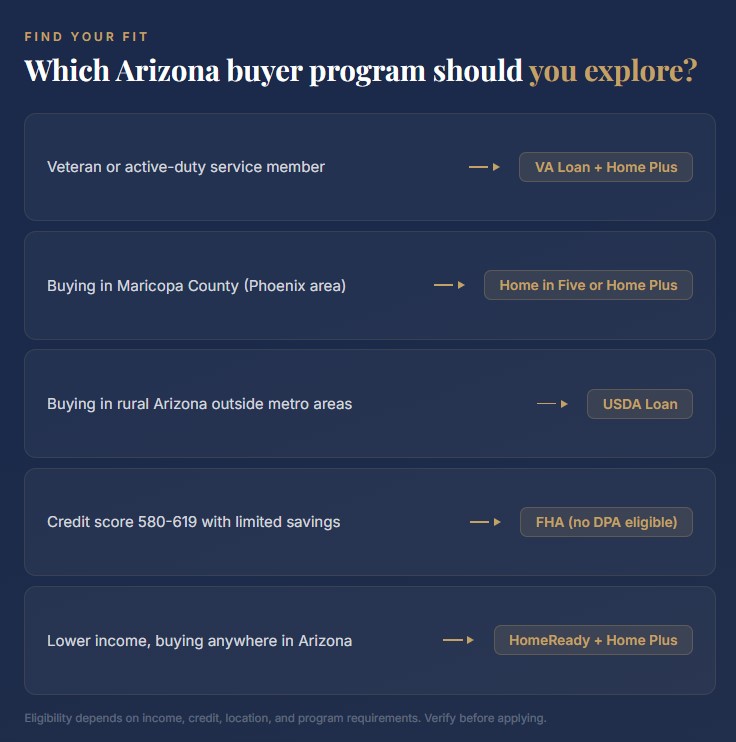
If you are a qualifying veteran or active-duty service member: VA financing is almost always worth investigating first. Zero down payment, no PMI, and competitive rates are difficult to beat. You can still layer Home Plus on top for closing cost help.
If you are buying in Maricopa County: Compare Home Plus and Home in Five side by side. Home in Five may offer more total dollars in assistance, but Home Plus has a lower minimum credit score (620 vs. 640) and broader income eligibility for some product types.
If you are buying outside Maricopa and Pima counties: Home Plus is your primary statewide option. Arizona Is Home may offer a below-market interest rate, but the 2026 non-forgivable terms and limited $55 million funding pool make it a different proposition than in prior years.
If you are purchasing in a rural area: Check USDA eligibility first. If the property qualifies and your household income is within limits, USDA’s zero-down structure and low fees are hard to match.
If you have a credit score between 580 and 619: FHA without DPA may be your most direct path, since most state DPA programs require 620 or higher. Focus on building savings for the 3.5% down payment and closing costs.
If you are unsure where to start: Understanding why pre-qualification matters in Arizona can help you figure out which programs you may actually be eligible for before you spend time researching options that don’t fit. The team at Qualify Before You Buy can review your income, credit, and savings to identify which combination of loan type and assistance program gives you the strongest position.
Buyer scenarios
Scenario 1: First-time buyer in Glendale with $8,000 saved
A buyer with a 640 credit score, $65,000 income, and $8,000 in savings could potentially explore an FHA loan paired with Home Plus 4% DPA. On a $350,000 purchase, 4% of the loan amount could cover the 3.5% FHA down payment. The remaining savings would go toward closing costs, earnest money, inspections, and moving expenses. Whether the numbers actually work depends on the interest rate, tax and insurance estimates, and total closing costs. A Qualify Before You Buy preapproval would give this buyer a clear cash-to-close estimate before they start looking at homes.
Scenario 2: Veteran relocating to Mesa
A veteran with a VA Certificate of Eligibility could finance the full purchase price with no down payment and no PMI. If closing costs are a concern, layering Home Plus on top of the VA loan could provide additional funds. Veterans with a service-connected disability of 10% or higher avoid the VA funding fee entirely, which on a $400,000 loan would save $8,600.
Scenario 3: Buyer purchasing in Prescott Valley
A buyer considering a property in an area outside the major metros should check USDA eligibility for the specific address. If eligible, the buyer could potentially finance the entire purchase with no down payment. If the property is not USDA-eligible, Home Plus or Arizona Is Home (if the county qualifies) would be the fallback DPA options.
Scenario 4: Buyer earning $50,000 with a 660 credit score
This buyer could potentially qualify for HomeReady or Home Possible with 3% down, combined with Home Plus assistance to cover that 3% down payment. The income cap for HomeReady is 80% of the local AMI, so eligibility depends on where the property is located. The lower mortgage insurance rates on these conventional products could result in a lower monthly payment than FHA.
“No money down” vs. “down payment assistance”: they are not the same thing
This distinction trips up a lot of buyers, so it is worth spelling out clearly.
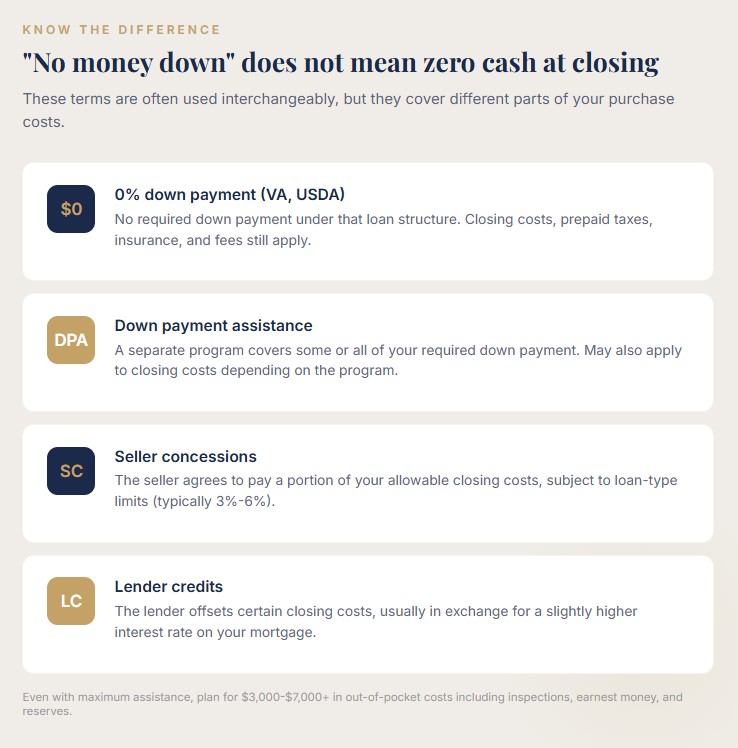
| Situation | What it actually means |
|---|---|
| 0% down payment (VA, USDA) | No required down payment under that loan structure, but closing costs and other expenses still apply |
| Down payment assistance | A separate program covers some or all of the required down payment on your loan |
| Closing cost assistance | Helps with lender fees, title charges, and other transaction costs (may or may not be included in your DPA) |
| Seller concessions | The seller agrees to pay a portion of your allowable closing costs, subject to loan-type limits |
| Lender credits | The lender offsets certain closing costs, usually in exchange for a slightly higher interest rate |
No program eliminates every cost. Even with zero down and maximum DPA, you should expect out-of-pocket expenses for items like the home inspection, earnest money deposit, appraisal, homeowner’s insurance, and potentially prepaid property taxes. Planning for $3,000 to $7,000 in cash beyond whatever DPA covers is a reasonable starting point for most Arizona purchases, though the actual figure varies by transaction.
This is one of the most common areas where buyers get confused, and it is exactly why Qualify Before You Buy emphasizes knowing your estimated cash-to-close before you start shopping. The preapproval process breaks this number down for you, so there are no surprises three days before closing.
Costs first-time buyers still need to plan for
Down payment assistance covers the down payment and sometimes closing costs. It does not cover everything. Here is what you should budget for:
- Earnest money deposit (typically 1% of purchase price, applied toward your costs at closing)
- Home inspection (usually $400 to $600 for a standard single-family home)
- Appraisal fee (typically $500 to $700)
- Closing costs beyond DPA coverage (title insurance, escrow fees, lender charges, recording fees)
- Prepaid expenses (property taxes, homeowner’s insurance, and potentially HOA dues collected at closing)
- Mortgage insurance premiums (FHA upfront premium, VA funding fee, or USDA guarantee fee)
- Moving costs
- Immediate repairs or maintenance (especially with older homes or Arizona-specific issues like HVAC systems, roof coatings, and hard-water plumbing concerns)
- Emergency reserves (lenders may require reserves, and you should have them regardless)
Arizona buyers also face some region-specific cost considerations. HOA fees are common in Phoenix-area master-planned communities and can add $100 to $300 or more per month. Property taxes vary by county and city but are generally lower than national averages. Homeowners insurance rates have been rising across the state, particularly in wildfire-adjacent areas.
How to apply for Arizona first-time buyer programs
Step 1: Determine whether you meet the first-time buyer definition
For most programs, “first-time buyer” means you have not owned a primary residence in the past three years. Some programs, like Home Plus, do not require first-time status at all. Check the specific program you are considering.
Step 2: Establish a realistic home-buying budget
Before researching programs, understand your income, debts, credit score, and available savings. A mortgage pre-approval will give you a clearer picture of what you may qualify for and what your estimated monthly payment could look like. At Qualify Before You Buy, this is the foundation of the entire process. You will know your price range, your monthly payment range, your estimated cash to close, and your interest rate options before you look at a single listing.
Step 3: Check program eligibility
Match your county, income, and credit profile against the program requirements outlined above. Remember that you can only use one DPA program per transaction.
Step 4: Review income and geographic requirements
Home Plus has a statewide income cap. Arizona Is Home uses county-level AMI limits. Home in Five applies only to Maricopa County. USDA is address-specific. Confirm your eligibility before you start shopping.
Step 5: Compare assistance structures
A forgivable second mortgage that disappears after five years is very different from a non-forgivable lien that comes due at sale or refinance. Understand the repayment terms for the specific product you select.
Step 6: Complete required homebuyer education
Every major Arizona DPA program requires at least one borrower to complete a homebuyer education course before closing. Do this early in the process rather than scrambling to finish it after your offer is accepted. Online options are available through most programs.
Step 7: Get pre-qualified or pre-approved
Understanding how long mortgage pre-approval takes and what documents you need helps you build a realistic timeline.
Step 8: Work with an approved participating lender
Home Plus, Arizona Is Home, and Home in Five all require you to use an approved participating lender. Not every mortgage company offers these programs. Qualify Before You Buy works with multiple lenders and already handles these DPA programs, which means you do not need to shop around for a lender who participates.
Step 9: Find an eligible property
The property must meet the requirements of both your loan type and the DPA program. This includes location restrictions, purchase-price limits where applicable, occupancy requirements, and property-condition standards. Once you are preapproved through Qualify Before You Buy, the buyer representation team can help you search for homes that fit both your budget and your program requirements, including negotiating seller concessions that could reduce your remaining out-of-pocket costs.
Step 10: Confirm cash-to-close before committing
Before you sign the purchase contract, your lender should be able to provide a preliminary estimate of your total cash-to-close, factoring in the DPA, any seller concessions you have negotiated, lender credits, and all remaining out-of-pocket costs.
For buyers comparing different Phoenix-area communities and neighborhoods, completing steps 1 through 4 before you start touring homes helps you avoid falling in love with a property that does not fit your financial position.
Why qualifying before you buy matters
Most first-time buyers start by browsing listings and dreaming about neighborhoods. The problem with that approach is that you end up emotionally attached to a home before you know whether you can actually afford it, which programs you qualify for, or what your real monthly payment would look like.
Qualify Before You Buy was built around a different approach. The idea is simple: eliminate the guesswork first. Know what price range you should shop within. Know your estimated monthly payment. Know your cash-to-close. Know which loan products and assistance programs fit your profile. Then go shopping.
This is especially important when DPA programs are part of the plan. Each program has its own lender requirements, income limits, credit floors, and property restrictions. If you wait until after you find a house to sort through this, you risk losing the property while scrambling to get financing in place, or worse, discovering that the program you were counting on does not apply to that property or that county.
By combining mortgage brokerage services and buyer representation under one roof, Qualify Before You Buy can align your financing and your home search from the start. You are not working with a lender who does not know what your agent is doing, or an agent who does not understand your financing constraints. The mortgage side and the real estate side communicate throughout the transaction.
Eligible buyers may also qualify for the Qualify Before You Buy home buyer savings guarantee, which is subject to the company’s current written program terms. Ask the team for details on eligibility, calculation, and how it works for your specific purchase.
Frequently asked questions
What are the best first-time home buyer programs in Arizona in 2026?
The most widely used program is Home Plus, which provides up to 4% down payment assistance statewide and does not require first-time buyer status. Maricopa County buyers should also compare Home in Five Advantage. VA and USDA loans offer zero-down financing for eligible borrowers. The best program depends on your county, income, credit score, and military status. Qualify Before You Buy can help you compare these options as part of the preapproval process.
What is the first-time home owner program in Arizona?
Arizona does not have a single program called the “first-time home owner program.” The term typically refers to the state’s down payment assistance programs, primarily Home Plus and Arizona Is Home, both administered by the Arizona IDA. Some programs require first-time buyer status while others, including Home Plus, do not.
Does Arizona offer down payment assistance?
Yes. Home Plus offers up to 4% of the loan amount statewide. Home in Five Advantage offers up to 6.5% in Maricopa County. Arizona Is Home provides 4% in eligible counties outside Maricopa and Pima. Availability, eligibility, and terms vary by program.
How much down payment assistance can first-time buyers get in Arizona?
Amounts range from 3% to 6.5% of the loan amount depending on the program, loan type, and any bonus qualifications. On a $375,000 loan, 4% assistance equals $15,000. Maximum amounts depend on the specific program’s current terms.
Do I have to be a first-time buyer to get Arizona down payment assistance?
Not always. Home Plus and Home in Five Advantage do not require first-time buyer status. Arizona Is Home and Home in Five Platinum may require it depending on the specific product variant. Check the program requirements for your situation.
What income qualifies for Arizona first-time home buyer programs?
Home Plus caps borrower income at $155,386 statewide (as of April 2026), with lower limits for certain loan products. Arizona Is Home uses county-level AMI limits, typically ranging from approximately $88,000 to $141,000 depending on household size and location. Home in Five has its own income cap. Limits change periodically.
Can FHA loans be combined with Arizona down payment assistance?
Yes. FHA loans can be paired with Home Plus, Home in Five, and Arizona Is Home. The DPA can cover the 3.5% FHA minimum down payment and potentially some closing costs. However, FHA mortgage insurance still applies, and you must use an approved participating lender for the DPA program.
Can I buy a house in Arizona with no down payment?
VA loans and USDA loans both allow zero down payment for eligible borrowers. For buyers who do not qualify for VA or USDA, down payment assistance programs may cover the required down payment on an FHA or conventional loan. However, closing costs and other expenses will still require cash, so “no down payment” does not mean “no money needed.” For a clearer picture of what you would actually need, explore no-down-payment home buying resources or start a preapproval with Qualify Before You Buy.
Can veterans buy a home in Arizona with no down payment?
Yes. VA loans allow eligible veterans and active-duty service members to purchase with no down payment and no PMI. The VA funding fee applies (2.15% for first-time use with no down payment in 2026), but veterans with a service-connected disability of 10% or higher are exempt from the fee. VA loans can also be combined with Home Plus for additional closing cost assistance.
Can USDA loans be used in Arizona?
Yes, in eligible rural areas. Most of Arizona’s land area qualifies, but the Phoenix and Tucson metro areas are excluded. Eligibility is determined address by address through the USDA’s online map. Household income limits also apply.
Does down payment assistance have to be repaid?
It depends on the program. Home Plus assistance is forgiven after 60 months. Home in Five uses forgivable structures with varying timelines. Arizona Is Home assistance for 2026 is non-forgivable and must be repaid in full at sale or refinance. Always confirm the repayment structure before you commit to a specific program.
Should I get pre-approved before applying for a first-time buyer program?
Getting pre-approved early helps you understand your budget, identify which programs you may qualify for, and confirms your credit score and income meet program requirements. Most DPA programs require you to work with a participating lender, so starting the pre-approval process with a lender who already handles these programs, like Qualify Before You Buy, can streamline the entire application.
Ready to find out what you qualify for?
Understanding your financing position before you start touring homes keeps you focused on properties that actually fit your budget. Qualify Before You Buy combines mortgage brokerage and buyer representation to help Arizona buyers eliminate the guesswork. Know your price range, your monthly payment, your estimated cash to close, and which down payment assistance programs you qualify for before you start shopping.
Start your preapproval or call (623) 203-6803 to talk with the team.