

Not exactly, and the distinction matters. An FHA loan with no down payment is not a standard product the way VA financing is. FHA is a low down payment mortgage that requires a minimum borrower investment, currently 3.5% of the adjusted value for borrowers with a credit score of 580 or higher. What eligible Arizona buyers can sometimes do is cover that 3.5% with approved down payment assistance or documented gift funds, so the money does not come out of personal savings.
That is a different thing than buying with nothing. You will almost certainly still need cash for earnest money, an inspection, and possibly the appraisal.
Does FHA offer a true zero-down mortgage?
No. FHA loans are made by approved lenders and insured by the Federal Housing Administration, which sits inside HUD. The program was built to lower the savings barrier, not remove it.
Two federal programs do allow qualified borrowers to finance the full purchase price: VA loans for eligible service members and veterans, and USDA loans in eligible rural areas. FHA sits in a different category. HUD calls the down payment the borrower’s Minimum Required Investment, and that requirement stays in place regardless of where the money originates.
Here is where people get confused. The MRI must be met, but HUD permits certain outside sources to satisfy it. That is the entire basis of the “zero down FHA loan” idea circulating online. The requirement is not waived. It is funded by someone else.
How an FHA loan with no down payment from your savings may work
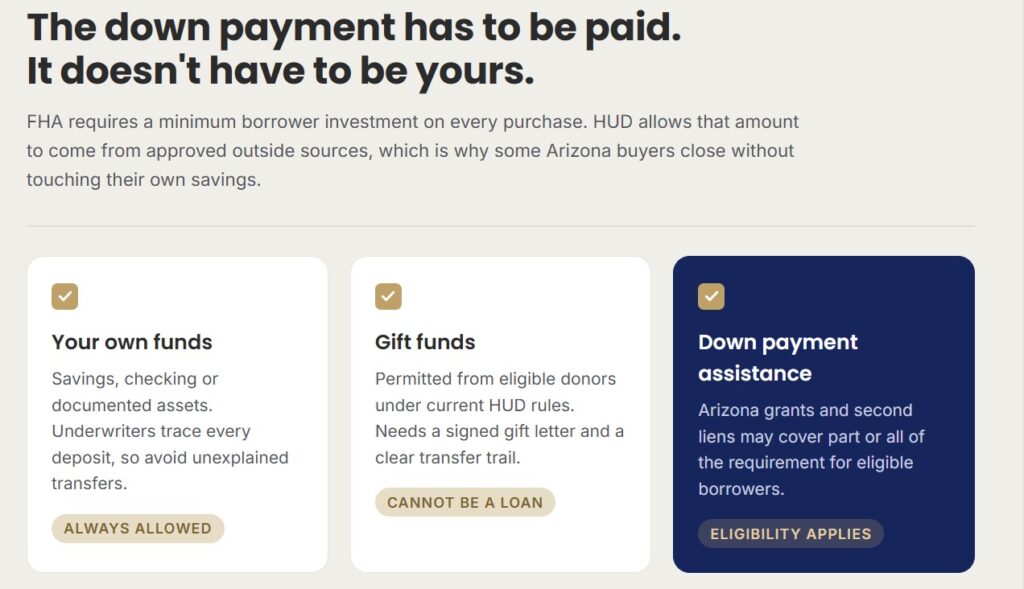
The structure is straightforward once you see it laid out:
- You qualify for FHA financing through an approved lender.
- You separately qualify for an assistance program or receive eligible gift funds.
- Those funds cover part or all of the required 3.5% investment.
- Seller concessions or lender credits may offset eligible closing costs.
- You cover whatever is left over, which is rarely zero.
Every dollar has to be documented. Underwriters trace the source, the transfer, and the eligibility of the donor or program. This is the step where deals fall apart. A buyer moves money between accounts three times before closing, or deposits cash from a family member without a paper trail, and suddenly the file needs explanations nobody can produce.
Keep your money boring during the mortgage process. One account, no unexplained deposits.
FHA down payment assistance in Arizona
Arizona has a reasonably active assistance landscape compared to many states. Programs come from the state, county and city industrial development authorities, nonprofits, and approved lender partners.
Two that Phoenix-area buyers hear about most often are the statewide Home Plus program administered by the Arizona Industrial Development Authority, and Home in Five, run through the Phoenix and Maricopa County IDAs. Assistance amounts, income limits and funding availability change, so confirm current terms with an approved lender before counting on any figure.
Assistance is usually delivered as one of these:
- A grant that is not repaid
- A forgivable second mortgage that phases out over a set period
- A deferred second lien repaid when you sell or do a cash-out refinance
- A repayable second lien with its own monthly payment
- Closing cost assistance, either alone or combined with down payment help
Programs attach their own rules on top of FHA’s: household or borrower income caps, purchase price limits, a minimum credit score that is often higher than FHA’s floor, occupancy requirements, homebuyer education, approved lender lists, and geographic boundaries. Funding can also run out mid-year.
One practical note. Most Arizona programs do not let you stack two assistance programs on the same purchase. You generally pick one. The right choice depends on your county, income, and credit profile, which is a conversation to have with a lender who actually delivers these programs rather than one who refers them out.
Can gift funds cover the FHA down payment?
Often, yes. FHA permits gift funds toward the minimum required investment when the donor qualifies under current HUD rules and the transfer is properly documented.
What lenders will want:
- A signed gift letter stating the funds are a gift with no repayment expected
- Evidence the donor had the money, such as a bank statement
- A clear trail showing the transfer from donor to borrower or directly to escrow
The critical rule: a gift cannot be a disguised loan. If there is any side agreement to pay it back, it is not a gift, and misrepresenting it on a mortgage application is fraud. Sellers, builders, agents and anyone else with a financial interest in the sale are generally not eligible donors.
Can the seller pay the FHA down payment?
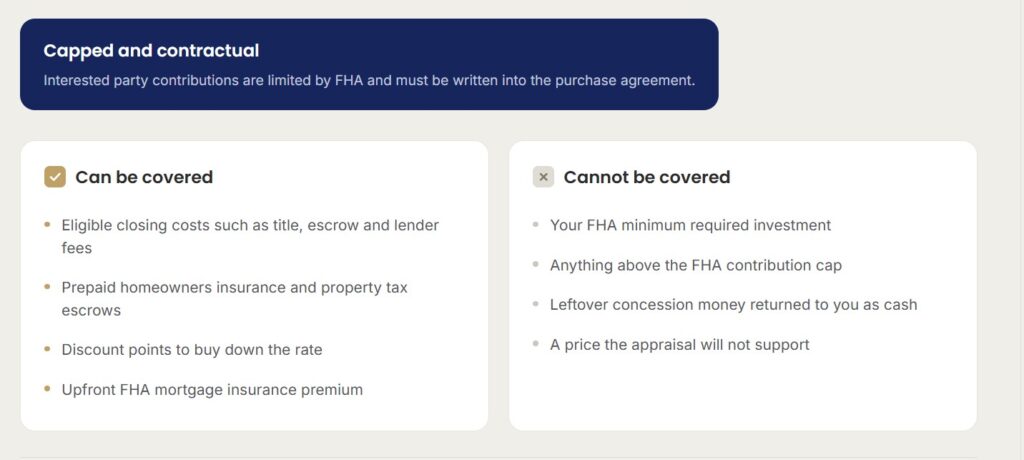
Seller concessions and other interested-party contributions can go toward eligible closing costs, prepaid expenses, and discount points. They cannot replace your minimum required investment, and FHA caps total interested party contributions at a percentage of the sales price.
A few things follow from that:
- The concession has to be written into the purchase contract
- The appraisal still has to support the agreed price
- Leftover concession money does not come back to you as cash
- Whether you get concessions at all depends on negotiation and how much competition the listing has
In slower Phoenix-area submarkets and on new construction with standing inventory, sellers and builders are frequently willing to contribute. In a multiple-offer situation on a well-priced resale, less so.
What about lender credits?
A lender credit reduces eligible closing costs, and like concessions, it cannot satisfy your down payment.
Credits are usually priced. You accept a slightly higher interest rate in exchange for money at the closing table. That can be a reasonable trade if you are short on cash today, but compare the full Loan Estimate rather than fixating on cash to close. A larger credit that costs you a quarter point for thirty years is a different decision than it looks like on closing day.
No down payment is not the same as no cash needed
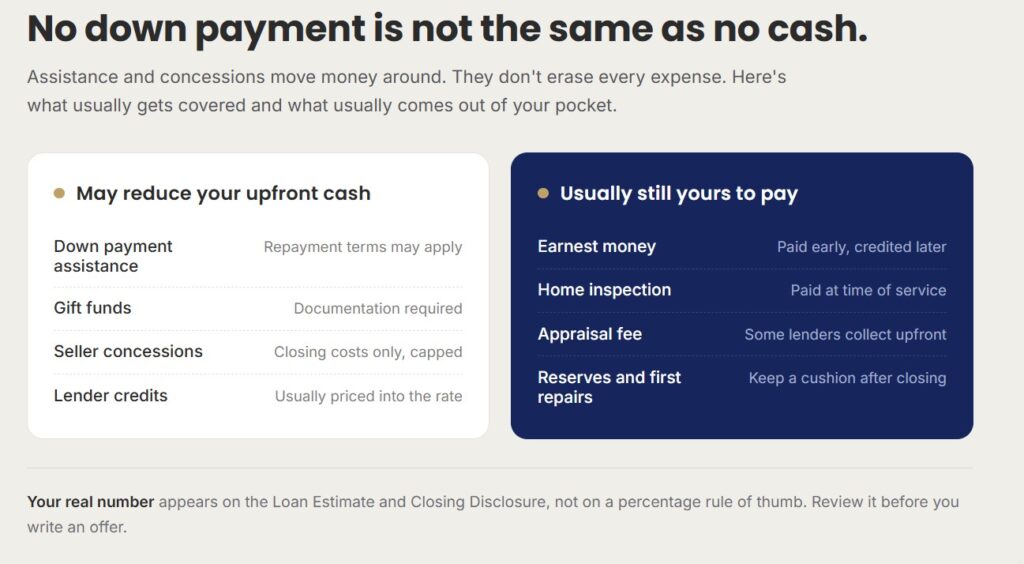
| Cost or funding source | Can it reduce upfront cash? | Important consideration |
|---|---|---|
| Down payment assistance | Yes | Eligibility and repayment rules may apply |
| Gift funds | Yes | Must meet FHA documentation rules |
| Seller concessions | Sometimes | Usually limited to eligible closing expenses |
| Lender credits | Sometimes | May affect pricing or interest rate |
| Earnest money | Not necessarily | Often paid upfront, credited later |
| Home inspection | Usually not financed | Commonly paid before closing |
| Appraisal | Sometimes collected upfront | Treatment varies by lender |
| Reserves | No | May still be required in some situations |
Earnest money is the deposit that goes to escrow when your offer is accepted. It gets credited toward your funds at closing, but you write that check early. Inspections are paid out of pocket at the time of service, and if you inspect two houses that do not work out, that money is gone. Reserves are savings the underwriter may want to see remaining after closing, depending on the file.
Other costs an Arizona FHA buyer may face
Beyond the down payment: lender origination and underwriting fees, title and escrow charges, prepaid homeowners insurance, property tax escrow deposits, upfront and annual FHA mortgage insurance, HOA transfer and disclosure fees, repairs the seller will not cover, plus moving costs and whatever the house needs in month one.
Your real number appears on the Loan Estimate and later the Closing Disclosure. Ignore percentage rules of thumb you read online. Run your own scenario through a mortgage calculator and then get an actual estimate from a lender.
Who may qualify for FHA down payment assistance?
You have to clear two separate hurdles: FHA loan eligibility and the assistance program’s own rules. Passing one does not get you the other.
Factors that come into play include credit profile, income, employment history, debt-to-income ratio, purchase price, property location, primary residence occupancy, household size, available assets, and completion of homebuyer education. Some programs restrict eligibility to first-time buyers, defined in most cases as someone who has not owned a home in the past three years. Many Arizona programs do not have that restriction at all.
No single factor decides it. A strong credit score with a debt-to-income ratio that is too high still gets declined.
Does your credit score affect the FHA down payment?
It does. Under current FHA guidance, a 580 score generally supports the 3.5% minimum, while scores between 500 and 579 typically require 10% down.
Two things buyers underestimate. First, lenders set their own overlays above FHA’s floor, so a program that theoretically allows 580 may be delivered by a lender requiring more. Second, assistance programs often set a higher credit minimum than the FHA loan underneath them, sometimes 620 or 640. You can be FHA-eligible and assistance-ineligible at the same score.
Step-by-step process
- Review your credit, income, debts and available funds honestly.
- Complete prequalification or preapproval with a lender who delivers Arizona assistance programs.
- Ask which programs are currently funded and open.
- Confirm the lender is approved for the program you want.
- Read the repayment or forgiveness terms before committing.
- Estimate total cash needed, not just the down payment.
- Complete required homebuyer education early, since it takes time.
- Search for an eligible primary residence within program price limits.
- Structure the offer and any concessions with your agent.
- Submit documentation promptly and stop moving money around.
- Get through appraisal and underwriting.
- Review your final cash to close before the closing date.
Illustrative example only
This is a hypothetical illustration, not a loan quote or an offer of assistance.
An Arizona buyer qualifies for FHA financing on a primary residence in the West Valley. An approved assistance program covers the required minimum investment. The seller agrees to contribute toward eligible closing costs within FHA limits. The buyer pays roughly $1,000 in earnest money at contract and around $500 for an inspection, both out of pocket. The earnest money is credited back at closing. After closing, the buyer still has a few thousand dollars in savings for the first repair.
Actual assistance amounts, costs, eligibility and structure vary by borrower, property, program and lender. No interest rate or monthly payment is implied here. Not every transaction can be arranged this way.
FHA with assistance vs. VA or USDA zero-down financing
FHA with assistance is open to the widest group of borrowers, requires both FHA and program eligibility, and carries mortgage insurance. The down payment comes from an approved outside source.
VA financing is limited to eligible service members, veterans and certain surviving spouses. It may allow no down payment under current program rules, with its own eligibility and underwriting requirements.
USDA financing may also allow no down payment, but household income limits and property location eligibility apply. Much of the Phoenix metro does not qualify, though some outlying Arizona areas do.
If you have VA eligibility, that is usually worth exploring first. Beyond that, the better option depends on your numbers.
Advantages and considerations
| Potential advantages | Important considerations |
|---|---|
| Reduces the savings barrier | Assistance may create a second lien |
| May allow buying sooner if otherwise prepared | Repayment may trigger on sale or refinance |
| Preserves cash for emergencies | Monthly payment may be higher |
| Combines FHA flexibility with approved funding | FHA mortgage insurance generally applies |
| May include help with closing costs | Program availability and funding can change |
| Price and property restrictions may apply | |
| You start with little equity | |
| Some expenses still require personal funds |
Assistance is a tool, not a prize. If it lets you buy a home you cannot comfortably carry, it has not helped you.
Common mistakes to avoid
- Assuming FHA is automatically a zero down loan
- Treating every assistance program as free money without reading the terms
- Missing repayment triggers buried in the second lien
- Shopping for homes before preapproval
- Relying on a blog post from three years ago for program rules
- Budgeting the down payment and forgetting closing costs entirely
- Expecting the seller to cover everything
- Making unexplained cash deposits during underwriting
- Financing furniture or opening a credit card before closing
- Changing jobs mid-process
- Leaving nothing in savings for the first repair
- Choosing a program purely because it lowers today’s cash
How mortgage preapproval helps
Preapproval turns guesswork into numbers. Working through it tells you whether FHA is even the right program for your file, what price range is realistic, what your monthly payment might look like, roughly what cash you will need at closing, and whether an assistance program is compatible with your income and credit.
It also surfaces problems while there is still time to fix them. A collection account you forgot about, a debt-to-income ratio two points too high, an income calculation that does not work the way you assumed.
Preapproval is not final loan approval and it is not a guarantee of assistance. Final approval depends on the full application, the property, the appraisal and underwriting. What it does is stop you from falling in love with a house you cannot finance. You can start the preapproval process here or get in touch with our team if you want to talk it through first.
Final answer
An FHA loan is generally not a standalone zero down mortgage. An eligible Arizona buyer may be able to use approved down payment assistance or documented gift funds so the required FHA investment does not come from personal savings, which is a meaningful difference but not the same as buying with no money.
Verify eligibility for both the loan and the program. Read the assistance terms, especially repayment triggers. Budget for closing costs and the cash you need before closing. And sort out financing before you start touring, not after.
Once you know your range, you can search Arizona homes for sale with a realistic number in mind, or look at new construction options where builder incentives sometimes help with closing costs. Buyers working with us on both the lending and representation side may also be eligible for our home buyer savings guarantee, subject to the current written program terms.
Figure out what fits your financial profile first. The house search gets a lot easier after that.
Frequently asked questions
Is there a true zero-down FHA loan?
No. FHA requires a minimum borrower investment on purchase transactions. What can happen is that an approved assistance program or eligible gift funds cover that requirement, so the money does not come from your own savings. The requirement itself is not waived.
Can Arizona down payment assistance cover the full FHA down payment?
Sometimes. Certain Arizona programs provide assistance calculated as a percentage of the loan amount, which may fully cover the FHA minimum investment for eligible borrowers. Amounts, income limits and funding availability change, so confirm current terms with an approved lender before assuming coverage.
Can gift funds cover an FHA down payment?
FHA rules permit gift funds toward the minimum investment when the donor is an eligible source under current HUD requirements and the transfer is properly documented. Expect a signed gift letter and evidence of the transfer. The funds cannot carry any repayment obligation.
Can the seller pay my FHA down payment?
No. Seller and other interested-party contributions apply to eligible closing costs, prepaids and discount points, subject to FHA limits. They cannot replace your minimum required investment, and excess contributions do not come back to you as cash.
Do I still need savings with FHA down payment assistance?
Usually, yes. Earnest money and the home inspection are typically paid before closing, and some lenders collect the appraisal fee upfront. Reserves may also be required depending on your file. Keeping a cushion after closing for repairs is a good idea regardless.
Do I have to be a first-time buyer to receive assistance?
Not always. Several Arizona programs are open to repeat buyers, while others restrict eligibility to first-time buyers, often defined as not having owned a home in the past three years. Each program sets its own definition, so check the specific guidelines rather than assuming.
This article is provided for general educational purposes and is not a loan commitment, guarantee of approval, financial advice, legal advice or tax advice. FHA guidelines, lender requirements, assistance-program availability, eligibility rules, fees and funding terms may change. Final approval depends on the borrower’s complete financial profile, documentation, property eligibility, lender underwriting and current program requirements.