

Most Arizona buyers can get a mortgage preapproval within one to three business days once the lender has their documents and permission to pull credit. Some lenders issue a preapproval letter the same day. Others take a week or more, especially when income is complicated or paperwork trickles in one file at a time.
The honest answer is that the lender’s turn time is rarely the bottleneck. Your document gathering is. A buyer who uploads everything on Monday morning usually has a letter by Tuesday. A buyer who sends two pay stubs and then disappears for a week has a five day preapproval, and it wasn’t the underwriter’s fault.
Here’s what actually happens during that window, what slows it down, and how to shorten it.
The quick version: typical mortgage preapproval timeline
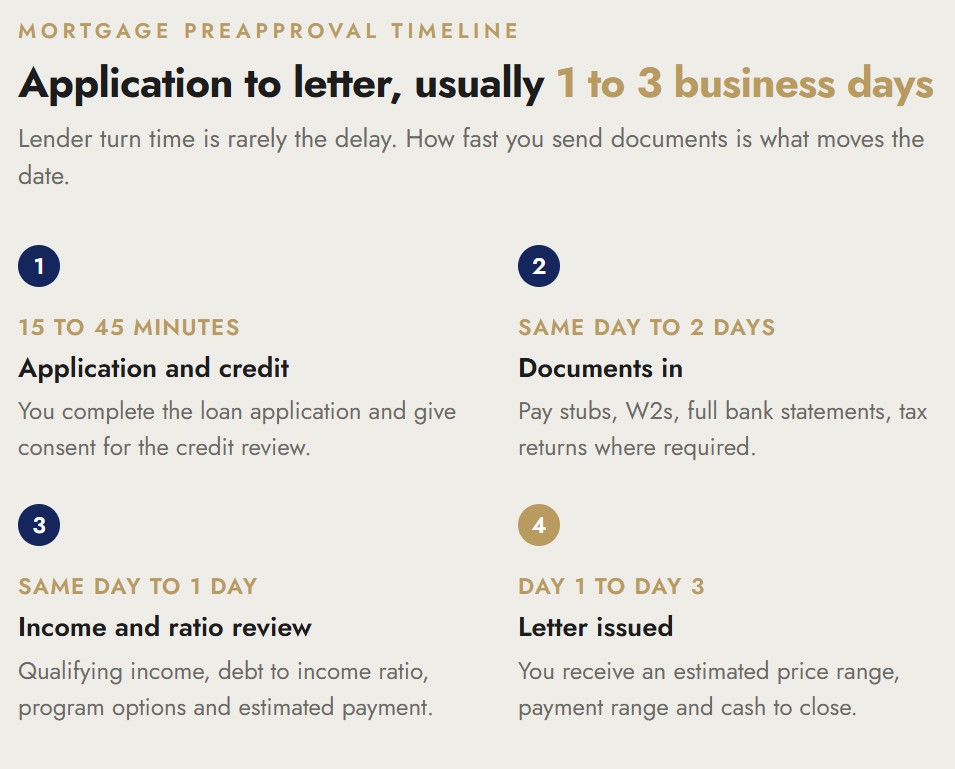
| Stage | Usual time | What’s happening |
|---|---|---|
| Application intake | 15 to 45 minutes | You complete the loan application and consent to a credit check |
| Credit pull and review | Same day | Lender reviews scores, debts, payment history, credit inquiries |
| Document collection | A few hours to several days | Pay stubs, W2s, bank statements, tax returns if needed |
| Loan officer review and pricing | Same day to 1 day | Income calculation, debt to income ratio, program options, estimated payment |
| Preapproval letter issued | 1 to 3 business days total | You receive a letter showing an estimated purchase price range |
| Underwriter reviewed preapproval | 3 to 7 business days | A live underwriter reviews the file before you shop, subject to lender availability |
These ranges reflect common lender practice and can vary by lender, loan program, and how quickly you provide information. Your own timeline may be shorter or longer.
Prequalification and preapproval are not the same thing
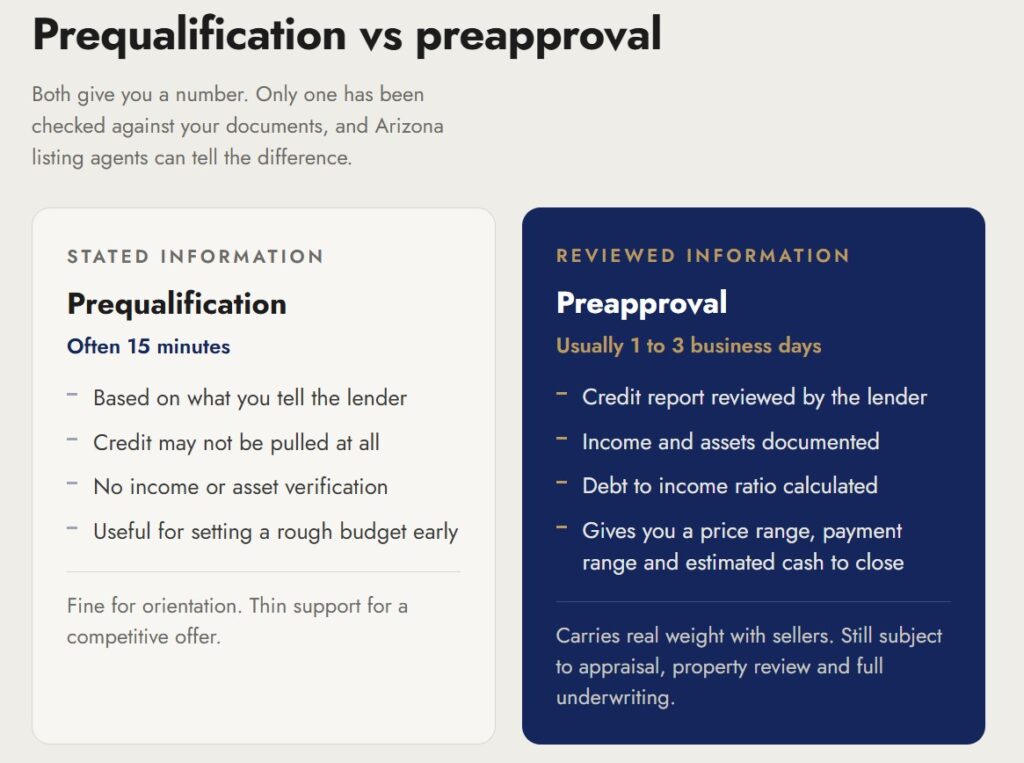
This trips up a lot of first time buyers, and the confusion has real consequences when you’re writing an offer.
Prequalification is the fast version. You share your income, debts, estimated credit, and down payment, and the lender gives you a general idea of what you may be able to borrow. It can take fifteen minutes. Some lenders do it without pulling credit at all. It’s useful for setting a rough budget, but it carries limited weight with a listing agent because nothing has been verified.
Mortgage preapproval goes further. The lender reviews your credit report, checks your documented income and assets, calculates your debt to income ratio, and issues a letter based on that review. It takes longer because someone is actually checking the numbers.
A preapproval is still not a loan commitment. Final financing depends on the property, the appraisal, title, insurance, updated financial information, and full underwriting approval. Any lender who tells you a preapproval guarantees your loan is overselling it.
Worth knowing: in a competitive Phoenix area listing, agents read preapproval letters closely. A letter from a lender who has verified income and assets carries more weight than a one paragraph prequalification printed off a website. If you’re planning to compete for a well priced home in Gilbert or Chandler, the extra two days spent getting a stronger letter is usually a better investment than the extra two days spent touring.
What makes a preapproval fast
Three things, mostly.
Complete documents on the first upload. Not most of them. All of them. Partial submissions create a back and forth loop where the lender requests one item, waits a day, reviews, then requests another.
Simple, salaried income. W2 income from one employer with a two year history is the easiest file to underwrite. The math is straightforward and the documentation is short.
Clean, recent credit. No disputed accounts, no unexplained recent inquiries, no collections that need documentation.
What slows it down
Self employment is the big one. If you own a business, hold more than 25 percent of a company, or earn significant 1099 income, expect the lender to request two years of personal and business tax returns, year to date profit and loss statements, and sometimes business bank statements. Qualifying income is calculated from net profit after expenses, not gross revenue, which frequently surprises business owners. That review takes longer, and the number is often lower than expected.
Other common delays:
- Large deposits in your bank account that need a paper trail. Lenders want to confirm the money isn’t borrowed. A gift from a family member usually requires a signed gift letter and proof of transfer.
- Income that varies. Commission, bonus, and overtime income generally needs a documented history before it can be counted.
- Recent job changes, especially between industries or from salaried to self employed work.
- Credit report items that need explanation, such as a past foreclosure, a bankruptcy discharge date, or an account listed in dispute.
- Divorce decrees, child support orders, or separation agreements that affect income and debt.
- Missing tax transcripts. The lender usually requests IRS transcripts through Form 4506-C, and processing time depends on the IRS.
- Rental property income, which requires Schedule E from your returns.
None of these disqualify you. They just add days. If any apply to you, tell your loan officer at the start instead of letting them discover it on day three.
Documents needed for mortgage preapproval
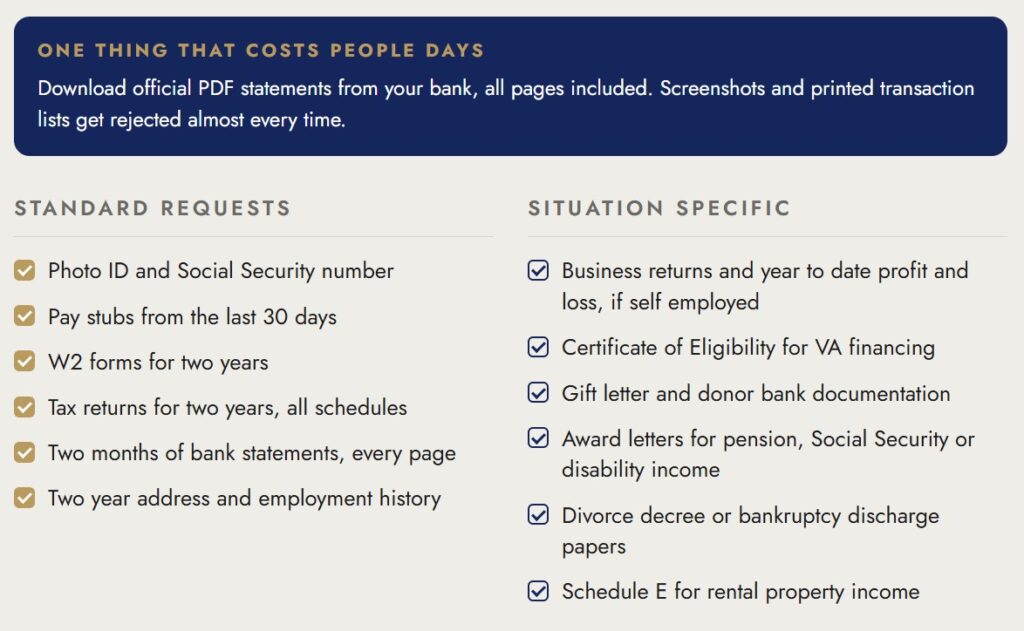
Gathering these before you apply is the single most effective way to compress the timeline. Most people can pull the whole set together in an evening.
Standard requests for salaried borrowers:
- Photo ID and Social Security number
- Pay stubs covering the most recent 30 days
- W2 forms for the last two years
- Federal tax returns for the last two years, all pages and schedules
- Bank and investment statements for the last two months, all pages including the blank ones
- Current address history for the last two years
- Landlord contact information or a mortgage statement, if applicable
Additional items depending on your situation:
- Two years of personal and business tax returns plus a year to date profit and loss statement, if self employed
- Certificate of Eligibility for VA financing. Requirements are outlined by the U.S. Department of Veterans Affairs
- Gift letter and donor bank documentation if part of your down payment is gifted
- Award letters for Social Security, pension, or disability income
- Bankruptcy discharge papers or a divorce decree, if applicable
One practical tip that saves a surprising amount of time: download bank statements as the official PDF from your bank’s website, not as a screenshot or a printed transaction list. Screenshots get rejected almost every time, and each rejection costs you a day.
Does getting preapproved hurt your credit?
A preapproval involves a hard credit inquiry, which may lower your score slightly. The effect is usually small and temporary.
Credit scoring models generally treat multiple mortgage inquiries within a short shopping window as a single event, so comparing a few lenders doesn’t stack up penalties the way it might sound. The Consumer Financial Protection Bureau explains how rate shopping windows work in more detail, and the specifics depend on which scoring model your lender uses.
What does cause problems is what people do after preapproval. Financing furniture, opening a store card, or taking out an auto loan between preapproval and closing changes your debt to income ratio and can shrink your approved amount or derail the loan entirely. Underwriters typically re-check credit shortly before closing.
How long does a preapproval letter stay valid?
Most preapproval letters are dated and expire in 60 to 90 days, though this varies by lender. Credit reports and income documents go stale, so the lender needs updated paperwork to reissue.
Renewing is far quicker than starting over. Usually it means fresh pay stubs, a current bank statement, and a new credit pull. Plan on a day or two.
Also keep in mind that the dollar amount on the letter is not fixed. Rate movement changes what a given monthly payment can buy. If rates rise after your letter is issued, your qualifying purchase price may drop even though nothing about your finances changed. Buyers shopping for more than a couple of months should check in with their lender periodically. Running scenarios through a mortgage calculator helps you see how sensitive your payment is to rate changes before it becomes a problem mid search.
Timeline differences by loan type
The preapproval process is broadly similar across programs, but a few things differ.
Conventional loans tend to move fastest for straightforward W2 borrowers. Automated underwriting systems from Fannie Mae and Freddie Mac often return a decision in minutes once data is entered.
FHA loans follow similar timing at the preapproval stage. Program requirements including minimum credit and down payment standards are published by HUD. Where FHA files sometimes take longer is later, at the property level, since appraisal standards are stricter.
VA loans may add a step if you don’t already have your Certificate of Eligibility. Many lenders can pull it electronically in minutes, but some cases require manual processing.
Jumbo loans usually take the longest. Higher loan amounts often mean more asset documentation, reserve requirements, and in some cases a second layer of review. Budget extra days.
New construction changes the calculation
Arizona buyers looking at new builds in Buckeye, Surprise, Queen Creek, or Maricopa run into a different timing question.
Builders frequently require a preapproval before they’ll write a contract, and many push their preferred lender by attaching incentives to it. You’re generally free to use your own lender, though the incentive may not follow you. Compare the total cost, not just the incentive headline.
The other issue is timing. On a home that won’t finish for six to nine months, your initial preapproval will expire before closing, and the lender will re-verify everything closer to completion. Some buyers assume the early approval carries through. It doesn’t. Keep your finances steady for the entire build period, because the file gets re-checked. If you’re weighing a build, the new construction side of the process has its own set of considerations around contracts, upgrades, and lot premiums.
Also remember that the builder’s sales representative works for the builder. Bringing your own representation at first visit matters, since many builders require your agent to be registered on that initial walk in.
Mistakes that stretch a two day process into two weeks
- Applying without documents ready and treating it as a fill in the blanks form
- Sending incomplete bank statements, which is the most common single cause of delay
- Waiting to mention self employment, a recent job change, or a past bankruptcy
- Shopping homes before knowing your estimated cash to close, then discovering the down payment and closing costs together exceed available funds
- Making a large deposit or transfer without keeping a record of where it came from
- Assuming a prequalification letter is enough for a competitive offer
- Letting a letter expire mid search and losing days on a home you wanted to bid on
How to get preapproved faster: a practical order of operations
- Pull your own credit report first and look for errors, disputes, or accounts you forgot about. Free reports are available through AnnualCreditReport.com.
- Collect the full document set in one folder before you speak to anyone.
- Have a rough monthly payment number in mind, not just a purchase price. What you qualify for and what feels comfortable are often different figures.
- Complete the application in one sitting.
- Answer follow up requests the same day. This matters more than anything else on the list.
- Ask what the letter actually represents, whether an underwriter reviewed it, and what conditions remain.
Buyers who follow this sequence commonly have a usable letter within two business days. Buyers who don’t average closer to a week.
What to do with your preapproval once you have it
The letter isn’t the finish line. It’s the thing that makes the rest of your search efficient.
With a documented price range, you can filter listings realistically instead of falling for homes $60,000 above your comfortable payment. You’ll know your estimated cash to close, which affects how much earnest money you can offer and whether you can absorb repair costs after inspection. You’ll also be positioned to move quickly when the right home appears, which in parts of the Phoenix metro still means the same week it lists.
At that point, searching Arizona homes for sale becomes a much shorter exercise, because you’re looking at homes you can actually buy.
Ready to start?
If you’d like to know your estimated price range, monthly payment, and cash to close before you tour a single property, you can start the preapproval process and get a clear picture of where you stand. Buyers who want to review financing options alongside representation questions can also reach the Qualify Before You Buy team directly to talk through next steps.
Qualify Before You Buy may offer a buyer savings or guarantee program for eligible transactions. Availability, eligibility, calculation methods, exclusions, property requirements, financing requirements, and payment terms are subject to the company’s current written program agreement. Details are on the buyer guarantee page.
Frequently asked questions
Can I get preapproved in one day?
Sometimes. If your income is salaried, your credit is clean, and you upload every document at once, some lenders issue a letter the same business day. It’s less common with self employed income, gift funds, or files needing tax transcripts.
Can I make an offer without a preapproval?
Technically yes, but most Arizona listing agents ask for a preapproval letter with the offer, and many sellers won’t consider one without it. Submitting without a letter puts you at a disadvantage against buyers who have one.
What’s the difference between a preapproval and a fully underwritten approval?
A standard preapproval reflects a loan officer’s review, often supported by automated underwriting. A fully underwritten approval means a human underwriter reviewed the complete file before you found a property. The second takes longer, typically several business days, but produces a stronger offer position. Both remain subject to property, appraisal, and final underwriting conditions.
Does a preapproval lock my interest rate?
No. Rate locks are generally tied to a specific property and executed purchase contract. Your preapproval letter uses an estimated rate for calculation purposes, and the actual rate is set later.
How long does preapproval take if I’m self employed in Arizona?
Plan on three to seven business days, sometimes longer. Two years of personal and business returns, a year to date profit and loss statement, and possibly business bank statements are usually required, and qualifying income is calculated from net profit rather than gross receipts.
Will my preapproval amount change if I change jobs?
It can. Lenders verify employment before closing, and a change in employer, pay structure, or industry may require re-review. Notify your loan officer before making a move rather than after.
How soon before house hunting should I get preapproved?
Two to four weeks ahead is a reasonable target. That leaves room to resolve credit issues, document large deposits, or address anything the lender flags, without pressure from a home you’ve already fallen for.
What if my preapproval expires while I’m still searching?
Ask your lender to reissue. Updated pay stubs, a current bank statement, and a fresh credit pull are typically enough, and it usually takes a day or two rather than restarting the full process.
This content is provided for general educational purposes and is not a loan commitment, guarantee of approval, financial advice, legal advice, or tax advice. Mortgage programs, rates, fees, eligibility requirements, property requirements, and underwriting standards may change. Final financing decisions depend on the borrower’s complete application, supporting documentation, property details, and applicable lender or program requirements. Real estate prices, inventory, taxes, HOA fees, incentives, and availability can change. Buyers should verify current information before making a purchasing decision.