

A mortgage pre approval checklist is really two lists in one. There is the paperwork your lender needs, and there is the personal prep work that decides whether that paperwork tells a good story. Most Arizona buyers only think about the first list. The second one is where deals get saved or lost.
To get preapproved in Arizona you will typically need two years of income documentation, two months of asset statements, a photo ID, your Social Security number for a credit pull, and details on any debts, judgments, or ownership interests you hold. Everything after that depends on your loan program and your situation.
Prequalification and preapproval are not interchangeable
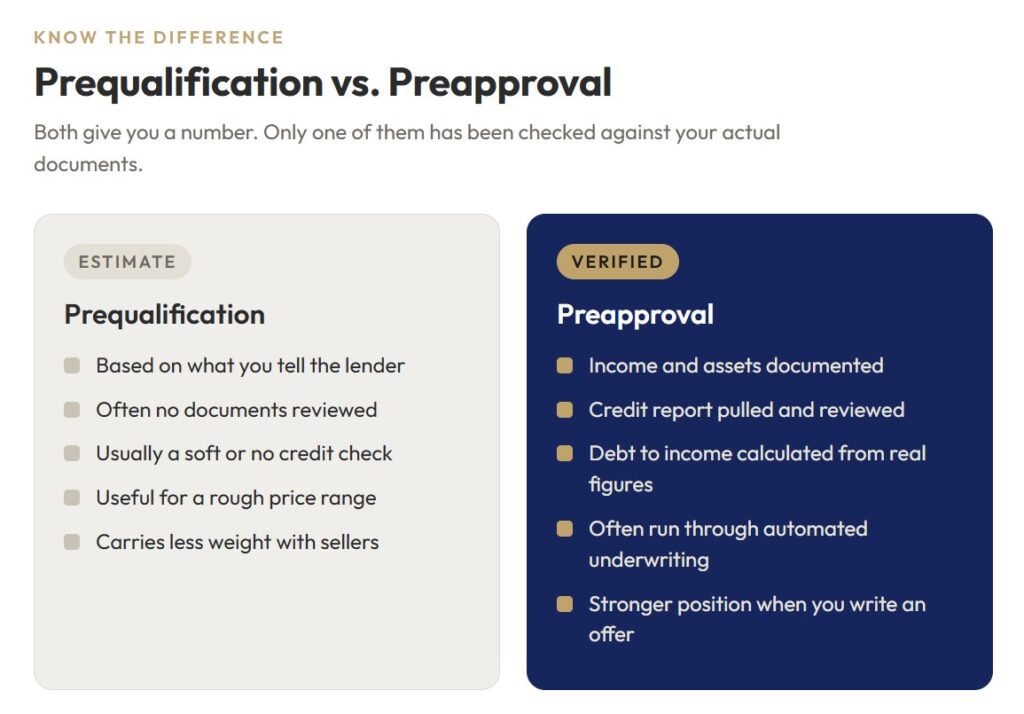
Plenty of Arizona listing agents will accept either letter. That does not mean they carry the same weight.
A prequalification is an estimate built on what you tell the lender. It is fast, useful for setting a rough price range, and easy to get wrong if you guess at your income or forget a car loan.
A preapproval involves actual verification. The lender reviews documents, pulls credit, calculates your debt to income ratio from real numbers, and often runs the file through an automated underwriting system. The letter you get back is stronger because someone checked.
Neither is a loan commitment. Final approval still depends on the property, the appraisal, title, insurance, and your financial picture staying roughly the same through closing. Any lender who tells you otherwise is overselling.
One misconception worth clearing up early: a preapproval letter does not lock your interest rate. A rate lock is a separate step, usually tied to a specific property and a specific closing timeline.
The document checklist
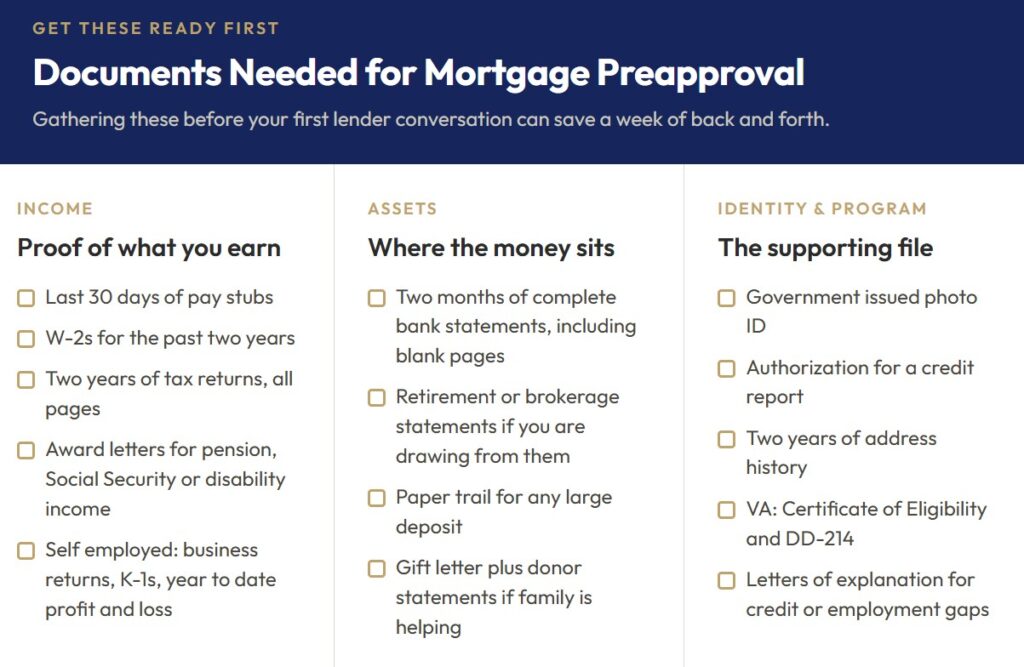
This is the core of any mortgage pre approval checklist. Gather these before your first conversation and you will save yourself a week of back and forth.
Identity and basics
- Government issued photo ID
- Social Security number and authorization for a credit report
- Address history, usually going back two years
- Landlord contact information if you rent, or the mortgage statement if you own
Income documentation
- Most recent 30 days of pay stubs
- W-2 forms for the past two years
- Federal tax returns for the past two years, all pages and all schedules
- Written explanation for any employment gap longer than about 30 days
- Award letters for Social Security, pension, disability, or annuity income
- Court order and payment history for child support or alimony you receive, if you want it counted
Self employed, 1099, or commission based? Add:
- Two years of business tax returns, including K-1s if you have ownership in a partnership or S corp
- Year to date profit and loss statement
- Business bank statements, often three to twelve months
- Business license or CPA letter confirming the business is active
Asset documentation
- Two months of complete bank statements for every account you plan to use, including the blank pages
- Recent retirement or brokerage statements if you are drawing from them
- A paper trail for any large deposit that does not match your payroll
- Gift letter and donor bank statements if a relative is helping with the down payment
That “complete statements” point matters more than it sounds. Underwriters reject screenshots and single page summaries constantly. Download the full PDF from your bank.
Program specific items
| Loan type | Additional items commonly requested |
|---|---|
| Conventional | Sometimes nothing extra. Documentation of mortgage insurance preferences if applicable |
| FHA | Explanation letters for credit issues, documentation of any prior FHA loan |
| VA | Certificate of Eligibility, DD-214 or statement of service, disability award letter if applicable |
| Jumbo | Additional reserve documentation, sometimes 6 to 12 months of housing payments in liquid assets |
Requirements shift by lender and by year. Verify current guidance directly with HUD, the VA home loan program, or Fannie Mae rather than trusting a blog post that may be a few cycles out of date.
What lenders actually calculate
Handing over documents is only half of it. Underwriters are running three numbers.
Debt to income ratio (DTI). Your monthly debt payments divided by your gross monthly income. Credit card minimums, auto loans, student loans, and the new housing payment all count. Groceries and utilities do not. Acceptable DTI varies by program and by compensating factors like reserves or credit depth.
Loan to value (LTV). The loan amount divided by the property value. Lower LTV usually means better pricing and, on conventional loans, an earlier path to dropping private mortgage insurance.
Credit profile. Not just the score. Length of history, recent inquiries, utilization, and how recently any late payment occurred. Lenders may use different scoring models than the free app on your phone, which is why the number your lender sees often differs from the one you expected. The CFPB has plain language explanations of how mortgage credit works.
If you have a credit card sitting at 80 percent of its limit, paying it down before your credit is pulled can help more than most buyers expect. Utilization moves fast. Disputing accurate negative items does not, and an active dispute on your report will stall some lenders entirely.
Arizona specific items to budget for
A national checklist will miss a few things that show up on Phoenix metro transactions.
Property taxes vary by parcel, not by city. Two homes on opposite sides of the same Peoria street can sit in different tax districts. Your lender will estimate escrow using the actual parcel once you are under contract, but for planning purposes, pull the number from the Maricopa County Assessor or Treasurer. Skip the rule of thumb.
HOA dues are common across the Valley. Master planned communities in Buckeye, Goodyear, Queen Creek, and North Phoenix frequently carry both a master association and a sub association fee. Both count in your qualifying payment. So do special assessment districts, which appear in some newer West Valley developments and can add meaningfully to the monthly cost.
Get homeowners insurance quotes earlier than you think you need to. Roof age and prior claims history on the specific property can move the premium enough to change your payment. Quote during preapproval, not the week before closing.
New construction runs on a different clock. If you are looking at a build with a six or nine month timeline, your preapproval will need updating before closing, and rate lock options for extended timelines have their own costs. Also worth remembering: the sales representative in the model home works for the builder. Bring your own representation. You can review how that works on the new construction side of the process.
Cash to close is not the same as the down payment
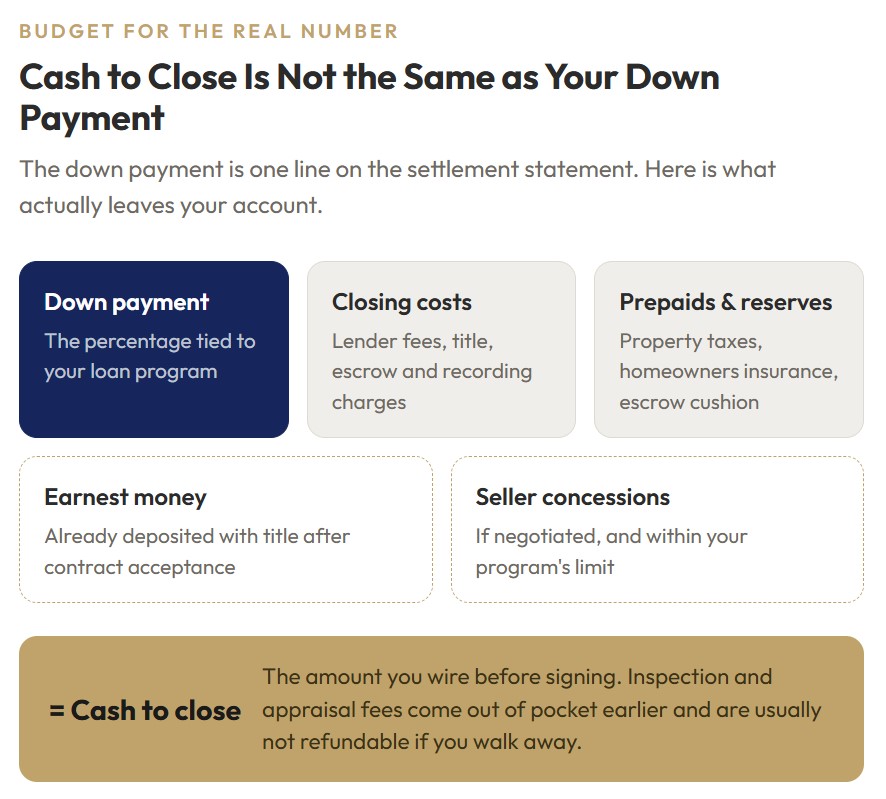
This trips up more Arizona buyers than any other single item on the checklist.
Your down payment is one line. Cash to close is the total: down payment, closing costs, prepaid taxes and insurance, escrow reserves, and lender fees, minus any earnest money already deposited and any seller concessions you negotiate.
Earnest money in Arizona is typically deposited with the title company shortly after contract acceptance. It counts toward your total, but it leaves your bank account early. Inspection and appraisal fees come out of pocket before closing and are usually not refundable if you walk away.
Seller concessions can offset part of this. Concession limits differ by loan program and by down payment size, so confirm the cap that applies to your file before you write the offer. Run a few scenarios through the mortgage calculator so the number is not a surprise.
For illustration only: on a $450,000 purchase with 5 percent down, the down payment is $22,500. Closing costs, prepaids, and reserves could add several thousand more depending on the loan program, lender fees, title charges, tax proration timing, and insurance premium. Actual figures depend on your specific transaction.
Mistakes that cost Arizona buyers their preapproval
Preapprovals fall apart between the letter and the closing table more often than people realize. Almost always for avoidable reasons.
- Buying furniture on credit. A financed sectional for the new house can push DTI past the limit. Wait until after funding.
- Changing jobs mid transaction. Not automatically disqualifying, but a switch from salaried to commission or 1099 usually restarts the income documentation clock.
- Moving money between accounts without a trail. Underwriters will ask about every unsourced deposit. Consolidate your down payment funds into one account at least two months before you apply.
- Applying for a car loan. Even the inquiry gets noticed. Most lenders re-pull credit before closing.
- Assuming the letter never expires. Credit reports and income documents age out, typically within 60 to 120 days depending on the lender.
- Shopping above the letter amount. Touring homes $75,000 above your range is how buyers end up attached to something that will not qualify.
A realistic timeline
For a straightforward W-2 borrower with organized documents, a preapproval can often be completed within a few business days. Self employed files, borrowers with recent credit events, and situations involving gift funds or non traditional income usually take longer.
The bottleneck is almost never the lender. It is waiting on a tax transcript, a missing statement page, or a gift donor who is traveling.
Start the paperwork before you fall in love with a listing. Once you have a letter in hand, you can browse Arizona homes for sale inside a range that reflects what you can actually finance.
When to bring in professional help
Talk to a licensed mortgage professional early if any of these apply:
- You are self employed or your income includes bonus, overtime, or commission
- You have a bankruptcy, foreclosure, or short sale in the past seven years
- You are relocating to Arizona and starting a new job
- You are buying before selling your current home
- You are VA eligible and unsure how entitlement restoration works
- Your credit report contains errors you have not resolved
A tax adviser is worth a call if you write off significant business expenses, since deductions that lower your taxable income also lower your qualifying income. An insurance agent should be involved before you finalize your budget, not after.
Your next step
Working through a mortgage pre approval checklist is not paperwork for its own sake. It tells you what you can actually spend, what the monthly payment looks like with taxes and HOA included, and how much cash you need on closing day. Buyers who handle this first waste less time and negotiate from a stronger position.
Qualify Before You Buy handles both the lending side and the buyer representation side, which means the price range you get and the homes you tour are working from the same numbers. You can start a preapproval review, look at the terms of the buyer savings guarantee, or reach out with questions before committing to anything.
Frequently asked questions
Does getting preapproved hurt my credit score?
A preapproval usually involves a hard credit inquiry, which may lower your score by a small amount temporarily. Scoring models generally treat multiple mortgage inquiries within a short shopping window as a single event, so comparing lenders within roughly 14 to 45 days typically does not compound the impact. The exact window differs by scoring model.
How long does an Arizona mortgage preapproval last?
Most preapproval letters are valid for 60 to 90 days, though lenders use different windows. The letter expires because the credit report and income documents behind it age out. Renewing usually means updated pay stubs, fresh bank statements, and a new credit pull.
Can I make an offer on an Arizona home without a preapproval letter?
You can, but many sellers and listing agents in the Phoenix metro will not seriously consider an offer without one. When there are competing offers, a missing letter is often the easiest reason to set a contract aside.
What if my credit score is below 620?
Some loan programs allow lower scores, though options narrow and lender overlays may apply. Score alone does not decide approval. Income, debt, reserves, payment history, and the property all factor in. A lender review can tell you whether you are close or whether a few months of preparation would open up better terms.
I am self employed. Will preapproval take longer?
Usually yes. Expect business returns, K-1s, a year to date profit and loss statement, and business bank statements. Qualifying income for self employed borrowers is generally calculated from net income after deductions rather than gross revenue, which surprises a lot of business owners.
Can I use gift funds for my down payment in Arizona?
Many loan programs allow gift funds from an eligible donor, typically a family member. You will need a signed gift letter stating the money does not need to be repaid, plus documentation showing the transfer. Rules on who can gift and how much vary by program.
Does a preapproval mean my loan is approved?
No. A preapproval reflects a review of your financial documents at a point in time. Final approval still depends on the property, appraisal, title, insurance, underwriting conditions, and your circumstances staying consistent through closing.
What if I am buying new construction with a long build timeline?
Your preapproval will almost certainly need updating before closing since documents expire. Extended rate lock options exist but usually carry a cost. Discuss the build timeline with your lender before you sign the builder contract.
This content is provided for general educational purposes and is not a loan commitment, guarantee of approval, financial advice, legal advice, or tax advice. Mortgage programs, rates, fees, eligibility requirements, property requirements, and underwriting standards may change. Final financing decisions depend on the borrower’s complete application, supporting documentation, property details, and applicable lender or program requirements.
Real estate prices, inventory, taxes, HOA fees, incentives, and availability can change. Buyers should verify current information before making a purchasing decision. Buyer savings guarantee availability, eligibility, calculation methods, exclusions, and payment terms are subject to the company’s current written program agreement.