

A 620 credit score does not automatically disqualify you from a VA home loan, but it also does not guarantee approval. The distinction that trips up most borrowers is this: the VA itself does not publish a minimum credit score requirement for VA-backed purchase loans. Individual lenders, however, set their own credit score floors, and 620 happens to be the most common benchmark you will encounter across the industry in 2026.
That one distinction matters more than most articles on this topic bother to explain. What the VA requires and what a particular lender requires are two different things, and confusing them can lead you to either assume you cannot qualify when you can or assume approval is certain when it is not.
This article breaks down exactly how a 620 score fits into the VA loan process, what lenders actually evaluate, and what you can do to put yourself in the strongest position before applying.
Can you get a VA home loan with a 620 credit score?
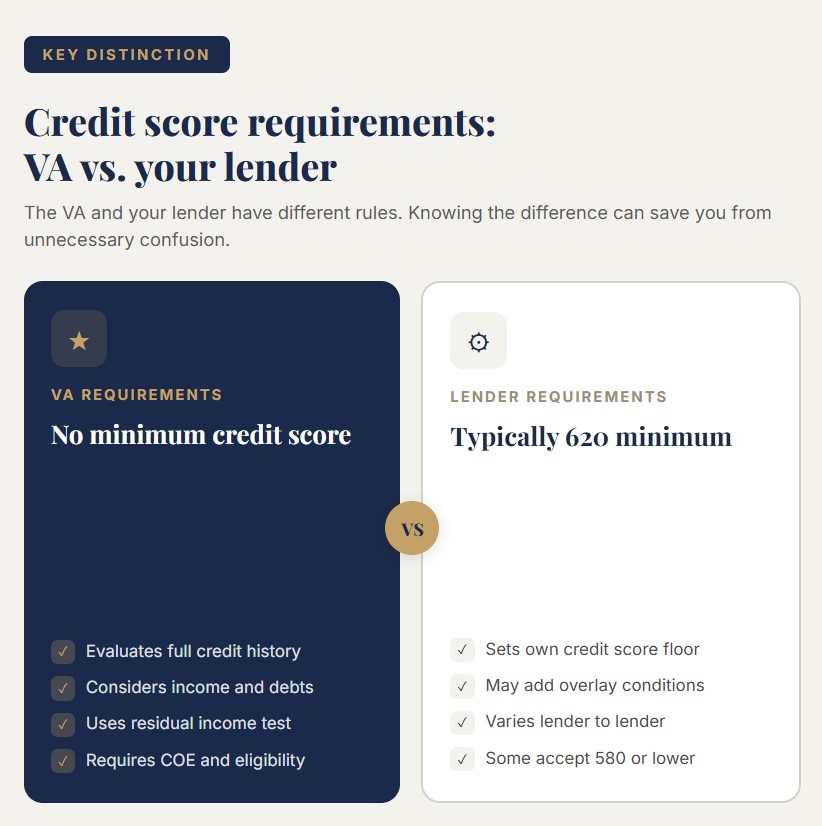
Yes, a 620 credit score can be sufficient to qualify with many VA lenders. But 620 is not an official VA requirement. The Department of Veterans Affairs does not set a universal minimum credit score for VA-backed home loans. Instead, each lender creates its own underwriting standards, and most use 620 as a floor for VA purchase loans. Some lenders accept scores as low as 580, while others may want 640 or higher. A 620 score may get you through the door, but the lender still evaluates your entire financial profile, including income, debts, credit history, assets, and residual income. You also need to be VA-eligible and hold a valid Certificate of Eligibility. A score alone does not determine approval.
Does the VA require a 620 credit score?
No. The VA does not require a 620 credit score, a 700 credit score, or any specific number. VA underwriting guidelines, outlined in VA Pamphlet 26-7, instruct lenders to evaluate the borrower’s overall creditworthiness rather than rely on a single score. The program was designed to consider the full financial picture: payment history, income stability, debts, assets, and residual income.
So where does 620 come from?
Private lenders fund VA loans, not the VA. Because most lenders sell those loans on the secondary mortgage market after closing, they need the loans to meet certain investor standards. A 620 FICO score has emerged as the threshold that satisfies most investors and most lenders’ internal risk models. It is a lender overlay, which is an additional requirement a lender places on top of the VA’s own guidelines.
Not every lender uses 620 as its floor. Some lenders work with borrowers in the 580 range, particularly when the rest of the application is strong. Others set their minimum at 640. The only way to know where a particular lender draws the line is to ask.
This is why shopping among VA lenders matters more than borrowers typically realize. A denial from one lender at 620 does not mean every lender will deny you. A different lender with different overlays and a different appetite for risk may say yes to the same file.
What credit score do you need for a VA home loan?
Because the VA does not publish a minimum, what you “need” depends entirely on the lender you choose. Here is a general look at how different score ranges tend to play out with VA lenders in 2026:
| Credit score range | General lender considerations |
|---|---|
| 760 and above | Typically qualifies with most lenders. May receive more competitive interest rate offers. Fewer underwriting conditions. |
| 700 to 759 | Comfortably within range for the majority of VA lenders. Rates and terms are generally favorable. |
| 660 to 699 | Still within range for most lenders. Some may apply slightly higher rates. Full financial profile review still matters. |
| 620 to 659 | Meets the minimum for many VA lenders. Underwriting will weigh credit history, DTI, and residual income more heavily. Rates may reflect added risk. |
| Below 620 | Fewer lenders available. Some lenders accept scores in the 580 range. Manual underwriting may be required. Compensating factors such as low debt, strong income, or significant reserves become critical. |
One thing to keep in mind: a credit score is a snapshot. Two borrowers with a 620 can have very different credit histories. One might have thin credit with limited accounts but no missed payments. Another might have a recent collection or a string of late payments followed by a recovery. Lenders look at the story behind the number.
Can you get a VA loan with a 620 credit score?
You can. Many VA loans close at the 620 level every month. But qualifying with a 620 looks different than qualifying with a 740.
At 620, the rest of your application carries more weight. A lender is not going to overlook high debt ratios or spotty recent payment history just because you meet the minimum score threshold. The score gets you considered. Your income, debts, employment history, assets, and the property itself determine whether the loan actually closes.
Think of 620 as clearing the first filter, not passing the final exam.
A few practical realities at this score level:
- Your interest rate will likely be higher than what a borrower at 720 receives
- Underwriters will pay closer attention to any negative items in your credit history from the past 12 to 24 months
- Your debt-to-income ratio and residual income carry even more importance
- Some lenders may require additional compensating factors, such as cash reserves
None of this means you should not apply. It means you should go in prepared and realistic about the process.
What else does a VA lender look at besides your credit score?
Credit history
Your credit report tells a longer story than the three-digit score. Lenders look at how many accounts you have, how long you have had them, whether you have made payments on time, and what types of credit you carry. A 620 score with 12 months of clean payments looks much better than a 620 score with a collection account from six months ago.
The VA specifically asks lenders to evaluate whether a borrower’s credit history shows a willingness and ability to repay. Recent late payments, charge-offs, or judgments raise red flags that a score alone does not capture.
Debt-to-income ratio
Your DTI compares your total monthly debt payments to your gross monthly income. VA guidelines use 41% as a general benchmark for the back-end ratio, meaning total monthly obligations including the proposed mortgage payment. This is not a hard ceiling. Plenty of VA loans close above 41% DTI when the borrower has strong residual income or other compensating factors.
But at a 620 credit score, a high DTI gives the underwriter less margin for comfort. Keeping your DTI as low as practical before applying strengthens your file.
Income and employment
Lenders typically want to see stable, reliable income that is likely to continue for at least three years. A consistent two-year employment history in the same field is the standard comfort zone. Active duty pay, BAH, BAS, disability compensation, and retirement income all generally count.
If you are self-employed, expect to provide two years of tax returns and a year-to-date profit-and-loss statement. Income verification is more involved, but self-employed veterans qualify for VA loans every day.
Assets and reserves
Cash in the bank helps. Lenders want to see that you can cover closing costs and, ideally, have some reserves left over after closing. Reserves are not required for every VA loan, but they serve as a compensating factor, especially at lower credit scores. Even two or three months of mortgage payments in savings can make a difference.
Residual income
This is the VA-specific test that separates VA underwriting from conventional lending. Residual income measures the cash you have left each month after taxes, the mortgage payment, all debts, and a regional maintenance estimate are subtracted from your gross income. The VA sets minimum thresholds based on your geographic region and household size.
Residual income is often the real approval gate on a VA loan. Even if your DTI is under 41%, falling short on residual income can stall the file. The flip side is also true: a borrower at 45% DTI with strong residual income has a legitimate path to approval because the numbers prove there is real money left over every month.
If your DTI exceeds 41%, many lenders want your residual income to be at least 20% above the VA’s standard table. That extra cushion acts as a compensating factor.
Occupancy
VA loans are intended for primary residences. You generally need to move into the property within about 60 days of closing. This is not a second-home or investment-property loan. Active duty service members with PCS orders have some flexibility, but the occupancy requirement applies to most VA borrowers.
Property requirements
The property must meet VA minimum property requirements, which are assessed during the VA appraisal. The appraisal confirms market value and identifies health or safety concerns. If the home fails to meet MPRs, the seller may need to make repairs before the loan can close.
Does a VA loan require a down payment?
One of the strongest features of VA financing is that it often allows qualified borrowers to purchase with no down payment, as long as the sales price does not exceed the appraised value of the home. This single benefit puts homeownership within reach for veterans and service members who might otherwise need years to save for a conventional down payment.
That said, “no down payment” does not mean every VA purchase happens at zero down. A down payment may come into play when the purchase price exceeds the appraised value, when the borrower wants to reduce the VA funding fee, or when a lender’s overlays require a small down payment at certain credit score levels.
If you are exploring no-down-payment home buying resources, understand that zero down still comes with closing costs. The down payment and closing costs are separate categories, and mixing them up is one of the most common planning mistakes VA buyers make.
Does a VA loan require PMI?
No. VA loans do not require private mortgage insurance. On a conventional loan, if you put less than 20% down, you are typically paying PMI, which adds a monthly premium to your housing costs. VA loans eliminate that expense entirely, regardless of how much or little you put down.
This is a meaningful cost difference. PMI on a conventional loan can run anywhere from $100 to $300 or more per month depending on the loan amount and credit profile. Over the life of a loan, skipping PMI can save tens of thousands of dollars.
The VA does charge a funding fee, which sometimes gets confused with mortgage insurance. They are not the same thing, and the funding fee structure works differently.
What is the VA funding fee?
The VA funding fee is a one-time charge applied to most VA-backed home loans. It helps sustain the VA loan program without relying on taxpayer funding, which is part of why the program can offer zero-down, no-PMI financing.
For 2026, the fee ranges from 0.5% to 3.3% of the loan amount. The exact percentage depends on three factors: whether you are using the VA benefit for the first time or a subsequent time, whether you are making a down payment, and the type of VA loan.
For a first-time VA purchase loan with no down payment, the funding fee is 2.15%. On a $350,000 loan, that comes to $7,525. Subsequent use with no down payment increases the fee to 3.3%. Putting 5% or more down drops the fee to 1.5% for both first-time and subsequent use, and 10% or more down reduces it further to 1.25%.
Veterans with a service-connected disability rating of 10% or higher are generally exempt from the funding fee entirely. Surviving spouses receiving Dependency and Indemnity Compensation and Purple Heart recipients may also qualify for an exemption. If you are eligible for an exemption, confirm it with your lender before closing.
You can pay the funding fee at closing or finance it into the loan amount. Financing raises your monthly payment slightly, but most borrowers choose this route to keep cash available for other needs.
Can you get a VA loan with a 620 credit score and no down payment?
This is one of the most common questions, and the short answer is yes, it is possible. A VA-eligible borrower with a 620 credit score can potentially use the zero-down feature if the lender’s overlays allow it and the rest of the financial profile supports approval.
But “no down payment” and “no money needed at closing” are not the same thing. Even with zero down, you should expect closing costs. On a VA loan, closing costs typically fall in the 2% to 5% range of the loan amount. On a $350,000 purchase, that could mean $7,000 to $17,500, including the funding fee.
Some of those costs can be covered through seller concessions. The VA allows sellers to contribute up to 4% of the purchase price toward the buyer’s concessions, which can include the funding fee. In a balanced market, negotiating seller-paid closing cost contributions is realistic, though not guaranteed.
Before you start looking at homes in Phoenix or anywhere else in Arizona, run the numbers on your actual cash-to-close scenario, not just the down payment.
What if your credit score is below 620?
Being below 620 does not automatically shut the door on a VA loan. The VA has no rule that says a borrower below 620 is ineligible. But the lender landscape narrows considerably.
Most major VA lenders set their floor at 620. If you are at 600, 590, or even lower, you will need to find a lender that accepts scores in that range. They exist, but they are less common. Some specialty VA lenders work with borrowers down to 580, and a few go lower with manual underwriting.
Manual underwriting means a human underwriter reviews the file rather than running it through an automated system. It is a more thorough review, and the underwriter will look closely at your recent payment history, residual income, DTI, and any explanations for past credit issues. Clean payment history over the past 12 months and strong residual income become critical at this level.
If your score is below 580, approval becomes significantly harder. At that point, spending several months working on credit improvement before applying is generally the more practical path.
How to improve your chances of getting a VA loan with a 620 credit score
A 620 score puts you at or near the minimum for many lenders, so anything you can do to strengthen the rest of your application matters.
- Pull your credit reports from all three bureaus. Look for errors, outdated accounts, or balances that should show as paid. Dispute anything inaccurate through the bureau directly.
- Make every payment on time for the next several months. Recent payment history carries heavy weight in VA underwriting. Even one 30-day late payment in the past year raises questions.
- Reduce revolving debt. Credit utilization, the percentage of your credit limits you are using, has a significant impact on your score. Paying down credit card balances below 30% of the limit can move your score noticeably.
- Avoid opening new credit accounts before applying. New inquiries and new accounts can temporarily lower your score and add to your debt obligations.
- Document your income and employment thoroughly. Gather pay stubs, W-2s, tax returns, and bank statements before you talk to a lender. Having documentation ready speeds up the process and signals that you are organized.
- Avoid large deposits or withdrawals you cannot explain. Lenders scrutinize bank statements. Unexplained large deposits trigger additional questions and can slow underwriting.
- Confirm your VA eligibility and obtain your Certificate of Eligibility. You can request your COE through the VA’s eBenefits portal, through your lender, or by mail. Do this early so it does not become a bottleneck.
- Compare at least three VA lenders. Rates, fees, and credit score requirements vary. A lender that works well with 620-score borrowers is a better fit than one whose sweet spot is 720 and above.
- Ask each lender specifically about their minimum credit score and any additional overlays. Not all lenders volunteer this information upfront.
- Get pre-approved before you start shopping for homes. Pre-approval gives you a realistic price range and shows sellers that a lender has already reviewed your financials. For a walkthrough of how long mortgage pre-approval takes, plan for a few days to a couple of weeks depending on the lender and the complexity of your file.
How to apply for a VA home loan with a 620 credit score
Step 1: Confirm VA eligibility
VA loan eligibility is based on your military service. Active duty, veterans, certain National Guard and Reserve members, and some surviving spouses may qualify. Check your eligibility status through the VA or through a lender who handles VA loans regularly.
Step 2: Obtain your Certificate of Eligibility
Your COE verifies that you meet the service requirements for the VA loan program. Most VA lenders can pull this electronically in minutes once they have your authorization and service information.
Step 3: Review your credit profile
Pull your credit reports. Know your score, your outstanding debts, and whether anything needs to be corrected before a lender reviews it. Surprises during underwriting delay closings and sometimes kill deals.
Step 4: Calculate your debts and monthly obligations
Add up all monthly debt payments: car loans, student loans, credit cards, personal loans, child support, and anything else that shows up on your credit report. Your DTI ratio will be calculated against these obligations.
Step 5: Gather income and asset documentation
Lenders typically request recent pay stubs (30 days), W-2s or 1099s (two years), federal tax returns (two years), and bank statements (two months). Self-employed borrowers need additional documentation.
Step 6: Compare VA lenders
Rates, lender fees, and underwriting overlays differ from one VA lender to the next. Get quotes from at least two or three. Do not assume the first lender you talk to offers the best terms.
Step 7: Ask about the lender’s minimum credit score
Be direct. Ask whether 620 meets their minimum and whether they have any additional requirements at that score level, such as maximum DTI limits or reserve requirements.
Step 8: Get pre-approved
Pre-approval involves a credit pull, income verification, and preliminary underwriting review. It results in a letter stating the loan amount you may qualify for, which you can present with an offer. Understanding why pre-qualification matters in Arizona can help you appreciate why sellers take prepared buyers more seriously.
Step 9: Find an eligible property
Work with a buyer’s agent to find a home that fits your budget and meets VA minimum property requirements. If you are considering new construction, make sure you understand builder contracts and how they interact with VA financing timelines.
Step 10: Complete the appraisal and underwriting
Once you are under contract, the lender orders a VA appraisal. The appraiser evaluates market value and confirms the property meets VA standards. Simultaneously, the underwriter reviews your full application. This phase is where additional documentation requests often surface.
Step 11: Review closing documents
Before your closing date, you will receive a Closing Disclosure outlining the final loan terms, interest rate, monthly payment, closing costs, and funding fee. Review every line. Discrepancies are easier to resolve before you sit down at the closing table.
Step 12: Close
Sign the documents, fund the loan, and pick up your keys. On a VA purchase, the closing process typically takes 30 to 45 days from the date you go under contract.
VA loan vs. FHA loan with a 620 credit score
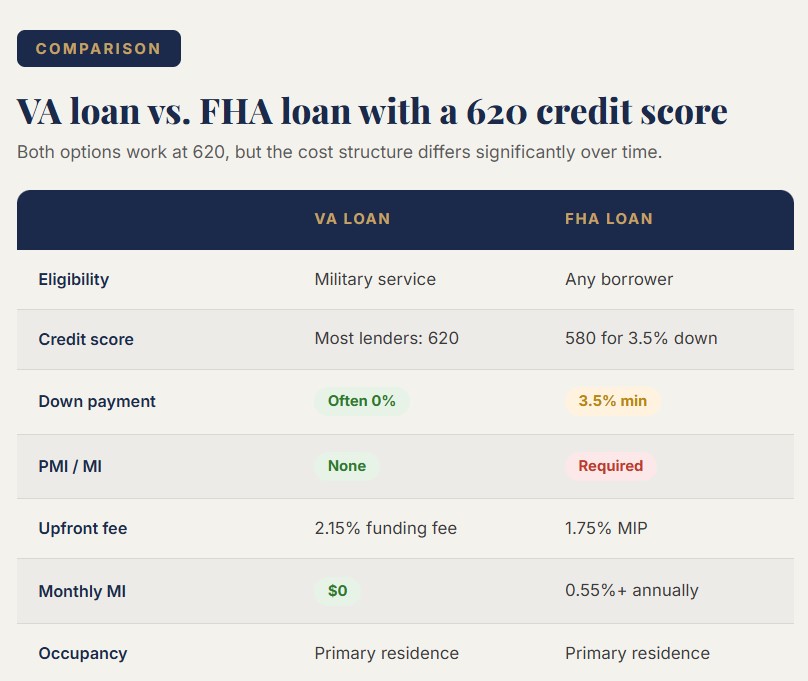
If you are VA-eligible and also considering FHA financing, this comparison may help clarify the tradeoffs:
| Feature | VA loan | FHA loan |
|---|---|---|
| Eligibility requirement | Military service or qualifying surviving spouse status | Open to any eligible borrower |
| Minimum credit score (typical lender) | No VA minimum; most lenders require 620 | 580 for 3.5% down; some lenders require 620 |
| Down payment | Often 0% | 3.5% minimum at 580+ |
| Private mortgage insurance | None | Required (upfront premium of 1.75% plus annual premiums for the life of the loan in most cases) |
| Funding fee | 0.5% to 3.3% depending on usage and down payment | None (replaced by MIP) |
| Primary residence | Required | Required |
| Standout advantage | No down payment and no PMI combined | Accessible to non-military borrowers with lower scores |
| Main limitation | Restricted to VA-eligible borrowers | Ongoing mortgage insurance adds to monthly costs |
Neither program is universally better. For VA-eligible borrowers, the VA loan typically costs less over time because you avoid monthly mortgage insurance. But if your credit score is below what VA lenders will accept and an FHA lender will work with you, FHA becomes the more practical option for right now.
Common mistakes when applying for a VA loan with a 620 credit score
Treating 620 as an official VA requirement. It is not. This is a lender-set threshold, and it varies. If one lender turns you down, another may not.
Assuming a 620 score means automatic approval. The score is one factor. Lenders evaluate your entire application. A 620 with high debt and inconsistent employment history faces a harder path than a 620 with stable income and low obligations.
Ignoring credit history in favor of the score. The number matters, but the narrative behind it matters just as much. A recent foreclosure or several late payments carry different weight than older, resolved issues.
Applying with only one lender. VA lenders are not interchangeable. Rates, fees, and willingness to work at lower credit levels differ considerably. One quote is not enough information.
Assuming no down payment means zero cash at closing. Closing costs, prepaid expenses, and the funding fee all require cash or a negotiated seller contribution. Plan for 2% to 5% of the loan amount in total closing costs.
Forgetting about the funding fee. First-time VA buyers with no down payment pay 2.15% of the loan amount. On a $350,000 purchase, that adds $7,525. You can finance it, but it still exists.
Making major financial changes during underwriting. Changing jobs, opening new credit accounts, cosigning a loan, or making large unexplained deposits can derail an otherwise approvable file. Keep your financial life stable from application through closing.
Shopping for homes before understanding your numbers. It is tempting to browse listings first, but looking at houses before you know your price range, estimated payment, and cash-to-close creates false expectations. Start with pre-approval.
Is a 620 credit score good enough for a VA home loan?
It depends on who is lending and what the rest of your file looks like.
A 620 meets the minimum requirement at many VA lenders. In that narrow sense, yes, it can be enough to get started. But “good enough to apply” and “good enough to close comfortably” are different conversations.
At 620, your interest rate will generally be higher than what borrowers at 700+ receive. Higher rates translate directly into higher monthly payments and more interest paid over the life of the loan. On a $350,000 loan, even a half-percentage-point difference in rate can mean tens of thousands of dollars over 30 years.
If you can improve your score by 20 or 40 points before applying, the financial benefit over the life of the loan may be substantial. But if waiting is not practical, such as when you are relocating for duty or your lease is ending, applying at 620 with a strong overall file is a reasonable path.
The honest assessment: a 620 score gives you access to the VA loan program through many lenders. Your income, debts, credit history, residual income, and assets determine whether access turns into an actual approval and a monthly payment you can comfortably manage.
Using a VA loan to buy a home in Arizona
Arizona has consistently attracted veteran and military buyers, partly due to its proximity to military installations and partly due to its range of housing options across different price points. If you are using a VA loan to buy in Arizona, a few state-specific considerations apply.
Property taxes. Arizona property tax rates vary by county and municipality. Maricopa County, which covers the Phoenix metro area, generally has effective property tax rates that are moderate compared to national averages, but your specific rate depends on the assessed value and local taxing districts. Always verify the actual tax amount for a specific property rather than relying on averages.
Homeowners insurance. Arizona does not face hurricane or flood risk in most areas, which can keep insurance costs lower than coastal states. However, if you are buying near a wash or in a flood-designated zone, flood insurance may apply. Your lender will require hazard insurance regardless.
HOA fees. Many Arizona communities, particularly newer developments and master-planned communities in the Phoenix suburbs, carry HOA fees. These can range from under $100 to several hundred dollars per month depending on amenities. HOA fees count toward your DTI calculation, so factor them in before you start looking.
VA appraisal. Arizona’s housing market has seen price fluctuation over the past few years. A VA appraisal protects you from overpaying, but it can also create a gap between the contract price and the appraised value. If the appraisal comes in low, you may need to renegotiate with the seller, cover the difference out of pocket, or walk away.
Market timing. The Phoenix metro area remains one of the more active housing markets in the West. Understanding your budget and getting pre-approved before you tour properties helps you move quickly when you find the right home. Sellers in competitive markets tend to give more weight to offers backed by a mortgage pre-approval.
Ready to explore your VA loan options in Arizona?
Knowing your credit score is a starting point, not the finish line. Before you start touring homes, take the time to understand your VA eligibility, your estimated price range, your monthly payment comfort zone, and how much cash you may need at closing. That preparation turns house hunting from guesswork into a focused search.
Qualify Before You Buy helps Arizona buyers connect the financing side and the property side of the home-buying process. If you are a veteran or service member with questions about VA financing, mortgage pre-approval, or buying a home in the Phoenix metro area, reach out to start a conversation about your next steps.
Frequently asked questions
Can you get a VA home loan with a 620 credit score?
Yes. A 620 credit score can meet the minimum threshold set by many VA lenders. The VA itself does not require any specific credit score. Whether you qualify depends on the lender’s requirements along with your income, debts, credit history, assets, and residual income. A 620 score gives you access to apply, but approval is based on the full financial picture.
Does the VA require a 620 credit score?
No. The Department of Veterans Affairs does not set a minimum credit score for VA-backed home loans. The 620 figure comes from individual lenders who establish their own underwriting standards. Some lenders accept lower scores, while others may require higher. The VA evaluates creditworthiness through the full credit history rather than a single number.
What is the minimum credit score for a VA loan?
There is no universal VA minimum. Each lender sets its own floor. In 2026, most VA lenders require 620, but some accept scores as low as 580. A small number may go lower with manual underwriting and strong compensating factors. The only way to know a lender’s minimum is to ask directly.
Can I get a VA loan with a credit score below 620?
Potentially, yes. Some lenders work with VA borrowers in the 580 to 619 range, though fewer lenders operate at this level. Below 580, approval becomes significantly more difficult. If your score is under 620, look for lenders that specialize in VA loans and ask specifically about their minimum requirements and manual underwriting options.
Does a VA loan require a down payment?
In most cases, no. VA-backed purchase loans often allow zero down payment when the purchase price does not exceed the appraised value. However, a down payment may be needed if the appraisal comes in lower than the contract price. A voluntary down payment also reduces the VA funding fee.
Does a VA loan require PMI?
No. VA loans do not require private mortgage insurance regardless of the down payment amount. This is one of the most significant cost advantages of VA financing compared to conventional loans, which typically require PMI when the down payment is less than 20%.
What credit history does a VA lender look at?
Lenders review the full credit report, including payment history across all accounts, collections, charge-offs, bankruptcies, foreclosures, credit utilization, and the length and depth of credit history. Recent payment behavior, particularly the past 12 months, carries significant weight. Two borrowers with identical scores can have very different credit histories.
Can I get a VA loan with bad credit?
It depends on what “bad credit” means in your specific case. A 620 score with a clean recent history is different from a 620 score with recent collections. Some VA lenders work with lower scores and less-than-perfect credit, but they will look closely at the overall pattern. Stable income, low debt, and healthy residual income can help offset credit concerns.
What is the VA funding fee?
The VA funding fee is a one-time charge on most VA-backed loans. In 2026, it ranges from 0.5% to 3.3% of the loan amount depending on the loan type, whether you are a first-time or subsequent VA loan user, and whether you make a down payment. First-time purchase borrowers with zero down pay 2.15%. Veterans with a service-connected disability of 10% or higher are generally exempt.
Does a 620 credit score guarantee VA loan approval?
No. A 620 score may satisfy a lender’s minimum threshold, but it does not guarantee approval. Lenders evaluate income, employment, debts, DTI ratio, residual income, credit history, assets, property eligibility, and VA eligibility. The credit score is one factor among many.
How do I get pre-approved for a VA loan?
Start by confirming your VA eligibility and obtaining your Certificate of Eligibility. Then contact one or more VA lenders, provide authorization for a credit check, and submit income and asset documentation. The lender reviews your financial profile and issues a pre-approval letter stating a loan amount you may qualify for. The process typically takes a few days to a couple of weeks.
What do VA lenders look at besides credit score?
VA lenders evaluate credit history, debt-to-income ratio, residual income, income stability, employment history, available assets, occupancy intent, and the property itself through a VA appraisal. Residual income, the money you have left after all major monthly expenses, is particularly important in VA underwriting and often determines whether a marginal file gets approved.