

The main home loans in Arizona are conventional, FHA, VA, USDA and jumbo loans, plus state down payment assistance such as the Arizona Home Plus program that can sit on top of a first mortgage. They differ in how much you must put down, what credit score lenders look for, how mortgage insurance works, and which homes qualify. FHA can start at 3.5% down, VA and USDA can start at zero for eligible borrowers and homes, conventional loans can start at 3% down for some buyers, and jumbo loans are for amounts above the conforming limit, which is $832,750 for a one-unit home in 2026.
No loan is best for everyone. The right one depends on your credit, your savings, your income, the home you want, and how long you plan to stay. This guide compares the options side by side and sends you to detailed pages on each one. Qualify Before You Buy is a mortgage team in Arizona, and we help buyers compare these loans before they make an offer.
Home loan types in Arizona at a glance
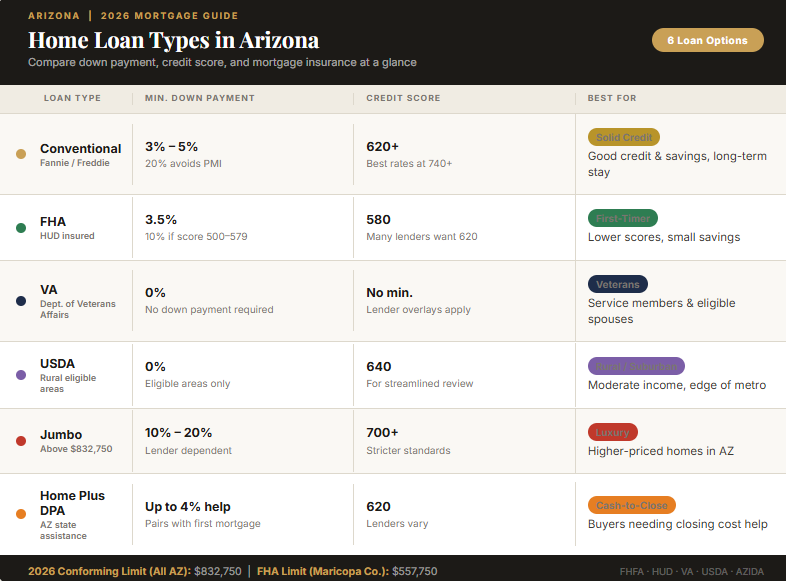
| Loan | Typical minimum down payment | Credit score guidance | Mortgage insurance | Best for |
|---|---|---|---|---|
| Conventional | 3% to 5% for some programs, 20% to avoid insurance | Often 620 or higher | Monthly, ends when equity builds | Buyers with solid credit and some savings |
| FHA | 3.5% with a 580 score | 580 federal minimum, many lenders want 620 | Upfront and monthly | Buyers with lower scores or small savings |
| VA | 0% for eligible borrowers | No VA minimum, lenders vary | None, but a funding fee applies unless exempt | Veterans and active-duty service members |
| USDA | 0% for eligible borrowers and areas | Often 640 for streamlined review | Upfront and annual fees | Moderate-income buyers in eligible areas |
| Jumbo | Often 10% to 20% | Often 700 or higher | Varies | Higher-priced homes above the conforming limit |
| Home Plus assistance | Up to 4% help with the down payment | 620 in lender training, lenders vary | Depends on the first mortgage | Buyers who need help with cash to close |
Figures are general guidelines checked on the date at the bottom of this page. Each lender can set its own overlays, so the number you see on a lender’s page may differ.
How to choose between them
Before you compare loans, answer four questions.
- How much cash do you have? Count the down payment, closing costs, and the reserves you want left over. Our guide to the cost of buying a house in Arizona lists the pieces.
- What is your credit score? Scores in the 580s lean toward FHA. Scores of 700 and above open more conventional options.
- Do you qualify for a special program? Military service points to VA. A rural or small-town location may point to USDA. A moderate income may qualify for Home Plus.
- How long will you stay? A short stay changes which loan costs less.
A loan officer can run two or three scenarios in an afternoon, and the comparison often changes the choice.
Conventional loans
A conventional loan is not backed by a government agency. Most are sold to Fannie Mae or Freddie Mac, and they follow those companies’ rules. The 2026 conforming loan limit for a one-unit home in Arizona is $832,750, according to the Federal Housing Finance Agency.
Strengths
- Mortgage insurance can be removed once your equity builds, instead of staying for the life of the loan, as FHA’s often does.
- Buyers with strong credit often get the best rates.
- The rules are flexible on the type of property, including second homes and investment properties.
- Down payments can be as low as 3% on certain programs for eligible buyers.
Trade-offs
- Lower credit scores raise the cost, and some scores cannot qualify.
- Down payments below 20% bring monthly mortgage insurance.
- Debt-to-income limits can be tighter.
Conventional loans also include HFA programs such as HFA Preferred and HFA Advantage, which the Arizona Home Plus program uses, and which have reduced mortgage insurance in some cases.
FHA loans
FHA loans are insured by the Federal Housing Administration. They allow a 580 credit score with 3.5% down, or 500 to 579 with 10% down, though lenders often set higher floors. Buyers pay an upfront mortgage insurance premium of 1.75% and a monthly premium. If you put down less than 10%, the monthly premium lasts for the life of the loan.
FHA is flexible on credit history and debt-to-income ratios, which is why many first-time buyers choose it. Read our full guide to FHA loan requirements in Arizona for credit, income, and appraisal rules. FHA also has county loan limits, covered in our guide to FHA loan limits in Arizona.
VA loans
VA loans are guaranteed by the U.S. Department of Veterans Affairs for eligible service members, veterans, and some surviving spouses. They offer zero down payment, no monthly mortgage insurance, and no VA loan limit for borrowers with full entitlement. Most borrowers pay a one-time funding fee, and those with a service-connected disability rating are generally exempt.
Arizona has a large military community, including Luke Air Force Base in the west Valley. Our detailed guide to VA loans in Arizona covers eligibility, the Certificate of Eligibility, and the appraisal.
USDA loans
USDA loans are backed by the U.S. Department of Agriculture for buyers with moderate incomes who purchase in eligible areas. Many people assume that only farms qualify. In fact, some suburban and small-town areas around the Valley qualify, depending on how the USDA maps them. USDA loans offer zero down payment, but they come with an upfront guarantee fee, an annual fee, and income limits.
The map and the income limits change, so check the property address before you fall in love with a home. Our guide to USDA loans in Arizona explains how to check.
Jumbo loans
A jumbo loan is a mortgage larger than the conforming loan limit. In Arizona that applies to loan amounts above $832,750 for a one-unit home in 2026. Jumbo loans are not insured by a government agency or bought by Fannie Mae or Freddie Mac, so lenders set tougher standards for credit, reserves, and down payment. Our guide to jumbo loans in Arizona covers what changes, including appraisal requirements and cash reserves.
Arizona down payment assistance
Arizona has assistance programs that help with the down payment and closing costs. The Arizona Industrial Development Authority runs the Home Plus program statewide, offering up to 4% assistance as a second mortgage that is forgiven after 60 months if you stay in the home and keep the first mortgage. The first mortgage rate may be slightly higher than market. We explain the trade-off in our guide to the Arizona Home Plus program. Other programs and local options are compared in our first-time home buyer programs guide.
Loan comparison: the same house, three loans
This example uses made-up numbers to show how the structure changes the cost. It is not a quote. Say a buyer is looking at a $400,000 home in the northwest Valley.
| Item | FHA | Conventional (5% down) | VA (no down payment) |
|---|---|---|---|
| Down payment | $14,000 (3.5%) | $20,000 (5%) | $0 |
| Base loan | $386,000 | $380,000 | $400,000 |
| Upfront fee financed | 1.75% MIP: $6,755 | None | Funding fee up to 2.15%: $8,600, or $0 if exempt |
| Monthly mortgage insurance | Yes | Yes, less than 20% down | None |
| Credit score emphasis | Flexible | Higher scores get better pricing | Flexible, lender dependent |
The payment on each depends on rate, taxes, and insurance. A real comparison needs real Loan Estimates, which is why we ask buyers to get them before choosing.
Common questions about eligibility
Income
Some programs have income limits, like USDA and Home Plus. Others, like FHA, VA, and conventional loans, do not have program income limits but do require that your debt-to-income ratio fits. Debt-to-income compares your monthly debts to your gross income.
Credit
Credit is one of the biggest drivers of price. Better scores generally mean lower rates and lower mortgage insurance. If your score is below where you want it, read about buying a house with a 580 credit score in Arizona.
Work history
Lenders want stable, documented income, typically a two-year history. Self-employed buyers need tax returns. Our preapproval checklist lists the documents.
The property
Each loan type has property standards. FHA, VA, and USDA require appraisals that check condition and safety. Conventional loans use a standard appraisal. Condos need project approval for FHA and VA.
Where homebuyers in the Phoenix area get stuck
- Choosing a loan by rate alone. A lower rate with higher fees can cost more.
- Skipping preapproval. Sellers want proof you can close. See how long buying a home in Phoenix takes.
- Changing jobs or taking on debt between preapproval and closing.
- Underestimating total costs. Taxes, insurance, and HOA dues add to the payment. See our guides on closing costs, homeowners insurance, and property tax.
- Looking in the wrong price range. Check the loan limits first.
- Not comparing at least two lenders. Rates and fees vary.
The mortgage process from application to keys
- Preapproval. You share income, assets, and credit, and the lender issues a letter.
- Home search. You tour homes within your budget.
- Offer and contract. Your agent writes the offer, and the seller accepts.
- Loan application and processing. You lock your rate and submit the final documents.
- Appraisal and inspection. The lender orders the appraisal. You order the inspection.
- Underwriting. The underwriter reviews the file and may ask for more documents.
- Clear to close. You receive the Closing Disclosure at least three days before closing.
- Closing. You sign, fund the loan, and get the keys.
Our guide to the home buying process in Arizona goes through each step in more detail.
A note on shopping lenders
Loan programs are set by agencies, but lenders and brokers choose how to price and package them. Two lenders can offer the same FHA or conventional loan with different rates, fees and timelines. Ask each one for a Loan Estimate on the same day, compare the rate and the cash to close, and ask about their experience with the program you want. A lender who works with USDA, VA or Home Plus files every week will usually move faster than one who sees them once a year.
Where to look: local guides for the northwest Valley
If you are buying in the northwest Valley, our local guides can help you narrow your search. Start with whether Peoria is a good place to live and the best neighborhoods in Peoria, then read about Anthem, and look at the cost of living in Peoria. Our broader guide to the best suburbs of Phoenix compares the area with other options.
Choosing by situation
Many buyers find it easier to start from their situation than from the loan names.

You have a lower credit score and little savings
FHA is often the first loan to review. It allows a 580 score with 3.5% down. If you are a veteran, a VA loan may give you a better result. If your income is moderate and the home is in an eligible area, a USDA loan could remove the down payment. Then look at the Home Plus program for cash-to-close help.
You have good credit and 5% to 10% to put down
Conventional loans usually compete well here. Mortgage insurance on a conventional loan can drop away when your equity builds, which can make the total cost lower than FHA over a long stay. Ask for both quotes.
You are a veteran or active-duty service member
Start with a VA loan. Zero down, no monthly mortgage insurance, and a funding fee that may be waived with a disability rating make the benefit hard to beat for many buyers. Our VA loan guide covers it step by step.
You are buying a pricier home
Check the conforming limit first. If your loan is above $832,750 for a one-unit home, jumbo guidelines apply. If you are close, see whether a larger down payment brings you under the limit.
You are buying on the edge of the metro
Check the USDA eligibility map for the address. If the area is eligible and your household income is within the limit, USDA could be the cheapest way in.
How lenders decide: the main numbers
Lenders weigh a few numbers in every loan.
| Number | What it is | Why it matters |
|---|---|---|
| Credit score | A summary of your credit history | Affects eligibility and price |
| Debt-to-income ratio | Monthly debts divided by gross income | Shows how much payment you can carry |
| Loan-to-value ratio | Loan amount divided by home value | Affects rate and mortgage insurance |
| Reserves | Savings left after closing | Provides a cushion; required for some loans |
| Income stability | Length and type of employment | Affects how income is counted |
You can improve most of these before you apply, usually by paying down debt, avoiding new credit, and saving. Our guide to buying a house with a 580 credit score in Arizona explains what lenders look at for lower scores.
Rate versus total cost
A low rate is attractive, but a loan with a low rate can have higher fees, higher mortgage insurance, or a shorter lock period. When you compare lenders, line up four things: the interest rate, the annual percentage rate, the monthly payment, and the cash to close. The Loan Estimate puts them on a standard form, which makes comparing easier. Our guide to who pays closing costs in Arizona shows how to read it.
Next steps
The fastest way to know which loan fits is to see the numbers. Talk to a loan officer and we will review your credit, income, and savings, then compare loans side by side. You can also read about our home buyer savings guarantee to learn how we work.
Frequently Asked Questions
What types of home loans are available in Arizona?
The main types are conventional, FHA, VA, USDA, and jumbo loans. Arizona also has down payment assistance, including the Home Plus program, that can pair with a first mortgage.
What is the easiest home loan to qualify for in Arizona?
FHA is often the most flexible on credit and savings, with a 580 score and 3.5% down. VA and USDA can be easier still for eligible borrowers because they allow zero down. Which is easiest for you depends on your situation.
How much do I need to put down on a house in Arizona?
It ranges from 0% for eligible VA and USDA borrowers to 3.5% for FHA, 3% to 5% for some conventional programs, and 10% to 20% for many jumbo loans. Closing costs are extra.
What is the conforming loan limit in Arizona for 2026?
The baseline one-unit conforming loan limit is $832,750, according to the Federal Housing Finance Agency. Arizona has no high-cost counties, so it applies statewide.
Can I get help with my down payment in Arizona?
Yes. The Arizona Home Plus program offers up to 4% assistance statewide for eligible buyers who use a participating lender. Terms, income limits, and rates apply.
Is FHA or conventional better?
It depends on your credit, savings, and plans. FHA is more flexible on credit but charges mortgage insurance for the life of the loan in many cases. Conventional loans cost less for strong borrowers. A side-by-side comparison shows which costs less for you.
How long does it take to get a mortgage in Arizona?
Preapproval can take from a few hours to a few days, depending on how fast you send documents. Closing usually takes 30 to 45 days after you go under contract.
Bottom Line: Choosing a Home Loan in Arizona
There is no single best home loan in Arizona. FHA helps buyers with lower credit scores or small savings, VA and USDA can remove the down payment for eligible borrowers, conventional loans reward stronger credit, and jumbo loans cover higher prices. The Home Plus program can change the math for any of them if cash to close is the problem. Compare real Loan Estimates for two or three options with your own numbers before you decide, and use the guides linked above for the details on each loan.
Ready to find out what you qualify for?
Understanding your financing position before you start touring homes keeps you focused on properties that fit your budget. Qualify Before You Buy combines mortgage brokerage and buyer representation to help Arizona buyers remove the guesswork. Know your price range, your monthly payment, your estimated cash to close and which down payment assistance programs you qualify for before you start shopping.
Start your preapproval or call (623) 203-6803 to talk with the team. You can also read about our buyer savings guarantee.