

To get an FHA loan in Arizona you generally need a credit score of 580 or higher for the 3.5% minimum down payment, or 500 to 579 with 10% down. You also need steady income that can be documented, a debt-to-income ratio that fits the lender’s guidelines, a home you will live in as your primary residence, and a property that passes an FHA appraisal. FHA loans are insured by the Federal Housing Administration, so lenders can approve borrowers with thinner credit or smaller savings than many conventional loans allow. Each lender can set stricter rules, which are called overlays.
This guide covers each requirement in plain language, what the FHA loan costs beyond the interest rate, and where Arizona buyers usually get stuck. If you already know you want FHA, keep reading.
FHA loan requirements at a glance
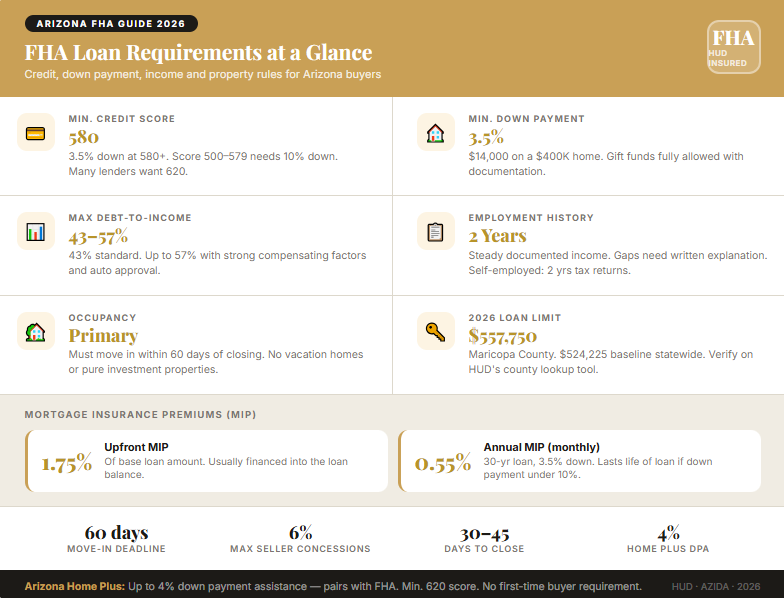
| Requirement | What FHA guidelines say | What to expect in practice |
|---|---|---|
| Minimum credit score | 580 for 3.5% down; 500 to 579 needs 10% down | Many lenders want 620 or higher |
| Minimum down payment | 3.5% of the purchase price | Gift funds are allowed with documentation |
| Debt-to-income ratio | Often up to 43%, higher with strong compensating factors and automated approval | Lender overlays vary |
| Occupancy | Primary residence only | You must move in within 60 days of closing |
| Employment | Steady income, usually a two-year history | Gaps need a written explanation |
| Upfront mortgage insurance | 1.75% of the base loan, can be financed | Added to your loan balance |
| Annual mortgage insurance | Paid monthly, rate depends on loan size, term and down payment | Often 0.55% on a 30-year loan with 3.5% down |
| Property | Must meet FHA minimum property standards | The appraiser checks safety, soundness and security |
| Loan limit | Set by county | Maricopa Co. limit: $557,750 (2026) |
These figures come from HUD’s published guidelines and were checked in November 2026. HUD updates them, so confirm the numbers with your loan officer before you make an offer.
What is an FHA loan?
An FHA loan is a mortgage insured by the Federal Housing Administration, part of the U.S. Department of Housing and Urban Development. The government does not lend you the money. A bank or mortgage company does, and FHA insurance protects that lender if the loan goes bad. Because of that protection, lenders can accept lower credit scores and smaller down payments.
The trade-off is mortgage insurance. You pay an upfront premium at closing and a monthly premium for years. We explain the numbers below so you can decide whether the trade-off makes sense.
Credit score requirements
FHA sets two tiers. With a score of 580 or higher you can put down as little as 3.5%. With a score from 500 to 579 you need at least 10% down. Scores below 500 do not qualify.
That is the federal rule. In real life, many lenders set their own minimum at 600 or 620 because they carry risk on loans they originate. If one lender turns you down for a 590 score, another may approve you. This is one reason we compare options for buyers rather than running one set of guidelines.
What counts besides the score
Lenders also look at your credit history. They want to see on-time payments over the last 12 to 24 months. Recent collections, charge-offs, and late payments on housing debts get extra scrutiny. After a bankruptcy or foreclosure, waiting periods apply, and they depend on the type of event. Ask a loan officer about your specific history, since the rules turn on dates.
If your score is lower than you want, our guide to buying a house with a 580 credit score in Arizona explains what lenders look at.
Down payment requirements
The minimum down payment is 3.5% of the purchase price when your score is 580 or higher. On a $400,000 home, that is $14,000. The money can come from savings, a gift from a family member, or an approved down payment assistance program.
Gift funds
FHA allows gifts from relatives, employers, labor unions, close friends with a clearly defined interest in the borrower, and charitable organizations. The donor signs a gift letter stating that no repayment is expected, and the lender documents the transfer. Do not move the money around without telling your lender. Large unexplained deposits cause delays.
Down payment assistance
Arizona has assistance programs that pair with FHA loans. The Arizona Home Plus program is the broadest one in the state. We also compare other options in our first-time home buyer programs guide.
Debt-to-income ratio
Debt-to-income, or DTI, compares your monthly debts to your gross monthly income. Lenders look at two numbers. The front-end ratio is your housing payment divided by income. The back-end ratio adds your other monthly debts, such as car loans, student loans, and credit card minimums.
FHA guidelines have long used 31% and 43% as benchmark ratios, and loans that receive an automated approval can go higher when the file has strong compensating factors, such as cash reserves or a history of paying a similar housing cost. Lenders vary on how high they will go. That is a question for the loan officer, not something a generic calculator can answer.
A simple DTI example
This is an illustration, not a quote. Say a household earns $6,500 a month before taxes. A 43% back-end ratio allows total monthly debts of about $2,795, including the new mortgage payment. If the household already pays $600 a month on a car and student loans, about $2,195 is left for the housing payment, which includes principal, interest, mortgage insurance, property tax, and homeowners insurance.
That is why paying off a small balance before you apply can raise your buying power more than you might expect. Each dollar of monthly debt you remove frees a dollar of room under the ratio.
Income and employment
Lenders want stable, documented income, and they usually look for a two-year history. A change of jobs is not a problem if you stay in the same type of work. Gaps need a written explanation, and a move into self-employment usually needs two years of tax returns.
Typical documents include:
- Pay stubs for the last 30 days
- W-2s for the last two years
- Federal tax returns if you are self-employed or have commission or bonus income
- Bank statements for two months
- A government-issued ID and your Social Security number
For a full list and a quick way to see where you stand, read our mortgage preapproval checklist.
Occupancy: the home must be your primary residence
FHA loans are for owner-occupied homes. You are expected to move in within 60 days of closing and live there for at least a year. You cannot use an FHA loan for a vacation home or a pure investment property. You can buy a two-to-four-unit property and live in one unit while renting the others, as long as the home meets FHA standards and you occupy one unit.
Mortgage insurance: what FHA really costs
Mortgage insurance is the largest difference between FHA and other loans, so it deserves a clear explanation.
Upfront premium
FHA charges an upfront mortgage insurance premium of 1.75% of the base loan amount. Most buyers finance it, which means it is added to the loan balance. On a $386,000 base loan, 1.75% is $6,755, so the loan amount becomes $392,755.
Annual premium
You also pay an annual premium, divided into monthly payments. The rate depends on the loan term, the loan amount, and the down payment. For a 30-year loan at or under the high-balance threshold with a down payment of less than 5%, the annual rate has been 0.55% of the loan balance. On a $392,755 balance, that is about $2,160 a year, or about $180 a month.
How long it lasts
If you put down less than 10%, the annual premium lasts for the life of the loan. If you put down 10% or more, it lasts for 11 years. Many FHA borrowers later refinance into a conventional loan once they have enough equity and a strong enough score, which removes the insurance. We explain that tradeoff in the FHA versus conventional section below.
Property requirements and the FHA appraisal
An FHA appraisal does two jobs. It estimates the home’s value, and it checks that the home meets HUD’s minimum property standards. The appraiser looks at safety, structural soundness, and security. This matters for Arizona homes in particular.
What the appraiser looks for in Arizona
- Roof condition. A roof near the end of its life can trigger a repair request. Sun and heat age roofs faster here than many buyers expect.
- Working systems. Heating, cooling, plumbing, and electrical must work. In Phoenix summers, a broken air conditioner is a safety issue, not a convenience.
- Peeling or chipping paint on homes built before 1978, because of lead paint rules.
- Safe access. Handrails, stairs, and secure entry points matter.
- Pools. A pool is not a problem by itself, but the equipment and safety features must work and the pool must be maintained.
- Termite or wood-destroying insect issues. The appraiser may require an inspection depending on the situation.
- Water and drainage. Standing water near the foundation is a red flag.
The FHA appraisal is not a home inspection. Hire an inspector too. You can read why in our guide to the home buying process in Arizona.
FHA loan limits in Arizona
FHA sets a maximum loan amount by county each year. Maricopa County has a higher limit than rural counties because the cost of housing is higher. The 2026 limit for Maricopa County is $557,750. Confirm the current figures with your loan officer before you make an offer.
Closing costs and who pays them
FHA allows the seller to contribute up to 6% of the sales price toward the buyer’s closing costs and prepaid items. Contributions are negotiated in the contract. Ask your loan officer how seller concessions affect your cash to close.
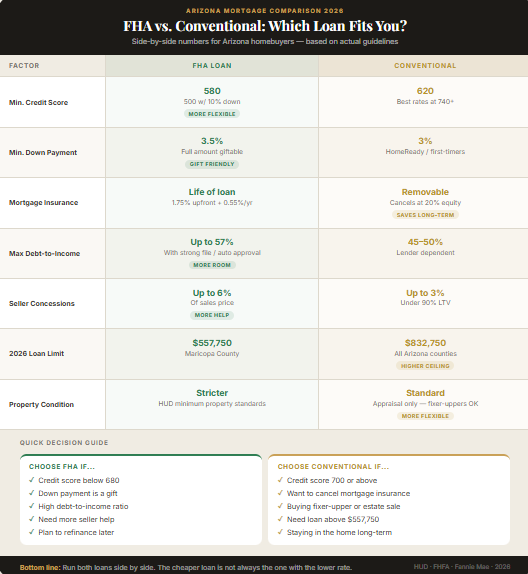
FHA versus conventional: which fits you?
| Question | FHA often fits when… | Conventional often fits when… |
|---|---|---|
| Credit score | Your score is in the 580s to low 600s | Your score is 700 or higher |
| Down payment | You have 3.5% and little more | You can put down 5% to 20% |
| Mortgage insurance | You accept it for the life of the loan, or plan to refinance | You want it to drop off once equity builds |
| Debt-to-income | Your ratio is on the high side | Your ratio is low |
| Property condition | The home is well maintained | The home needs cosmetic work an FHA appraiser might flag |
This is a general guide. A loan officer can run both and show you the monthly payment on each. The cheaper loan is not always the one with the lower rate.
Other loan types worth a look
If you are in a rural area or a suburb on the edge of Phoenix, a USDA loan has no down payment requirement for eligible areas. If you served in the military, a VA loan can beat FHA on cost. And if the home price is far above the county limit, a jumbo loan may come into the discussion.
How to get approved for an FHA loan in Arizona
- Check your credit. Pull your reports and look for errors. You can get free reports at AnnualCreditReport.com.
- Gather income documents. Use the list above.
- Pick a budget you are comfortable with. Approval and comfort are not the same.
- Get preapproved. A preapproval lets sellers know you are serious, and it shows what you can borrow. See how long buying a home in Phoenix takes so you can plan.
- Shop for a home within your price. Ask your agent about FHA-friendly properties.
- Order the appraisal and inspection. The lender orders the appraisal. You order the inspection.
- Close. Review your Closing Disclosure three days before closing.
Common reasons FHA applications fail
- A credit score below the lender’s overlay
- A debt-to-income ratio that is too high after adding the new payment
- Large deposits that cannot be explained
- A job change into a different field right before closing
- New debt taken on after preapproval, like a car loan
- An appraisal that flags repairs the seller will not make
- A property that is a non-warrantable condo, since FHA approves condo projects individually
New debt after preapproval is the most avoidable of these. Wait until after closing to finance a car or furniture.
Example: a first-time buyer in the north Valley
This is an illustration, not a real client. A couple earns about $90,000 a year together. Their credit scores are 640 and 665. They have $15,000 saved and want to buy near Peoria. Their lender runs the numbers on FHA and on a conventional loan with a smaller down payment.
On the FHA loan, they put down 3.5% and pay mortgage insurance for the life of the loan. On the conventional loan, a higher down payment lowers their insurance, but they would need more cash. The monthly payment on each is close. They pick FHA because it leaves more of their savings in the bank for repairs and moving costs. They plan to review a refinance in a few years.
The point is that neither loan wins in every case. Run both.
Frequently Asked Questions
What credit score do I need for an FHA loan in Arizona?
FHA guidelines allow a 580 score with 3.5% down, or 500 to 579 with 10% down. Many lenders require 620 or higher, so the practical minimum depends on the lender you choose.
How much is the down payment for an FHA loan?
The minimum is 3.5% of the purchase price if your score is 580 or higher. On a $400,000 home that is $14,000. The money can come from savings, gifts, or an approved assistance program.
How much is FHA mortgage insurance?
There is an upfront premium of 1.75% of the base loan and an annual premium paid monthly. For a typical 30-year loan with 3.5% down, the annual rate has been 0.55% of the loan balance. Rates can change, so ask for a current quote.
Can I get an FHA loan after a bankruptcy or foreclosure?
Often yes, after a waiting period that depends on the type of event and your recovery since. Ask a loan officer about your specific dates, because the timing rules are detailed.
Can I use gift money for an FHA down payment?
Yes. FHA allows gifts from eligible donors with a signed gift letter and a documented transfer. Do not deposit gift money without telling your lender first.
Does an FHA loan require the home to be my primary residence?
Yes. You are expected to move in within 60 days of closing and live there at least a year. You cannot use FHA for a vacation home or pure investment property.
Is an FHA appraisal different from a home inspection?
Yes. The appraisal estimates value and checks minimum property standards for the lender. An inspection is for you, and it gives a detailed look at the home’s condition. Get both.
Bottom Line: FHA Loan Requirements in Arizona
An FHA loan is built for buyers who have steady income but a lower credit score or a smaller down payment. The rules to remember are a 580 score for 3.5% down, a debt-to-income ratio your lender can approve, primary residence use, and a home that passes the FHA appraisal. The cost to weigh is mortgage insurance, so compare FHA with a conventional loan using your actual numbers before you commit.
Ready to find out what you qualify for?
Understanding your financing position before you start touring homes keeps you focused on properties that fit your budget. Qualify Before You Buy combines mortgage brokerage and buyer representation to help Arizona buyers remove the guesswork. Know your price range, your monthly payment, your estimated cash to close and which down payment assistance programs you qualify for before you start shopping.
Start your preapproval or call (623) 203-6803 to talk with the team. You can also read about our buyer savings guarantee.