

FHA loan limits in Arizona set the highest purchase price that an FHA-backed mortgage can cover. If a home costs more than the limit for its county, an FHA loan cannot finance the full amount, and you need a different loan or a larger down payment to cover the gap. Understanding the limit before you start shopping keeps you from falling in love with a home your financing cannot reach. This guide is part of our series on home loans in Arizona.
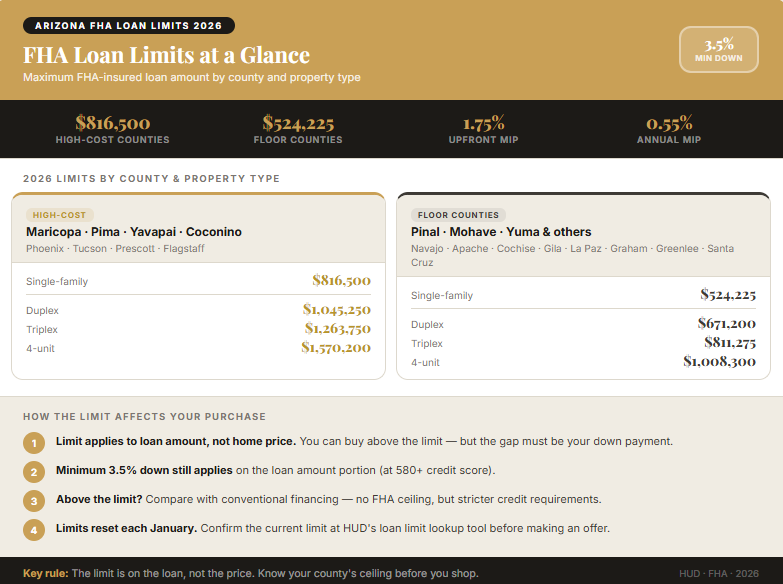
The limits change each year. The Federal Housing Finance Agency sets conforming loan limits, and FHA ties its own limits to those figures. For most Arizona counties the 2026 FHA loan limit for a single-family home is $524,225. High-cost counties, including most of the Phoenix metro and Tucson, have a higher limit of $816,500. These numbers matter most to buyers who are shopping near the top of their budget and using FHA financing.
What is an FHA loan limit?
An FHA loan limit is the maximum mortgage amount the Federal Housing Administration will insure in a given county and property type. It is not a cap on the home price, but it is a cap on the loan. If a home is priced above the limit, you can still buy it with FHA financing as long as your down payment covers the difference between the price and the limit.
For example, if the limit in your county is $524,225 and you want to buy a home priced at $550,000, the most an FHA loan can cover is $524,225. You would need to put at least $25,775 down plus the standard 3.5% minimum on the loan amount, or find a different loan program.
Limits apply by county and by the number of units in the property. A duplex, triplex, or four-unit building has a higher limit than a single-family home in the same county.
2026 FHA loan limits in Arizona by county
| County | Single-family limit | Duplex limit | Triplex limit | 4-unit limit |
|---|---|---|---|---|
| Maricopa (Phoenix metro) | $816,500 | $1,045,250 | $1,263,750 | $1,570,200 |
| Pima (Tucson) | $816,500 | $1,045,250 | $1,263,750 | $1,570,200 |
| Yavapai (Prescott) | $816,500 | $1,045,250 | $1,263,750 | $1,570,200 |
| Coconino (Flagstaff) | $816,500 | $1,045,250 | $1,263,750 | $1,570,200 |
| Pinal, Mohave, La Paz, Graham, Greenlee, Santa Cruz, Navajo, Apache, Cochise, Gila, Yuma | $524,225 | $671,200 | $811,275 | $1,008,300 |
These figures come from HUD’s published limits for 2026. Confirm the exact limit for your county at HUD’s loan limit lookup tool before you rely on a specific number, because limits are updated annually and sometimes mid-year.
How the limit interacts with your down payment
The FHA loan limit applies to the loan amount, not the purchase price. That means you can buy a home priced above the limit if you bring enough cash to cover the difference.
If you are buying in Maricopa County where the limit is $816,500 and the home is priced at $870,000:
- The gap between price and limit is $53,500.
- You need to cover that gap in cash.
- Then apply the standard 3.5% minimum down payment on top of the loan amount.
- Total cash needed is roughly $53,500 plus about $28,578 (3.5% of $816,500), or about $82,000 before closing costs.
Most buyers near the limit are better served by looking at the conventional loan market above the limit or by staying within the limit when shopping. For buyers using down payment assistance, the Arizona Home Plus program works with FHA loans and can help with the down payment portion, subject to its own income and loan limits. Ask your lender whether the assistance applies to loans close to the FHA ceiling.
FHA loan limits and loan types in Arizona
FHA has a floor limit and a ceiling limit. The floor applies to lower-cost counties and the ceiling to high-cost counties. Arizona has both:
- Floor counties (most of rural Arizona): $524,225 for a single-family home in 2026.
- Ceiling counties (Maricopa, Pima, Yavapai, Coconino): $816,500 for a single-family home in 2026.
The FHA limit is separate from conforming loan limits set by Fannie Mae and Freddie Mac. When a loan exceeds the conforming limit it becomes a jumbo loan, which is a conventional product with different underwriting rules. FHA does not offer a jumbo equivalent. For high-price purchases above the FHA ceiling, most buyers look at conventional financing. Our guide to FHA vs. conventional loans in Arizona covers how those two products compare on cost, credit requirements, and flexibility.
FHA loan requirements in Arizona
Meeting the loan limit is only part of qualifying for FHA financing. The loan itself has separate requirements. Our FHA loan requirements in Arizona guide covers the full picture, including credit score minimums, mortgage insurance premiums, and property standards. A short summary:
| Requirement | What to know |
|---|---|
| Minimum down payment | 3.5% at 580+ credit score; 10% at 500–579 |
| Credit score | 580 for 3.5% down; 500 minimum for 10% down |
| Upfront MIP | 1.75% of the loan amount, usually financed |
| Annual MIP | Typically 0.55% for most 30-year loans |
| Loan limit | Varies by county; see the table above |
| Property | Must meet HUD minimum property standards |
When another loan makes more sense
The FHA loan limit matters most when home prices are close to or above the ceiling. If you are shopping in that range, it is worth comparing FHA with other options:
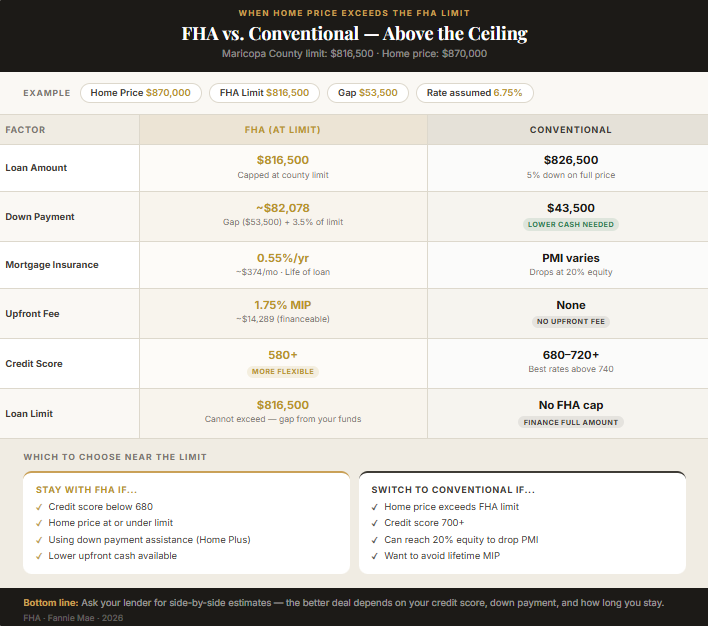
- Conventional loan: No FHA limit applies. Private mortgage insurance can be removed once equity reaches 20%. Credit and income requirements are stricter but costs can be lower for buyers with strong credit.
- VA loan: If you are an eligible veteran or service member, there is no loan limit on a VA loan for buyers with full entitlement. No mortgage insurance. See how it compares with home loans in Arizona.
- USDA loan: There is no specific dollar limit, but the USDA loan requires the property to be in an eligible area and the household income to be under a cap. It is not an option for most Phoenix-area buyers because of the location restriction.
If you are unsure which loan fits your budget and the home price range you are considering, our mortgage preapproval checklist lists what documents to gather, and a preapproval will tell you exactly how much you can borrow under each program.
How to stay within the FHA limit
If the limit matters for your search, the simplest approach is to build it into your maximum purchase price from the start. In Maricopa County, that means keeping offers at or below $816,500 if you plan to put the minimum 3.5% down. In floor counties, it means staying at or below $524,225.
If you want to buy above the limit, talk to your lender before writing offers. The lender can run the numbers on a combined approach, such as a larger down payment or a conventional loan, so you understand what the gap costs in cash before you commit.
Our guide on how to buy a home in Phoenix walks through the full purchase process, including how financing decisions fit into the offer and closing timeline.
Down payment assistance and the FHA limit
Several Arizona assistance programs work with FHA loans and can cover part of the down payment or closing costs. Arizona Home Plus is one of the most used. It lists FHA as an eligible first mortgage type and provides assistance as a percentage of the loan amount, with no repayment required after a set period if you stay in the home.
The assistance amount is tied to the loan, so a loan close to the FHA ceiling produces more assistance in dollar terms than a smaller loan. However, the Arizona Home Plus program also has its own income limits and purchase price limits, which may be lower than the FHA ceiling in some counties. Confirm that the home you are considering qualifies under both the FHA limit and the assistance program’s limit before you make an offer.
For buyers who want to explore all available programs, our first-time home buyer programs guide lists the options available in Arizona, including programs from the state housing authority and local municipalities.
FHA loan limits for multi-unit properties
FHA loan limits increase for 2-, 3-, and 4-unit properties. This matters for buyers who plan to house-hack: buy a small multi-unit, live in one unit, and rent the others. FHA allows this, and the rental income from other units can be counted toward your qualifying income in some cases.
In a high-cost county such as Maricopa, the limits in 2026 are:
- Duplex (2-unit): $1,045,250
- Triplex (3-unit): $1,263,750
- 4-unit: $1,570,200
The same FHA rules apply. You still need a 3.5% down payment, still pay the upfront and annual MIP, and the property must still meet HUD standards. The property must also be your primary residence; FHA does not finance pure investment properties.
What changes year to year
FHA loan limits are recalculated annually based on changes in median home prices. When home prices rise, limits typically rise. When prices fall, limits can drop, though there is a floor below which they are not supposed to go.
The 2026 limits are the ones in effect for loans originated this year. If you are looking ahead to a purchase next year, check HUD’s site in December for the following year’s limits, which are usually announced in November. For most buyers, the relevant number is the limit for the county where they are buying and the property type they are considering.
Frequently Asked Questions
What is the FHA loan limit in Arizona for 2026?
It depends on the county. High-cost counties including Maricopa, Pima, Yavapai, and Coconino have a limit of $816,500 for a single-family home. Most other Arizona counties have a limit of $524,225. Multi-unit properties have higher limits.
Can I buy a home above the FHA loan limit?
Yes, but the FHA loan cannot exceed the limit. If the home costs more, you need to cover the difference with a larger down payment, or switch to a conventional or other loan type. The 3.5% minimum still applies to the loan amount portion.
Does the FHA loan limit change every year?
Yes. HUD reviews and adjusts limits annually based on median home prices. The new limits usually take effect January 1 and are announced in November of the prior year.
Are FHA loan limits the same as conforming loan limits?
No. They are related but different. The FHA ceiling for high-cost areas is set at 150% of the conforming loan limit. FHA limits apply only to FHA-insured loans. Conforming limits apply to conventional loans sold to Fannie Mae and Freddie Mac.
Does the FHA limit apply to the purchase price or the loan amount?
The loan amount. You can purchase a home at any price, but the FHA-insured portion of the mortgage cannot exceed the limit for your county. Any amount above the limit must come from your own funds as a down payment.
Is there an FHA loan limit for condos in Arizona?
The same county-level limits apply to FHA-eligible condos as to single-family homes. However, the condo project itself must be on HUD’s approved list or go through a spot approval process. The loan limit is a separate consideration from project approval.
Bottom Line: FHA Loan Limits in Arizona
The FHA loan limit for most of the Phoenix metro and other high-cost Arizona counties is $816,500 for a single-family home in 2026. For rural and lower-cost counties, the limit is $524,225. If you are shopping near or above the limit, understand the gap before you make an offer and ask your lender to compare FHA with conventional financing for that price range. If you are well under the limit, the limit is unlikely to affect your purchase.
Ready to find out what you qualify for?
Understanding your financing position before you start touring homes keeps you focused on properties that fit your budget. Qualify Before You Buy combines mortgage brokerage and buyer representation to help Arizona buyers remove the guesswork. Know your price range, your monthly payment, your estimated cash to close and which down payment assistance programs you qualify for before you start shopping.
Start your preapproval or call (623) 203-6803 to talk with the team. You can also read about our buyer savings guarantee.