

A USDA loan lets eligible buyers purchase a home in Arizona with no down payment. It is backed by the U.S. Department of Agriculture, but you get it from a private lender, and you do not have to be a farmer. Two things decide whether it works for you. The home must be in a USDA-eligible area, and your household income must be at or below the limit for your county. If both are true, a USDA loan often costs less each month than an FHA loan, because its mortgage insurance fees are lower. If either is false, a different loan will serve you better. This guide is part of our series on home loans in Arizona.
Many Phoenix-area buyers assume USDA loans are only for farmland. That is not true, and the opposite assumption causes just as many problems. Some suburban and edge-of-metro addresses qualify, many central addresses do not, and the only way to know is to check the specific property. This guide explains how, what the loan costs, and how it compares with FHA and VA.
What is a USDA loan in Arizona?
A USDA loan, formally the Single Family Housing Guaranteed Loan Program, is a government-backed mortgage for buyers who meet income limits and who buy a primary residence in an eligible area. It requires no down payment, so buyers can finance up to 100% of the appraised value. Instead of traditional mortgage insurance, it charges a one-time guarantee fee of 1% and an annual fee of 0.35% of the loan balance.
You apply through an approved private lender, not through the USDA directly. That lender handles credit review, underwriting, and closing. There is also a separate USDA direct loan program for lower-income households, which uses different rules and is not the focus of this guide.
USDA loan requirements at a glance
| Requirement | What to know |
|---|---|
| Down payment | None required |
| Property location | Must be in a USDA-eligible area, checked by address |
| Income limit | Household income at or below 115% of the area median |
| Occupancy | Primary residence only |
| Credit score | USDA has no official minimum; most lenders want about 640 for automated approval, and some review lower scores manually |
| Loan term | 30-year fixed rate |
| Upfront fee | 1% guarantee fee, which can be financed |
| Annual fee | 0.35% of the loan balance, paid monthly |
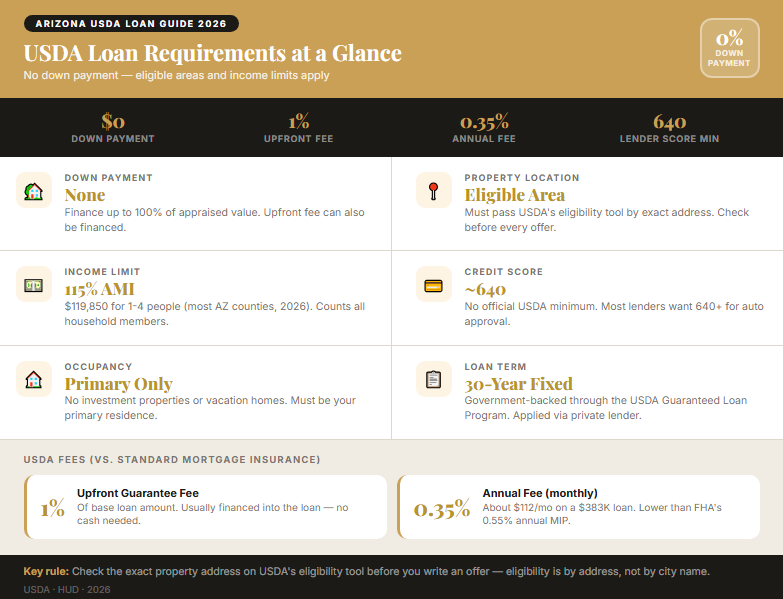
The fee and income rules above come from USDA program guidance as summarized by lenders and rate sites. The credit score threshold is a lender standard, not a USDA rule, so it varies. Check with your lender.
The income limit
USDA counts the income of everyone in the household, not just the people on the loan. A common published figure for 2026 is $119,850 for households of one to four people and $158,250 for households of five to eight in most Arizona counties. Limits are 115% of the area median income and change by county and household size, so use USDA’s income tool for your specific county before you rely on a number.
Here is the point that catches buyers. If a nonborrowing adult lives in the home, such as an adult child or a parent, their income may count toward the limit. Ask your lender how they count it before you shop.
Which Arizona areas are USDA eligible?
USDA eligibility maps cover areas that USDA considers rural or on the edge of a metro area. In Arizona, that tends to exclude the dense core of the Phoenix metro and include many smaller towns and some outlying suburban addresses. The boundaries change over time, and they can run through the middle of a subdivision, so two neighbors can have different answers.
We are not going to list cities as eligible or ineligible, because a list would go out of date and could send you to a house that does not qualify. Do this instead:
- Open USDA’s property eligibility tool.
- Enter the full address of the specific home.
- Save a screenshot of the result with the date.
- Give it to your lender and your agent.
Do this before you write an offer. If a home turns out to be outside the boundary, a USDA loan will not close.
What a USDA loan costs
USDA loans trade the large down payment for fees. Here is a comparison using the same home price for USDA and FHA. This is an illustration with an assumed 6.5% rate for 30 years, not a quote.
| USDA | FHA | |
|---|---|---|
| Home price | $380,000 | $380,000 |
| Down payment | $0 | $13,300 (3.5%) |
| Base loan amount | $380,000 | $366,700 |
| Upfront fee | $3,800 (1%) | $6,417 (1.75%) |
| Loan amount if the upfront fee is financed | $383,800 | $373,117 |
| Annual fee or premium | 0.35%, about $112 a month | 0.55%, about $168 a month |
| Principal and interest (assumed 6.5%) | About $2,426 | About $2,358 |
Two things show up in that table. USDA has the lower fee each month, about $56 less than FHA in this case. But because USDA has no down payment, the loan amount is larger, so principal and interest is higher. Over a few years, the two loans can come out close, and your credit score, rate, and the home itself can tip the result either way. Ask for both estimates.
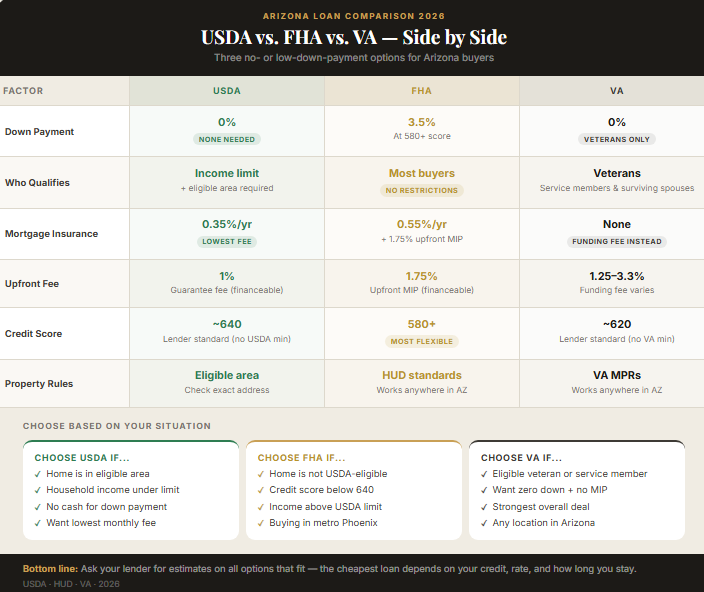
USDA vs. FHA vs. VA
USDA vs. FHA. FHA works nearly anywhere, has no income limit, and accepts lower credit scores, but it requires a down payment of at least 3.5% and has a higher annual premium. USDA needs an eligible address and an income under the limit. Our FHA loan requirements guide explains how FHA works in Arizona, and our FHA vs. conventional comparison covers the next step up.
USDA vs. VA. If you are an eligible veteran or service member, a VA loan also offers no down payment and has no monthly mortgage insurance. It has a funding fee instead. Read our VA loan guide. VA is usually the better deal for those who qualify.
USDA vs. conventional. Conventional loans work if you have a larger down payment and solid credit. A 3% down conventional loan is possible for some buyers, but private mortgage insurance and credit requirements vary.
Pros and cons of a USDA loan in Arizona
Pros
- No down payment
- Lower mortgage insurance cost than FHA
- Fixed 30-year rate
- Seller can contribute toward closing costs within program limits
- The upfront fee can be financed
Cons
- The home must be in an eligible area, and many central addresses are not
- Household income cannot exceed the limit
- Primary residence only
- Most lenders want a score near 640 or above
- The annual fee lasts for the life of the loan
How to apply for a USDA loan in Arizona
- Check the income limit. Use USDA’s tool for your county and household size.
- Check the property address. Do this for every home you consider, before making an offer.
- Get preapproved. Use a lender that does USDA loans. Our preapproval checklist lists the documents. Read the difference between preapproval and prequalification if the terms confuse you.
- Make an offer with USDA terms. Your agent should add the right financing language and timelines.
- Complete the appraisal and the USDA review. The appraisal still applies, and the lender submits the file for the guarantee.
- Close. The upfront fee is paid at closing or financed into the loan.
USDA closings can take a little longer than conventional because of the added review. Ask your lender for a realistic timeline, and read our guide on how long buying a home in Phoenix takes.
Can you use down payment help with a USDA loan?
Some assistance programs pair with USDA loans. Arizona’s Home Plus program lists USDA among the first mortgage types it can work with, subject to the lender and the program’s rules. Our Home Plus guide explains the current terms, and our first-time home buyer programs guide lists other options. Because USDA already allows zero down, assistance would most likely help with closing costs, so ask your lender what the combination does to your rate and fees.
Example: a family choosing between USDA and FHA
This is an illustration, not a real client. A family of four has a household income of $95,000 and about $8,000 in savings. They are looking at a home that the USDA tool shows as eligible, priced at $380,000.
With USDA, they put nothing down and pay about $112 a month in the annual fee. With FHA, they would need about $13,300 for the down payment, which they do not have, plus a higher monthly premium. USDA is the clear choice here, even though their principal and interest is a bit higher.
If the same home had been outside the USDA boundary, the family would have needed a different plan, such as a smaller price, a down payment program, or a different area. The loan must follow the address.
Common USDA mistakes
- Assuming a city is eligible. Eligibility is by address, not by city name.
- Forgetting household income. The limit counts everyone in the home.
- Skipping the eligibility screenshot. If the maps change during escrow, a dated record helps.
- Waiting on the appraisal. Order timing matters. Ask your lender when it will be ordered.
- Overlooking the annual fee. It is lower than FHA but not zero.
Questions to ask before you fall in love with a USDA home
USDA eligibility depends on the address and on your household, so check both before you tour.
- Is the address in an eligible area today? Maps are updated, and a property that was eligible once may not be now.
- Is my household income under the limit? The limit depends on household size and the county, and it counts the income of everyone who lives in the home.
- Will the property be my primary residence? USDA does not finance investment properties or vacation homes.
- Does the home meet USDA property standards? Safe, sound, and sanitary are the themes, with a working water supply, a safe road, and no major defects.
- Does my lender participate in the USDA guaranteed program? Not every lender does.
- What are the upfront and annual fees? Ask for a current quote so you can compare with FHA and VA.
The income limit and how household income is counted
USDA income rules look at the whole household, not only the borrower. Lenders generally count income from adults who live in the home, with some exceptions, and they allow certain deductions. That means a buyer with a modest income who shares a home with a working relative may exceed the limit. It also means that deductions for dependents or child care can help in some cases. Because the rules are detailed, do not guess. Ask a loan officer to run your household through the limit before you start shopping.
Where USDA loans tend to apply near Phoenix
The USDA map is based on population and location, not on whether a place feels rural. In the Phoenix metro area, the central and densely developed cities are generally not eligible, while some edge areas and smaller towns can be. Because boundaries change and sometimes fall in the middle of a neighborhood, two houses on the same street can be treated differently. Use the USDA’s property eligibility tool with the exact address, save a screenshot with the date, and give it to your lender.
If you are buying in or near the northwest Valley, our guides to Peoria, Anthem, and the wider best suburbs of Phoenix can help you shortlist areas, and then you can check each address.
Combining USDA with other help
Some buyers pair a USDA loan with assistance. The Arizona Home Plus program lists USDA among the first mortgage types it works with, according to its lender training, and other local programs may allow it too. Rules, rates, and income limits for each program apply on top of USDA’s. Ask your lender to confirm that the combined rules work. Our guide to the Arizona Home Plus program explains how the assistance works.
USDA timelines and what slows them down
USDA loans have an extra layer of review. The lender underwrites the loan, and then the USDA reviews it for the guarantee. That second step can add days, so ask your lender for a realistic timeline before you set a closing date in the contract. Delays often come from missing income documents, a household member whose income was not counted, or an appraisal that flags repairs. You can speed things up by gathering paperwork early and by asking your agent to build a few extra days into the contract. Our guide to how long buying a home in Phoenix takes explains the full timeline, and our preapproval checklist lists the documents.
How USDA fits into the bigger picture
A USDA loan is one tool among several. If your home is in an eligible area and your household income is under the limit, it can be one of the lowest-cash ways to buy. If the address is not eligible or the income is too high, other options take over. Our overview of home loans in Arizona lays out the choices side by side, and our guide to the cost of buying a house in Arizona shows what you will pay on top of the loan itself.
Frequently Asked Questions
What is a USDA loan?
A USDA loan is a government-backed mortgage for buyers who meet income limits and who purchase a primary residence in an eligible area. It requires no down payment and charges a 1% upfront guarantee fee plus a 0.35% annual fee instead of standard mortgage insurance.
What are the income limits for a USDA loan in Arizona?
Household income must not exceed 115% of the area median income, which depends on your county and household size. A commonly published 2026 limit is $119,850 for households of one to four people. Check USDA’s income tool for the exact figure.
Can I get a USDA loan in Phoenix?
It depends on the exact address. USDA eligibility maps include some outlying suburban areas and exclude much of the dense metro core. Check each property on USDA’s eligibility tool before you make an offer.
What credit score do I need for a USDA loan?
USDA itself has no official minimum score, but many lenders want about 640 or higher for automated approval. Some will manually review lower scores, so ask your lender.
Is a USDA loan cheaper than FHA?
Often the monthly fee is lower, since USDA’s annual fee is 0.35% versus 0.55% for most FHA loans. Because USDA has no down payment, the loan amount is larger, so compare the full payment and cash needed on both.
Can I use USDA for a second home or investment property?
No. USDA loans are for primary residences only.
Bottom Line: USDA Loans in Arizona
A USDA loan can be one of the lowest-cash ways to buy, but only if the address is in an eligible area and your household income is under the limit. Check both before you tour homes, then compare the USDA fees with FHA and conventional options. In many parts of the Phoenix area USDA will not apply, so confirm the exact address early.
Ready to find out what you qualify for?
Understanding your financing position before you start touring homes keeps you focused on properties that fit your budget. Qualify Before You Buy combines mortgage brokerage and buyer representation to help Arizona buyers remove the guesswork. Know your price range, your monthly payment, your estimated cash to close and which down payment assistance programs you qualify for before you start shopping.
Start your preapproval or call (623) 203-6803 to talk with the team. You can also read about our buyer savings guarantee.