
A 580 credit score does not disqualify you from buying a home in Arizona. Under current FHA guidelines, 580 is the threshold for the standard 3.5% down payment structure, which means the door to mortgage financing is not shut at that score. But walking through that door requires more than just meeting a minimum number on a credit report.
Your credit score gets you to the starting line. The lender’s full underwriting process decides whether you cross it. And if you are counting on Arizona down payment assistance to reduce your cash at closing, the credit requirements for those programs are meaningfully higher than FHA’s floor.
This article breaks down which loan types may work at a 580 score, how Arizona assistance programs treat that score differently, what else lenders evaluate beyond the number, and what practical steps you can take to give yourself the strongest shot at approval.
Can you actually get approved with a 580 credit score?
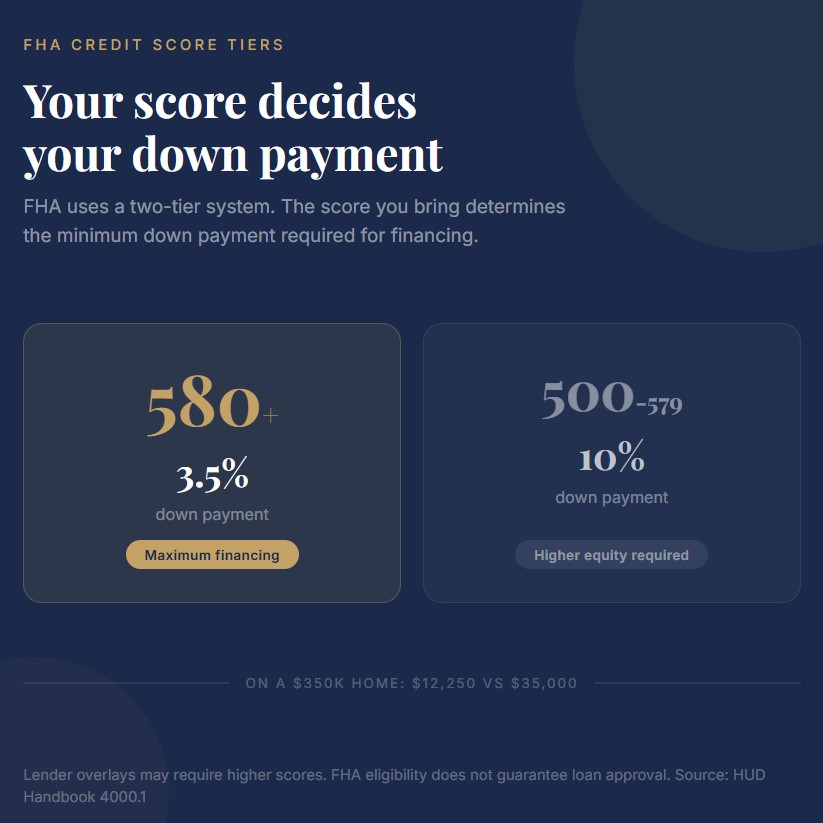
Yes, but with conditions. FHA’s policy allows borrowers with a 580 credit score or higher to qualify for maximum financing at 3.5% down. That policy has remained unchanged heading into 2026, and HUD has not announced modifications to the two-tier credit score structure.
Here is the part that catches buyers off guard: FHA sets the minimum, but FHA does not lend you the money. A private lender does. And that lender can layer on additional requirements, sometimes called overlays.
Some lenders will process FHA loans at the 580 threshold. Others set their internal floor at 600, 620, or even 640. A rejection from one lender at 580 does not mean every lender will say no. Shopping matters, and pre-qualification before house hunting can reveal where you actually stand before you waste weekends at open houses.
The short version: 580 meets FHA’s minimum. Whether it meets your lender’s minimum is a separate question entirely.
What home loan can you get with a 580 credit score?
Not every mortgage program treats a 580 score the same way. Here is how the main loan types compare:
| Loan type | Potentially available at 580? | Typical down payment | Key consideration |
|---|---|---|---|
| FHA | Yes, per HUD guidelines | 3.5% minimum | Lender overlays may require higher scores |
| VA | Depends on the lender | 0% for eligible veterans | VA has no published minimum score; lenders set their own |
| USDA | Unlikely at most lenders | 0% for eligible areas | Most USDA lenders require 620-640 |
| Conventional | Very unlikely | 3-20% | Fannie Mae and Freddie Mac guidelines generally start at 620 |
| Arizona DPA-layered | Usually not at 580 | Varies by program | Most Arizona DPA programs require 620-640 minimum |
FHA is the most accessible path for a buyer sitting at 580. The other options either require lender-by-lender investigation (VA) or are realistically out of reach at that score for most borrowers (conventional, USDA).
FHA loan witha 580 credit score in Arizona
FHA is worth understanding in detail because it is the program most likely to work at this credit level.
The 580 threshold. A middle FICO score of 580 or higher qualifies for FHA’s maximum financing with a 3.5% minimum down payment. If you have a coborrower, lenders typically use the lower of the two borrowers’ middle scores to qualify, which means your coborrower’s credit matters just as much as yours.
The 500-579 range. FHA does not cut off entirely below 580. Borrowers with scores between 500 and 579 can still qualify, but the required down payment jumps to 10%. On a $350,000 home, that is the difference between roughly $12,250 and $35,000 just for the down payment, before any other costs.
Mortgage insurance. Every FHA loan carries both an upfront mortgage insurance premium (currently 1.75% of the loan amount, typically financed into the loan) and an annual mortgage insurance premium added to the monthly payment. Unlike conventional PMI, FHA mortgage insurance does not automatically drop off when you reach 20% equity. For loans with less than 10% down, it stays for the life of the loan unless you refinance out of FHA.
Property requirements. The home must be a primary residence. It has to pass an FHA appraisal, which evaluates both value and minimum property standards. Investment properties and most second homes do not qualify.
FHA loan limits in Arizona. The 2026 FHA loan limit varies by county. In Maricopa County, the single-family limit is $546,250. Coconino County has a higher limit of $609,500. The national floor for 2026 is $541,250 for most counties. For most Phoenix metro buyers, the FHA limit covers the median home price in cities like Glendale, Surprise, Buckeye, and Mesa.
Lender overlays are the real gatekeeper. Some banks and mortgage companies will not touch an FHA file below 620, even though HUD permits 580. This is not unusual, and it is not a violation of any rule. Lenders absorb risk when they originate FHA loans, and they set internal guidelines accordingly. Mortgage brokers with access to multiple wholesale lenders can sometimes find options that a single retail bank cannot.
If you want to understand the full list of what lenders typically need from you, the Arizona mortgage pre-approval checklist is a good starting point. Having your documents organized before applying saves time and reduces surprises during underwriting.
How much down payment do you need with a 580 credit score?
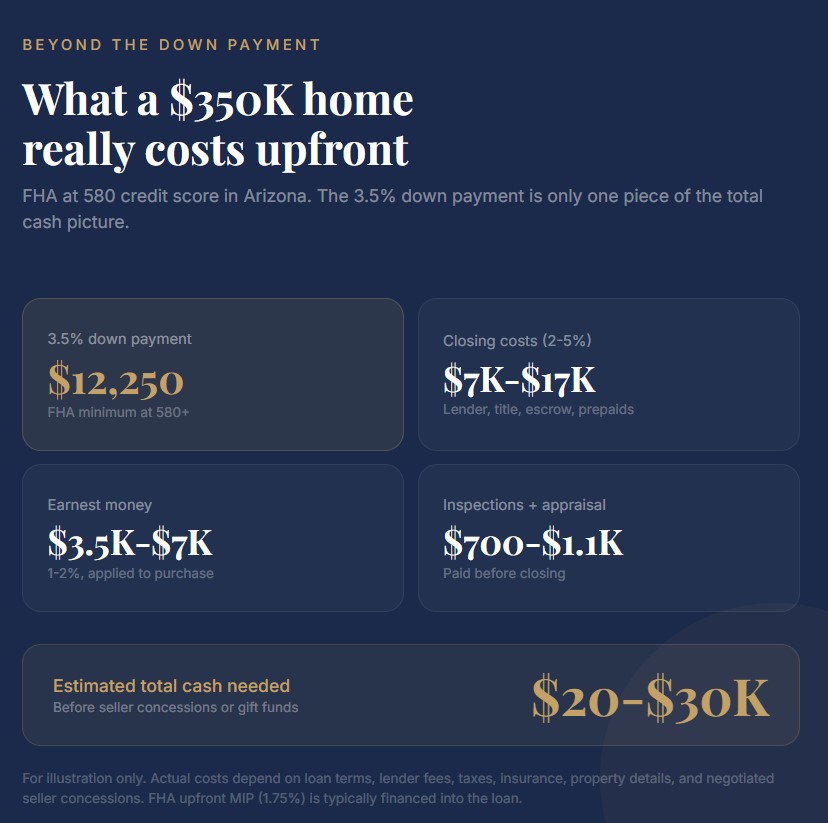
The 3.5% FHA minimum gets cited everywhere, and it is accurate as far as it goes. On a $350,000 purchase, 3.5% comes to $12,250.
But the down payment is only part of the cash you need to bring. Buyers frequently underestimate the total upfront cost, and that gap between expectations and reality kills deals. Plan for all of these:
- Earnest money deposit: Typically 1-2% of the purchase price, submitted with your offer. This goes toward your purchase, not on top of it, but you need the cash available early in the process.
- Closing costs: Generally 2-5% of the purchase price. These include lender fees, title fees, escrow charges, prepaid taxes, prepaid insurance, and other settlement costs.
- FHA upfront mortgage insurance premium: 1.75% of the loan amount, usually rolled into the loan balance rather than paid out of pocket, but it increases your total loan.
- Appraisal fee: Typically $400-$600 in the Phoenix metro area, paid before closing.
- Home inspection: $300-$500 for a standard inspection, not required by FHA but strongly recommended.
On a $350,000 home, a buyer could reasonably need $12,000-$25,000 or more in total cash, depending on how closing costs are handled. Seller concessions (where the seller agrees to pay some of the buyer’s closing costs) can reduce the buyer’s cash outlay, but sellers are not obligated to agree to them.
For a deeper look at whether FHA can be combined with strategies to reduce or eliminate the down payment, this guide on FHA down payment requirements in Arizona covers the possibilities and limits.
Can you get down payment assistance with a 580 credit score in Arizona?
This is where buyers at the 580 level run into a wall they did not expect. Meeting FHA’s credit threshold does not mean you meet the credit threshold for Arizona’s down payment assistance programs. These are separate programs with separate rules.
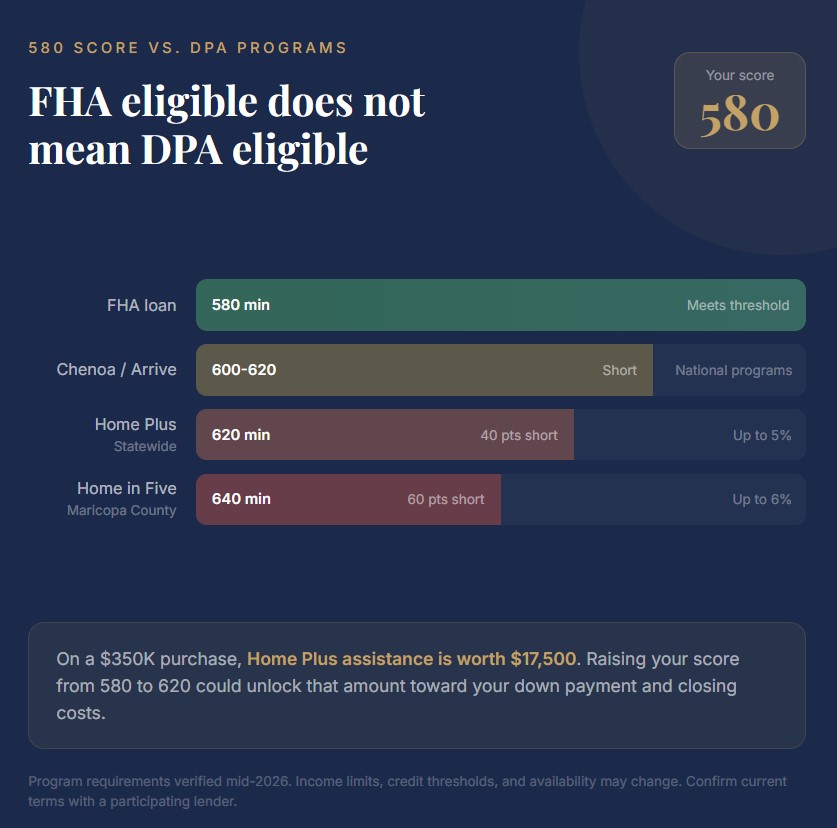
Arizona IDA Home Plus. This statewide program provides up to 5% of the loan amount toward down payment and closing costs, structured as a forgivable second mortgage. It pairs with FHA, VA, USDA, and conventional first mortgages. No first-time buyer requirement. But the minimum credit score requirement is 620, not 580. The 2026 income cap is $155,386 for borrower income ($146,503 with FHA, VA, USDA, or conventional HFA financing). A homebuyer education course is required.
Home in Five Advantage. Available only in Maricopa County, this program offers up to 6% in down payment and closing cost assistance through a forgivable second mortgage, with an extra 1% available for qualifying military, veterans, K-12 teachers, and first responders. The minimum credit score is 640. The income cap is $138,600 per the official program description, though some participating lenders report updates as high as $157,360 for 2026. Buyers should confirm current limits directly through a participating lender. No first-time buyer requirement. A homebuyer education course is required.
Arizona Is Home. This variant through the Home in Five program requires first-time buyer status (or veteran/targeted area exceptions), has its own income cap of $131,520, and requires a minimum credit score higher than FHA’s 580 floor.
National programs. Some national DPA programs like Chenoa Fund and Arrive Home may accept scores as low as 600 or 620, with no income caps in some cases. These are worth investigating, but each has its own layered requirements and not every lender participates.
Here is the practical takeaway: a buyer at 580 can potentially qualify for the FHA loan itself but would likely need to bring the full 3.5% down payment plus closing costs from personal savings, gift funds, or another permitted source, because most Arizona DPA programs require a higher score.
If your score is between 580 and 619, one of the most valuable things you can do is figure out whether a few months of credit work could push you above the DPA threshold. The dollar difference can be significant. On a $350,000 purchase, 5% in Home Plus assistance represents $17,500 that you would otherwise need to bring yourself.
Why a 580 credit score may not be enough to get approved
Credit score gets the most attention, but lenders evaluate a full financial picture. You can have a 580 score and still get declined for other reasons, or you can have a 580 score with strong compensating factors that make a lender more comfortable.
Debt-to-income ratio
Your DTI compares your total monthly debt payments (including the proposed mortgage) to your gross monthly income. FHA guidelines can allow DTI ratios in the 43-50% range, and occasionally higher with strong compensating factors, but most lenders prefer to see the back-end ratio stay reasonable for the borrower’s overall profile. A 580 score combined with high DTI is a much harder file to approve than a 580 score with a 38% DTI.
Employment and income
Lenders typically want a two-year employment history, though not necessarily with the same employer. Gaps in employment, recent job changes, or income that is difficult to document (commissions, self-employment, gig work) can complicate approval. Self-employed borrowers generally need two years of tax returns showing stable or increasing income.
Credit history beyond the score
The score is a summary. Lenders also look at what is behind it. A 580 score caused by a single medical collection three years ago reads very differently than a 580 score caused by multiple recent missed payments on revolving debt. Recent late payments on housing accounts (rent, mortgage) are particularly damaging.
Collections and charge-offs
FHA’s guidelines provide some relief here. Medical collections are excluded entirely from FHA underwriting calculations. Non-medical collections under $2,000 cumulative are generally excluded as well. But larger collection balances or recent charge-offs can still trigger manual underwriting or lender concerns.
Cash reserves
Having two or three months of mortgage payments in savings after closing can be a compensating factor. Buyers with thin reserves at a 580 score face tighter scrutiny.
Property eligibility
The house itself must qualify. FHA appraisals check for health, safety, and structural soundness issues. Peeling paint on pre-1978 homes, roof problems, foundation issues, missing handrails, and other defects can delay or derail financing.
Automated underwriting
Most FHA loans are initially run through an automated underwriting system (AUS). The AUS considers the complete file, not just the credit score. An “approve/eligible” finding from the AUS makes the process smoother. A “refer/eligible” finding pushes the file to manual underwriting, which involves more documentation, stricter DTI limits, and additional compensating factor requirements.
Can you get a conventional home loan with a 580 credit score?
Realistically, this is very difficult. Conventional loans follow Fannie Mae and Freddie Mac guidelines, and the typical minimum credit score for conventional financing is 620. Some conventional programs may accept lower scores in specific circumstances, but 580 falls below the standard threshold for most conventional products.
Beyond the score itself, conventional borrowers at lower credit tiers face higher private mortgage insurance premiums and potentially higher interest rates, which can make the monthly payment less competitive compared to FHA. For a buyer at 580, FHA is almost always the more practical route.
If your score is close to 620 and you have time before buying, improving those 40 points could open up conventional options, potentially with lower long-term costs because conventional PMI can be cancelled once you reach 20% equity.
Can veterans buy a home in Arizona with a 580 credit score?
VA loans are backed by the U.S. Department of Veterans Affairs and are available to eligible active-duty service members, veterans, and surviving spouses. One of the strongest features: VA loans do not require a down payment for eligible borrowers with full entitlement, regardless of credit score.
But VA does not publish a universal minimum credit score the way FHA does. Instead, each VA-approved lender sets its own minimum. Some VA lenders will work with borrowers at 580. Others require 600, 620, or higher.
A few things to keep in mind:
- VA eligibility is based on service history, not first-time buyer status. You can use VA financing multiple times.
- VA does not charge mortgage insurance, but there is a VA funding fee (which can be financed) unless the borrower is exempt.
- The property must be a primary residence.
- A Certificate of Eligibility (COE) is required.
- Lender underwriting still evaluates income, debt, employment, and residual income.
If you are a veteran or active-duty service member at 580, the best approach is to contact multiple VA-approved lenders to see which ones will consider your file. The absence of a down payment and mortgage insurance can make VA financing extremely favorable even with a lower credit score.
Can you get a USDA loan with a 580 credit score in Arizona?
USDA Rural Development loans offer zero-down financing for eligible properties in designated rural areas, with guarantee fees rather than traditional mortgage insurance.
USDA does not set a hard minimum credit score in the same way FHA does, but borrowers at 580 face practical barriers. Most USDA-approved lenders require 620-640. USDA’s automated underwriting system (GUS) generally needs a 640 score to issue an automated approval; below that, the file goes to manual underwriting.
Arizona’s USDA-eligible areas are mostly outside the Phoenix metro. Parts of Pinal County, areas south of Tucson, and many rural communities qualify, but most of the Phoenix metro cities where buyers actively search (Glendale, Peoria, Mesa, Chandler, Gilbert) are not USDA-eligible.
For a buyer at 580 looking in the Phoenix metro area, USDA is generally not a realistic option.
What does a 580 credit score mean for your Arizona home buying budget?
Your credit score affects more than simply whether you can qualify. It also influences the cost of borrowing.
Interest rate. Borrowers with lower credit scores typically receive higher interest rates. The difference between a 580-score rate and a 680-score rate on the same loan can be meaningful over 30 years. Even a quarter-point difference in rate on a $300,000 loan adds roughly $15,000-$18,000 in interest over the life of the loan.
Mortgage insurance. FHA mortgage insurance premiums are not credit-score-tiered the way conventional PMI is, so the MIP cost is the same at 580 as it is at 700. But if you were able to qualify for conventional financing at a higher score, the PMI could potentially be lower, and it could be removed sooner.
Monthly payment. A higher rate means a higher monthly payment, which means the same income qualifies you for a smaller loan amount. The house you can afford at 580 may be priced lower than what you could afford at 640 or 680.
Lender options. Fewer lenders will work at 580 than at 620 or 640. A smaller pool of lenders means less competition for your business, which can also affect rate and fee pricing.
None of this means buying at 580 is a bad decision. But it does mean you should go in with realistic expectations about cost.
How to improve your chances of buying with a 580 credit score
These steps will not guarantee approval, but they address the factors lenders evaluate most closely:
- Pull all three credit reports. Check Equifax, Experian, and TransUnion through AnnualCreditReport.com. Dispute any errors. A corrected error could push your score higher.
- Stop applying for new credit. Every application generates a hard inquiry, which can lower your score and signal risk to a mortgage lender.
- Pay every account on time. Payment history is the largest factor in most credit scoring models. Even one 30-day late payment during the months before you apply can hurt.
- Reduce revolving balances. Credit utilization (how much of your available credit you are using) heavily influences your score. Paying a credit card from 90% utilization to 30% can produce a noticeable score increase within one to two billing cycles.
- Do not take on new debt. A new car payment or furniture financing before closing can change your DTI and blow up your approval.
- Document income and employment. Gather pay stubs, W-2s, tax returns, and bank statements. Self-employed borrowers should have two years of complete returns ready.
- Save for closing costs. Even with a low down payment, you will likely need several thousand dollars for other costs. Start saving early, and keep those funds in a documented account.
- Compare lenders. Talk to at least two or three FHA-approved lenders. Ask specifically whether they work with 580 scores and what overlays they apply.
- Check DPA eligibility separately. Do not assume your FHA eligibility extends to down payment assistance. Check directly with the program or a participating lender. If your score is close to 620, ask what it would take to get there.
- Get pre-qualified or pre-approved. Understanding how long mortgage pre-approval takes and starting the process early gives you time to address any issues before you are under contract on a home. Use the Arizona mortgage pre-approval checklist to organize your documents ahead of time.
Should you buy now with a 580 credit score or wait?
This is a personal decision, and it depends on your specific financial situation, housing needs, and timeline. Here is a framework for thinking through it rather than a recommendation.
Buying now may make sense if:
- You can qualify for an FHA loan with a lender that accepts 580
- You have enough cash for the down payment and closing costs without DPA
- Your monthly payment is genuinely affordable alongside your other expenses
- Your housing situation is urgent or renting is significantly more expensive
- Waiting would mean facing rising home prices without a corresponding score improvement
Waiting may be worth considering if:
- A few months of credit work could raise your score above 620 and unlock DPA
- Your DTI is borderline and reducing debt would improve your approval odds
- You have limited savings and need more time to build reserves
- Your employment or income history has gaps that need more seasoning
- You could qualify for better rates and terms with a higher score
There is no universal right answer. A buyer with a stable job, $15,000 in savings, a 580 score, and reasonable DTI is in a very different position than a buyer at 580 with $3,000 in savings and a 50% DTI.
Step by step: buying a house in Arizona with a 580 credit score
Step 1: Check your credit reports
Pull reports from all three bureaus. Identify errors, delinquencies, collections, and your current utilization. Know your middle score, because that is the one lenders will use.
Step 2: Determine your realistic budget
Calculate what monthly payment you can actually handle. Include principal, interest, taxes, insurance, HOA fees (if applicable), and mortgage insurance. Do not stretch to the maximum a lender might approve.
Step 3: Identify potential loan programs
At 580, FHA is the primary option. If you are a veteran, explore VA. If you are looking in a USDA-eligible area, check those requirements. Conventional is unlikely at this score.
Step 4: Check lender-specific requirements
Contact multiple FHA-approved lenders and ask directly about their minimum score. Not every lender will work at 580, and finding out before you formally apply saves you a wasted hard inquiry.
Step 5: Check Arizona DPA separately
Do not conflate FHA eligibility with DPA eligibility. Home Plus requires 620. Home in Five requires 640. If your score is close, ask how much time and effort it would take to get there. Explore your options through these no-down-payment home buying resources.
Step 6: Gather income and asset documentation
Pay stubs (most recent 30 days), W-2s (two years), tax returns (two years for self-employed), bank statements (two to three months), and any gift fund documentation if applicable.
Step 7: Get pre-qualified or pre-approved
A pre-qualification or pre-approval gives you a realistic picture of what you can afford and makes your offer stronger when you find a home. In Arizona’s market, sellers take pre-approved buyers more seriously. Why pre-qualification matters in Arizona explains the competitive advantage.
Step 8: Compare your cash to close
Ask your lender for an estimated closing cost breakdown. Add the down payment, closing costs, prepaids, earnest money, and reserves. If the total is more than you have, you need a plan to close the gap before you get under contract.
Step 9: Find an eligible Arizona property
Look for homes within your price range that meet FHA property standards. Working with a buyer representative who understands FHA appraisal requirements can help you avoid wasting time on properties that will not pass. For Phoenix area options, this guide on the best places to buy a home in Phoenix covers several communities worth considering.
Step 10: Complete underwriting and close
Once under contract, your lender orders the appraisal, verifies your documents, and submits the file to underwriting. Keep your financial profile stable during this period: no large purchases, no new credit, no job changes if avoidable.
Frequently asked questions
Can you buy a house with a 580 credit score in Arizona?
Yes, a 580 credit score meets FHA’s threshold for the 3.5% down payment structure. But meeting the FHA minimum does not guarantee approval. Lenders evaluate your full financial profile including income, debt, employment history, and cash reserves. Some lenders also set their internal minimum above 580, so you may need to shop around to find an FHA-approved lender willing to work at that score.
What is the best home loan for a 580 credit score?
FHA is the most widely available option at a 580 score. VA may be available depending on the lender and your military eligibility. Conventional and USDA loans are generally not accessible at 580 because most lenders require higher minimum scores for those programs. FHA’s combination of a low down payment and flexible credit guidelines makes it the most practical path for most buyers at this credit level.
Can I get an FHA loan with a 580 credit score?
FHA guidelines set 580 as the minimum for maximum financing at 3.5% down. Scores between 500 and 579 require 10% down. However, your lender may require a higher score than FHA’s minimum based on their own internal risk guidelines. Contact multiple FHA-approved lenders to compare their specific requirements.
How much down payment do I need with a 580 credit score?
With FHA, the minimum down payment at a 580 score is 3.5% of the purchase price. But total cash needed is higher when you include closing costs (typically 2-5%), earnest money, inspections, and prepaid expenses. On a $350,000 home, plan for $12,000-$25,000 or more in total upfront cash depending on how closing costs are handled.
Can I get down payment assistance with a 580 credit score?
Most Arizona DPA programs require a higher credit score. Home Plus requires 620 and Home in Five requires 640. Some national programs may accept 600-620. A buyer at 580 would generally need to bring the down payment and closing costs from personal savings, gift funds, or another permitted source rather than relying on state or county assistance.
Can I buy a house in Arizona with a 580 credit score and no money down?
Not easily through FHA, which requires at least 3.5% down at a 580 score. VA-eligible borrowers may be able to use VA financing with no down payment, depending on lender requirements. Gift funds from family members are permitted for FHA’s down payment if properly documented. Most Arizona DPA programs that could cover the down payment require a credit score above 580.
Can I get a conventional loan with a 580 credit score?
This is very unlikely. Conventional mortgage guidelines through Fannie Mae and Freddie Mac generally require a minimum credit score of 620, and many lenders set their floor even higher for borrowers without strong compensating factors. FHA is the more realistic route at 580.
Can veterans buy a home with a 580 credit score?
Possibly. VA does not publish a universal minimum credit score, and each VA-approved lender sets its own requirements. Some lenders will work with VA borrowers at 580. VA’s zero-down-payment benefit and absence of mortgage insurance make it worth exploring if you have eligibility.
Can I get a USDA loan with a 580 credit score?
This is difficult. While USDA does not set a firm minimum score like FHA, most USDA lenders require 620-640 for automated underwriting approval. Manual underwriting may be an option below 640, but it involves stricter requirements and fewer willing lenders. Most Phoenix metro areas are also outside USDA-eligible boundaries.
What credit score do I need for Arizona down payment assistance?
It depends on the program. Home Plus requires a minimum of 620. Home in Five Advantage requires 640. Arizona Is Home requires first-time buyer status and has its own credit and income thresholds. Some national DPA programs may accept 600-620. Always confirm current requirements directly with the program or a participating lender, as thresholds can be updated.
What else do lenders consider besides credit score?
Lenders evaluate debt-to-income ratio, employment history, income stability, cash reserves, the type and age of credit history, recent payment patterns, and the property itself. A strong profile in these areas can sometimes help offset a lower credit score through compensating factors.
Should I wait until my credit score is higher before buying?
That depends on your situation. If a few months of work could push your score above 620 and unlock down payment assistance worth thousands of dollars, waiting may be worth it. If you are in a stable financial position and can handle the costs without DPA, buying now may make sense. There is no universal answer, and speaking with a mortgage professional can help you evaluate the tradeoffs for your specific circumstances.
A practical next step
A 580 credit score does not automatically lock you out of the Arizona housing market, but it does narrow your options and increase the importance of preparation. The buyers who do well at this score level are the ones who go in knowing exactly what they qualify for, what it costs, and where the gaps are, before they start shopping.
Qualify Before You Buy can help you understand your estimated price range, monthly payment, upfront cash requirements, and which loan programs may fit your profile. Getting that picture clear before you tour homes saves time, protects your negotiating position, and keeps the process from turning into an expensive guessing game.