

A 620 credit score can open the door to mortgage financing, but the score itself tells you almost nothing about the purchase price you can handle. Two buyers with identical 620 scores can qualify for wildly different home prices if their incomes, debts and down payments differ.
What actually drives affordability? Your gross monthly income, the debts you already carry, the loan program you choose, the interest rate you lock, your down payment, property taxes, insurance, HOA dues and mortgage insurance. The credit score matters because it influences which loan programs and rates are available to you, but it is one input in a much larger calculation.
This guide walks through how lenders evaluate affordability, what the numbers look like at different income levels, how each major loan type treats a 620 score, and what Arizona buyers should know about local costs that shift the math.
How much house can I afford with a 620 credit score?
There is no single dollar figure that applies to everyone with a 620 score. Affordability depends on how much you earn, how much you owe each month, what loan program you use and what rate you receive.
A lender typically compares your total monthly housing payment, which includes principal, interest, taxes, insurance, HOA and mortgage insurance, against your gross monthly income. That ratio, called the debt-to-income ratio, is the main yardstick. Most programs cap total DTI somewhere between 43% and 50%, though the exact ceiling varies by loan type, lender and compensating factors.
A buyer earning $6,000 per month with $400 in existing debt payments is in a completely different position than a buyer earning $6,000 with $1,200 in debt. Same credit score. Very different home prices.
Before focusing on a purchase price, focus on what monthly payment fits your income, your existing obligations and your comfort level. A mortgage pre-approval puts real numbers behind that question.
How lenders calculate how much house you can afford
Lenders do not start with a purchase price. They start with your income, subtract your obligations and figure out how much room remains for a housing payment.
The core concept is the debt-to-income ratio, usually written as DTI. There are two versions.
Front-end DTI compares your proposed housing payment to your gross monthly income. Some conventional guidelines reference a 28% front-end benchmark, though this is not a hard cutoff for every program.
Back-end DTI compares your total monthly obligations, housing payment plus all recurring debts, to your gross monthly income. This is the ratio that carries the most weight in underwriting.
Acceptable DTI ceilings are not universal. Conventional loans purchased by Fannie Mae or Freddie Mac may allow back-end DTI up to 50% in certain automated underwriting scenarios, while other profiles may be capped at 45% or lower. FHA guidelines generally allow up to 43% on the back end but can go higher with compensating factors. VA loans use a different framework altogether, layering in a residual-income test on top of DTI.
There is no single magic ratio. The maximum DTI a lender will accept for your file depends on your credit profile, reserves, loan-to-value, loan type and what the automated underwriting system returns. A 620 credit score with thin reserves and high LTV will generally face tighter DTI limits than a 720 score with six months of savings in the bank.
Affordability examples at different income levels
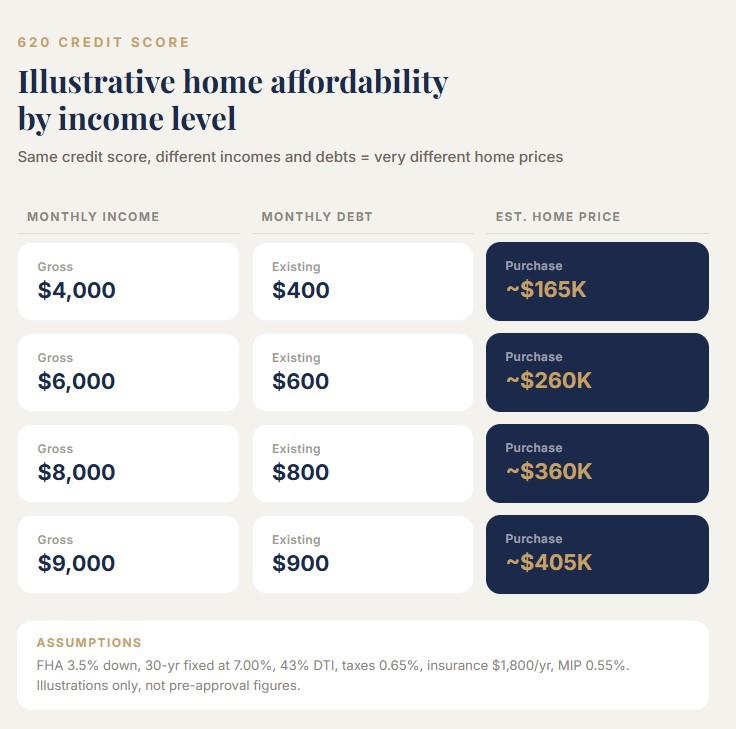
The table below uses a consistent set of assumptions to show how income and debt shift the picture. These are illustrations, not pre-approval figures or personalized estimates.
Assumptions for all examples:
- 30-year fixed rate at 7.00% (Freddie Mac reported a 6.95% weekly average on September 17, 2026; actual rates vary by borrower, lender, loan type and market conditions)
- 3.5% down payment (FHA scenario)
- Annual property taxes estimated at 0.65% of purchase price
- Homeowners insurance estimated at $1,800 per year
- FHA annual mortgage insurance at 0.55% of the loan amount
- FHA upfront mortgage insurance premium of 1.75% financed into the loan
- No HOA in these examples
- Back-end DTI capped at 43% for illustration
| Gross monthly income | Existing monthly debt | Max housing payment at 43% DTI | Illustrative purchase price |
|---|---|---|---|
| $4,000 | $400 | $1,320 | ~$165,000 |
| $5,000 | $500 | $1,650 | ~$210,000 |
| $6,000 | $600 | $1,980 | ~$260,000 |
| $7,000 | $750 | $2,260 | ~$300,000 |
| $8,000 | $800 | $2,640 | ~$360,000 |
| $9,000 | $900 | $2,970 | ~$405,000 |
Look at the $6,000 income row. If that buyer carried $1,200 in monthly debt instead of $600, the maximum housing payment drops to roughly $1,380 and the illustrative purchase price falls to around $175,000. Same income, same credit score, dramatically different result.
These figures are rough estimates. Actual affordability will depend on the precise interest rate, the loan program’s mortgage insurance structure, verified tax and insurance costs, lender overlays and underwriting decisions. They exist to show the relationship between the inputs, not to predict what any individual buyer will qualify for.
Does a 620 credit score limit how much house you can buy?
A 620 score does not set a ceiling on purchase price. It influences affordability indirectly by affecting which loan programs are available, what interest rate you receive and how much mortgage insurance costs.
Here is how that plays out.
Interest rate. Borrowers with lower credit scores generally receive higher interest rates than borrowers with higher scores, all else being equal. A rate difference of even half a percentage point changes the monthly payment meaningfully. On a $300,000 loan at 7.00%, the principal and interest payment is about $1,996. At 7.50%, it is about $2,098. That $102 monthly difference reduces how much purchase price a given income can support.
Mortgage insurance pricing. On conventional loans, private mortgage insurance rates are heavily influenced by credit score and loan-to-value ratio. A 620 score with 5% down could face PMI rates in the 1.5% to 2.0%+ range annually, versus roughly 0.5% to 0.7% for a borrower with a 760 score. FHA mortgage insurance is not credit-score tiered, which is one reason FHA can be attractive for buyers in the 620 range.
Loan program access. Some conventional lenders set their minimum credit score at 620, but others require 640 or higher. A 620 score meets FHA’s minimum for a 3.5% down payment (FHA requires 580). VA does not publish a minimum score, but many VA lenders require 620 as an overlay.
So the credit score shapes the cost of borrowing and the menu of options. But the actual purchase-price ceiling comes from income, debt and the monthly payment those factors support.
Qualification versus comfortable affordability
A detail worth thinking about: the maximum amount a lender will approve is not necessarily the amount you should spend. Lenders evaluate whether you can make the payment based on documented income and debt. They do not account for your grocery spending, childcare costs, retirement contributions, irregular expenses or personal savings goals.
A buyer approved for a $2,400 monthly housing payment who also needs $600 a month for childcare and $400 for car maintenance may find that payment uncomfortably tight. Running your own budget before you shop, not just after, is the single most overlooked step in the process.
How income affects how much house you can afford
Income is the largest single driver of borrowing capacity. But “income” in mortgage underwriting is more specific than what lands in your bank account.
Lenders use qualifying income, which is the portion of your earnings they can document and expect to continue. Salary from a full-time job with a two-year history is straightforward. Hourly income with overtime may require a two-year average of overtime hours. Commission and bonus income typically needs a two-year track record. Self-employment income uses the average of two years of tax returns, and the write-offs that reduce your tax bill also reduce your qualifying income.
Part-time income, rental income, alimony, Social Security and disability payments can all count, but each has documentation and continuity requirements.
One common surprise for self-employed buyers: you might deposit $10,000 a month into your business account, but after deductions your tax returns show $5,500 in net income. The lender uses the $5,500 figure. If your 620 credit score already limits your rate options, a lower qualifying income compresses affordability further.
How debt affects your home-buying budget
Monthly debt obligations eat directly into borrowing capacity. Every dollar committed to an existing payment is a dollar that cannot go toward a housing payment inside the DTI calculation.
The debts lenders count include car loans, student loans, personal loans, credit card minimum payments, child support, alimony and any installment obligation reporting on your credit. They generally do not count utilities, insurance premiums (other than housing-related), subscriptions or groceries.
Student loans deserve a special mention. If your loans are in deferment or on an income-driven plan with a $0 payment, lenders still need to use a payment figure. Conventional guidelines may use 0.5% or 1% of the outstanding balance as the assumed monthly payment. FHA uses 0.5% of the balance or the actual payment, whichever applies. A $40,000 student loan balance with a $0 actual payment could still show up as a $200 or $400 monthly obligation in underwriting.
Two buyers with the same $6,000 monthly income and the same 620 credit score illustrate this clearly:
- Buyer A has $300 in monthly debt. At 43% DTI, the max total obligations are $2,580, leaving $2,280 for housing. That supports a purchase price in the low-to-mid $300,000 range under the assumptions above.
- Buyer B has $1,100 in monthly debt. The same 43% DTI leaves $1,480 for housing, which drops the illustrative purchase price to somewhere near $190,000.
Same score. Same income. An $800 difference in monthly debt created roughly a $130,000 gap in buying power.
How your down payment changes how much house you can afford
A larger down payment does three things: it reduces the loan amount and therefore the monthly payment, it can eliminate or reduce mortgage insurance, and it may improve the interest rate by lowering the loan-to-value ratio.
But draining your savings to maximize the down payment creates its own risks. Lenders may require reserves, meaning money left over after closing. And buyers who close with near-zero savings are one unexpected repair away from financial stress.
Here is a practical way to think about it. On a $350,000 purchase:
- 3.5% down (FHA) = $12,250 down. Loan amount roughly $325,528 after financing the upfront MIP. Monthly P&I around $2,166.
- 5% down (conventional) = $17,500 down. Loan amount $332,500. Monthly P&I around $2,213, plus PMI.
- 10% down = $35,000 down. Loan amount $315,000. Monthly P&I around $2,096, plus PMI at a lower rate.
- 20% down = $70,000 down. Loan amount $280,000. Monthly P&I around $1,863. No PMI.
The 20% down scenario saves over $300 a month compared to the 3.5% option, but it requires $57,750 more cash upfront. For a buyer with a 620 credit score who is stretching to enter the market, the 3.5% or 5% options may be more realistic, and that is perfectly fine as long as the monthly payment works within the budget.
How your loan type changes affordability
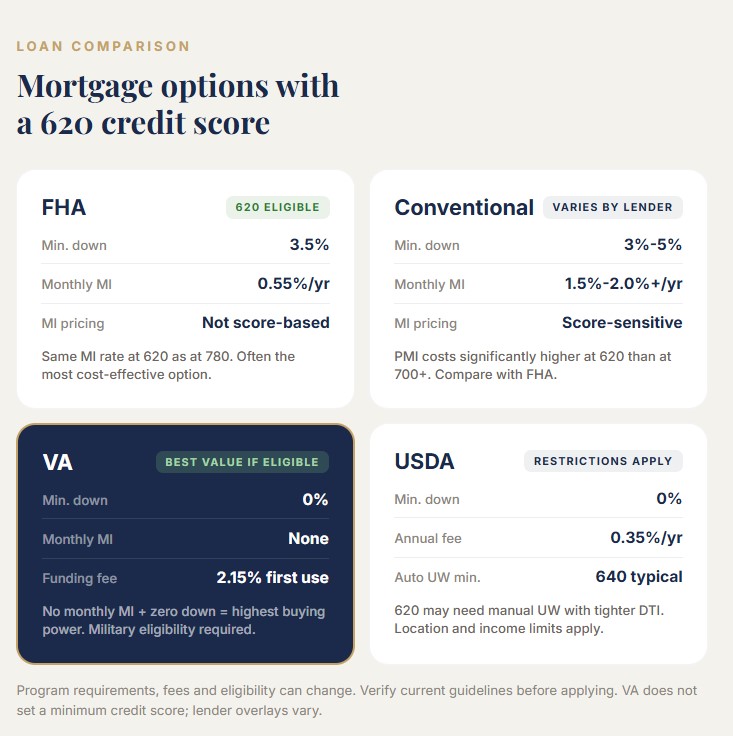
The loan program you choose affects your minimum down payment, mortgage insurance costs, allowable DTI and available interest rates. Here is how the four main program types compare for someone with a 620 credit score.
| Loan type | Credit score considerations | Typical minimum down payment | Mortgage insurance or fees | Key considerations for 620 score buyers |
|---|---|---|---|---|
| Conventional | Many lenders require 620 minimum; some require 640+. PMI pricing worsens below 680. | 3% to 5% | Private mortgage insurance required below 20% down. Rates are credit-score sensitive. | PMI costs will be higher than for a 700+ score. Some lenders may not approve at 620 depending on other risk factors. |
| FHA | 580 minimum for 3.5% down. 500-579 requires 10% down. | 3.5% | Upfront MIP of 1.75% (can be financed). Annual MIP of 0.55% for most loans, for the life of the loan with less than 10% down. | 620 comfortably exceeds FHA’s floor. MIP is not credit-score tiered, so insurance costs are the same as a 750-score buyer. |
| VA | VA itself sets no published minimum. Most VA lenders use 580-620 as an overlay. | 0% | No monthly mortgage insurance. VA funding fee of 1.25% to 3.3% depending on service history, down payment and prior VA loan use. | Eligible veterans and service members benefit from no down payment and no monthly MI. The funding fee can be financed. |
| USDA | USDA’s automated system generally looks for 640+. Manual underwriting may consider lower scores. | 0% | Upfront guarantee fee of 1% and annual fee of 0.35%. | Geographic and income restrictions apply. A 620 score may require manual underwriting, which limits DTI to 29%/41%. |
Each of these programs calculates the total monthly payment differently because of their distinct insurance and fee structures. That changes how much purchase price a given income can support.
How much house can you afford with a 620 credit score and FHA?
FHA is often the most practical starting point for buyers with a 620 credit score. The minimum score for a 3.5% down payment is 580, so a 620 clears that threshold with room to spare.
FHA mortgage insurance is the same rate regardless of credit score, which removes the penalty that conventional PMI imposes on lower scores. The upfront premium is 1.75% of the base loan amount, and it can be rolled into the loan. The annual premium runs 0.55% of the loan balance for most borrowers putting less than 10% down, and it stays for the life of the loan unless you refinance into a different product.
For 2026, the FHA loan limit in Maricopa County, which covers Phoenix, Scottsdale, Mesa, Chandler, Glendale, Surprise, Goodyear and most of the Phoenix metro, is $557,750 for a single-family property. That ceiling is high enough to cover most of the Phoenix-area market, where median sale prices have been running in the $425,000 to $465,000 range depending on the data source and time period.
FHA DTI guidelines generally allow up to 43% on the back end, with some flexibility up to 50% or higher when the automated underwriting system (TOTAL Scorecard) identifies compensating factors such as reserves or minimal payment shock.
A practical note that catches people off guard: FHA requires the property to meet specific condition standards. Homes with significant deferred maintenance, safety hazards or structural concerns may not pass the FHA appraisal. This can limit your options in older neighborhoods or with certain fixer-upper properties.
If you are exploring FHA down-payment options in Arizona, it is worth understanding how down-payment assistance programs can pair with FHA financing to reduce your upfront cash needs.
How much house can you afford with a 620 credit score and a conventional loan?
Conventional loans backed by Fannie Mae or Freddie Mac are available with as little as 3% down, but a 620 credit score sits at the lower edge of eligibility. Many lenders set their own minimum at 620, and some push it to 640 or even 660.
The bigger issue is cost. Private mortgage insurance on a conventional loan is priced based on credit score and loan-to-value ratio. A 620 score with 5% down could face PMI rates in the 1.5% to 2.0%+ range annually, versus roughly 0.5% to 0.7% for a borrower with a 760 score. On a $300,000 loan, that gap could mean $250 to $350 more per month in PMI alone, which directly reduces the purchase price your income can support.
The 2026 conforming loan limit is $832,750 in most of the country, including all Arizona counties. Loans above this amount require jumbo financing, which generally demands higher credit scores and larger down payments.
For many buyers with a 620 score and limited down payment, conventional financing ends up being more expensive month-to-month than FHA. Run both scenarios side by side before deciding. The “best” loan type is the one that produces the most manageable total payment for your specific financial situation.
How much house can you afford with a 620 credit score and a VA loan?
VA home loans offer two significant advantages: no down payment requirement and no monthly mortgage insurance. For eligible veterans, active-duty service members and qualifying surviving spouses, this combination can meaningfully increase purchasing power compared to FHA or conventional financing.
Here is an important distinction: the VA does not publish a minimum credit score. The VA’s own underwriting guidelines focus on residual income (the money left over after all major expenses), DTI and overall credit history rather than a hard score cutoff. However, most VA-approved lenders impose their own overlays, and 620 is a common minimum. Some lenders go as low as 580, while others want 640.
The VA funding fee replaces mortgage insurance. For a first-time VA borrower with no down payment, the funding fee is 2.15% of the loan amount. This can be financed into the loan. Subsequent use increases the fee to 3.3% unless you make a 5% or greater down payment. Veterans receiving VA disability compensation are exempt from the funding fee entirely.
Because there is no monthly MI and no required down payment, a VA-eligible buyer with a 620 score and the same income as a non-veteran FHA buyer may qualify for a noticeably higher purchase price. The monthly savings from avoiding mortgage insurance frees up room in the DTI calculation.
VA also uses a residual-income test, which is a check that you have enough money left each month after taxes, shelter and major expenses to cover basic family living costs. The required residual income varies by family size and geographic region. This acts as a built-in affordability guardrail that other programs lack.
How much house can you afford with a 620 credit score and a USDA loan?
USDA Rural Development loans offer zero-down financing with relatively low guarantee fees, but they come with restrictions that limit who can use them.
Geographic eligibility. The property must be in a USDA-eligible area. Despite the name “rural,” some suburban areas qualify. In the Phoenix metro, most of the urban core is excluded, but parts of Buckeye, Maricopa, San Tan Valley, Queen Creek and areas further from the metro center may be eligible. The USDA eligibility map changes periodically, so buyers should check the current map before assuming a property qualifies.
Income limits. USDA caps household income at 115% of the area median income. For a household of 1-4 people in Maricopa County, this limit has typically been in the $100,000 to $115,000 range, though the exact figure is updated annually.
Credit considerations. USDA’s automated underwriting system (GUS) generally looks for a 640 minimum score. Borrowers below 640 may be considered through manual underwriting, but manual underwriting imposes tighter DTI limits (typically 29% front-end and 41% back-end) and requires stronger compensating factors. A 620 score is not automatically disqualifying, but the path is narrower.
The guarantee fees are modest: 1% upfront (financeable) and 0.35% annually. These are lower than FHA’s insurance costs, which helps offset the tighter DTI limits that manual underwriting may impose.
How much house can you afford with a 620 credit score in Arizona?
Arizona introduces several cost variables that shift affordability calculations, and buyers who skip this part of the math tend to underestimate their actual monthly obligation.
Property taxes. Arizona property tax rates are among the lowest nationally. Effective rates in Maricopa County typically run between 0.5% and 0.7% of the assessed value. On a $400,000 home, estimated annual property taxes might fall in the $2,000 to $2,800 range, which is considerably lower than what buyers would pay in states like Texas or Illinois. That lower tax burden gives Arizona buyers a small affordability advantage.
Homeowners insurance. Arizona insurance costs have been rising, but the state does not face the hurricane or severe-storm surcharges seen in Florida or the Gulf Coast. Annual premiums on a standard policy for a $350,000 to $450,000 home might run $1,500 to $2,400, depending on coverage, location and construction type.
HOA dues. This is where many Arizona buyers get caught off guard. A huge share of the Phoenix metro’s housing inventory sits within master-planned communities that carry monthly HOA assessments. Dues of $75 to $250 per month are common, and some communities with extensive amenities charge $300 or more. These dues count in the DTI calculation and reduce the purchase price your income supports.
A $200 monthly HOA fee on top of a $2,000 housing payment changes the math the same way an extra $200 in car payment debt would. When comparing homes in different communities, always factor HOA costs into the monthly number, not just the listing price.
Where the market sits. Phoenix-area median home values have been in the $387,000 to $465,000 range depending on the source and measurement period, with the broader metro showing essentially flat to slightly positive year-over-year price movement as of mid-2026. West Valley cities like Buckeye, Surprise and Goodyear tend to run 15% to 25% below the metro median. East Valley cities like Gilbert and Chandler tend to run above it. Scottsdale significantly exceeds the FHA loan limit for most properties.
Understanding which communities fit within your price range before you start touring saves real time and emotional energy. If you are working with a 620 credit score and moderate income, you may want to explore the best places to buy a home in Phoenix to identify neighborhoods that fit your budget.
Costs beyond the purchase price
The sticker price on a listing is not the full cost of owning the home. Your actual monthly obligation includes:
- Principal and interest on the mortgage
- Property taxes, collected monthly through escrow in most cases
- Homeowners insurance, also escrowed
- Mortgage insurance (FHA MIP, conventional PMI, VA funding fee or USDA guarantee fee)
- HOA dues, if applicable
- Maintenance and repairs, which are not part of the mortgage payment but are real ongoing costs (budget 1% to 2% of the home’s value annually as a rough guide)
- Utilities, which in Arizona can be significant during summer months when air conditioning runs heavily
A buyer focused only on “can I afford a $350,000 house?” without accounting for these layers often ends up with a monthly obligation that is $400 to $700 higher than the principal-and-interest payment alone. Always work with the full PITI-plus-HOA number, not just the loan payment.
How much cash do you need to buy a house with a 620 credit score?
The maximum purchase price a lender may approve and the amount of cash you need at closing are two different questions, and mixing them up is a common source of stress.
Potential upfront expenses include:
- Down payment. 3.5% on FHA, 3% to 5% on conventional, 0% on VA and USDA if eligible.
- Closing costs. Typically 2% to 5% of the loan amount, including lender fees, title insurance, escrow setup, recording fees and prepaid items.
- Earnest money deposit. Usually $1,000 to $5,000 in the Phoenix market, submitted with the offer and applied toward closing costs or down payment.
- Appraisal fee. Typically $450 to $700, often paid upfront.
- Home inspection. Typically $400 to $600, paid at the time of inspection.
- Prepaid taxes and insurance. Several months of property taxes and insurance may need to be deposited into escrow at closing.
On a $350,000 FHA purchase, a rough cash-to-close estimate might look like this:
| Item | Estimated amount |
|---|---|
| Down payment (3.5%) | $12,250 |
| Closing costs (est. 3%) | $10,500 |
| Prepaid escrow items | $2,500 |
| Inspection and appraisal | $1,000 |
| Approximate total | $26,250 |
Seller concessions can help. FHA allows the seller to contribute up to 6% of the sale price toward the buyer’s closing costs. In a balanced or buyer-friendly market, negotiating $5,000 to $10,000 in seller concessions is realistic, though not guaranteed.
Arizona also has down-payment assistance programs, including the Home Plus program and the Maricopa County Home in Five Advantage program. These programs may provide 3% to 5% of the purchase price or loan amount as a grant or forgivable second lien. Eligibility depends on income limits, credit requirements, purchase-price caps and completion of homebuyer education. You can explore more no-down-payment home buying resources to understand the options available in Arizona.
A simple way to estimate how much house you can afford
This is a back-of-the-napkin process, not a substitute for actual underwriting. But it gives you a reasonable starting framework.
Step 1: Calculate your gross monthly income. Annual salary divided by 12. If hourly, multiply your rate by typical hours per week, then by 52, then divide by 12. If self-employed, use the net income from your most recent two years of tax returns, averaged.
Step 2: Add up your recurring monthly debts. Car payments, student loans, credit card minimums, personal loans, child support. Include anything that shows on your credit report with a monthly obligation.
Step 3: Determine your maximum total obligations. Multiply gross monthly income by 0.43 (or whatever DTI ceiling your target loan program allows). This is the combined limit for housing payment plus existing debts.
Step 4: Subtract existing debts from the total. The remainder is the maximum housing payment your income can support at that DTI level.
Step 5: Account for taxes, insurance, HOA and mortgage insurance. These eat into the housing payment. If you estimate $400 per month for taxes and insurance and $150 for mortgage insurance, subtract $550 from the housing budget. What remains covers principal and interest.
Step 6: Convert the principal-and-interest payment to a loan amount. Use an online mortgage calculator or the standard amortization formula. At 7.00% on a 30-year term, every $100,000 borrowed costs approximately $665 per month in P&I.
Step 7: Add your down payment to the loan amount. That gives you a rough maximum purchase price.
Step 8: Get pre-qualified or pre-approved. This process replaces estimates with verified numbers based on your actual income, credit and debt profile.
Why pre-qualification matters when you have a 620 credit score
Buyers with 620 credit scores have less margin for error than buyers at 740. The rate options are narrower, the insurance costs may be higher, and some lenders will decline the application outright based on overlay policies.
This is exactly why pre-qualification matters in Arizona. Getting pre-qualified or pre-approved accomplishes several things:
- It identifies which loan programs are actually available to you based on your specific credit, income and asset profile, not generic guidelines.
- It reveals your realistic price range before you start visiting properties and getting emotionally attached to homes outside your budget.
- It surfaces potential problems early, such as debts you forgot about, income documentation gaps or credit-report errors that could derail an application later.
- It strengthens your offer. Sellers and listing agents take pre-approved buyers more seriously, particularly when inventory is tight.
For Arizona buyers, getting this step done before serious house hunting is not optional. A buyer who falls in love with a $400,000 home and then discovers they qualify for $310,000 has wasted time, emotional energy, and possibly the goodwill of their agent.
If you are unsure what documents you will need, the Arizona mortgage pre-approval checklist walks through what to prepare. The process typically takes anywhere from a few hours to a few business days depending on the complexity of your financial situation. You can read more about how long mortgage pre-approval takes to set realistic expectations.
Common mistakes buyers make when estimating affordability with a 620 score
Using the listing price instead of the total monthly cost. A $350,000 home with $250 in monthly HOA and high property taxes costs more per month than a $370,000 home in a non-HOA neighborhood with lower taxes. Always compare total monthly payments.
Assuming the online calculator result is the final answer. Mortgage calculators are useful for rough math, but they rarely account for mortgage insurance accurately, and they cannot factor in lender overlays or underwriting decisions.
Ignoring the rate premium. A 620 credit score buyer may receive a rate 0.5% to 1.0% higher than a 740-score buyer on the same loan program. That rate gap reduces purchasing power by tens of thousands of dollars. If you have time before buying, improving your score even modestly can produce real savings.
Confusing what the lender approves with what you can comfortably pay. Lender DTI limits do not account for your full financial life. The approved payment might technically work on paper but leave you with almost nothing for savings, emergencies or quality of life.
Skipping the cash-to-close calculation. You may qualify for a $350,000 loan, but if you need $25,000 in cash to close and you have $15,000, the deal does not happen. Cash availability is a separate constraint from income-based affordability.
Frequently asked questions
How much house can I afford with a 620 credit score?
There is no universal answer. Your affordable purchase price depends on gross income, existing monthly debts, down payment, loan type, interest rate, property taxes, insurance and mortgage insurance. A buyer earning $6,000 per month with $500 in debt might afford a home in the $260,000 to $300,000 range under an FHA scenario at current rates, while a buyer earning $8,000 with $800 in debt might reach $360,000 or more. Getting pre-qualified puts real numbers behind the estimate.
What income do I need to buy a $300,000 house?
With a 7% interest rate, 3.5% down on FHA, estimated taxes, insurance and mortgage insurance, the total monthly payment on a $300,000 home might be roughly $2,300 to $2,500. To keep that payment within a 43% DTI, you would need a gross income of roughly $5,500 to $6,500 per month depending on existing debt, or approximately $66,000 to $78,000 annually. These figures are illustrative and depend on exact rates, fees and costs.
What income do I need to buy a $400,000 house?
Using the same FHA assumptions and a 7% rate, the total monthly payment could run $3,000 to $3,300. At 43% DTI, you would generally need a gross monthly income of roughly $7,500 to $8,500 depending on existing debts, translating to approximately $90,000 to $102,000 annually. These are rough estimates, not pre-approval figures.
Can I buy a house with a 620 credit score?
Yes. A 620 score meets the minimum requirements for many conventional lenders and comfortably exceeds the FHA minimum of 580 for a 3.5% down payment. VA-approved lenders commonly accept 620 as well. Approval still depends on income, debt, employment history, assets and property eligibility.
What is the best mortgage for a 620 credit score?
FHA tends to be the most cost-effective option for many 620-score buyers because the mortgage insurance rate is not credit-score sensitive. Conventional loans are available at 620 but carry higher PMI costs. VA loans are the strongest option for eligible borrowers because they require no down payment and no monthly MI. The best choice depends on your full financial picture, not just the score.
Can I get an FHA loan with a 620 credit score?
Yes. FHA requires a minimum score of 580 for a 3.5% down payment. A 620 score exceeds that floor. You will still need to meet income, employment, debt and property requirements. FHA mortgage insurance costs the same regardless of whether your score is 620 or 780, which is a meaningful advantage over conventional PMI.
Can I get a conventional loan with a 620 credit score?
Many lenders accept 620, but some require 640 or higher. Even if you qualify, the PMI costs at 620 are substantially higher than at 680 or above, which can make the monthly payment more expensive than an FHA alternative. Compare both options before choosing.
Can I get a VA loan with a 620 credit score?
The VA does not set a minimum credit score, but most VA lenders use 620 as their floor. Some lenders go lower. If you meet the lender’s requirement and have qualifying military service, VA loans are typically the most affordable option due to zero down payment and no monthly MI.
How much down payment do I need with a 620 credit score?
FHA requires 3.5% down. Conventional loans may require 3% to 5%. VA and USDA offer 0% down for eligible borrowers. Down-payment assistance programs in Arizona may help cover part or all of the down payment for qualifying buyers, potentially reducing out-of-pocket costs significantly.
Does debt affect how much house I can afford?
Significantly. Every dollar of existing monthly debt reduces the amount available for a housing payment within your DTI ratio. Paying down or paying off a car loan or credit card balance before applying can increase your purchasing power by tens of thousands of dollars. Two buyers with the same income and credit score can qualify for very different home prices based on debt alone.
How much cash do I need to buy a house?
Plan for the down payment plus 2% to 5% of the loan amount in closing costs, plus prepaid escrow items, inspection fees and appraisal fees. On a $350,000 FHA purchase, total cash needs might range from $18,000 to $28,000 before seller concessions or assistance programs. VA and USDA borrowers with zero down payment still need to cover closing costs and prepaids.
Should I get pre-approved before deciding how much house I can afford?
Yes. Pre-approval replaces guesswork with verified numbers from a lender who has reviewed your income, credit and debt. It also identifies issues early and gives you a realistic price range before you start shopping. For buyers with a 620 credit score, pre-approval is especially valuable because it confirms which loan programs and rates are actually available to you.
Taking the next step
Figuring out how much house you can afford with a 620 credit score comes down to one thing: running the numbers with your actual income, debts, savings and loan options rather than relying on a generic answer from the internet.
A credit score is one piece of the picture. Your income sets the ceiling. Your debts lower it. Your down payment, loan type and local costs determine where you actually land.
If you are an Arizona buyer thinking about getting started, Qualify Before You Buy can help you review your financial position and explore what mortgage options may be available for your situation. Understanding your realistic buying power before you start touring homes is the single most productive thing you can do. Knowing your price range, your estimated monthly payment and your cash-to-close number turns house hunting from a guessing game into a focused search.