

A 700 credit score can put you in a reasonably good position when exploring mortgage options. It clears the minimum credit thresholds for conventional loans, FHA loans, and the lender overlays most VA and USDA lenders apply. That matters, but a score alone does not decide whether a lender approves your application, what interest rate you receive, or how much house you can realistically afford.
Lenders look at the whole picture: your income, employment history, monthly debt obligations, down payment, available reserves, and how those factors combine in their underwriting review. Two borrowers with identical 700 scores can receive very different outcomes depending on everything else in their files. What a 700 score does is give you a reasonably solid starting point. What you do with it depends on how the rest of your financial profile holds up.
Is a 700 Credit Score Good Enough to Buy a House?
Yes. A 700 credit score is generally sufficient to explore conventional, FHA, VA, and USDA mortgage programs, and most lenders will consider the application. It does not guarantee approval, and it does not guarantee a particular interest rate.
A 700 sits in a range that FICO and VantageScore generally classify as “good.” That classification matters because lenders use credit scores as one factor in assessing risk, and a 700 signals a credit history without major recent problems. Most conforming conventional loans, which follow Fannie Mae and Freddie Mac guidelines, have historically applied a 620 floor for manually underwritten files. Fannie Mae’s automated underwriting system (Desktop Underwriter) has removed a fixed numeric floor for DU-reviewed files as of late 2025, though lenders can still apply their own minimum score requirements as overlays. In practice, a 700 score will typically clear both program guidelines and the overlays most lenders use.
Two things are worth keeping in mind. First, the scoring model matters: the FICO score your lender pulls may differ from what a credit monitoring app shows you. Second, credit score eligibility and mortgage approval are not the same question. Meeting a lender’s score threshold opens the door to underwriting review; it does not mean the loan will be approved. Income, debt, and property all still have to clear.
What Home Loan Can You Get With a 700 Credit Score?
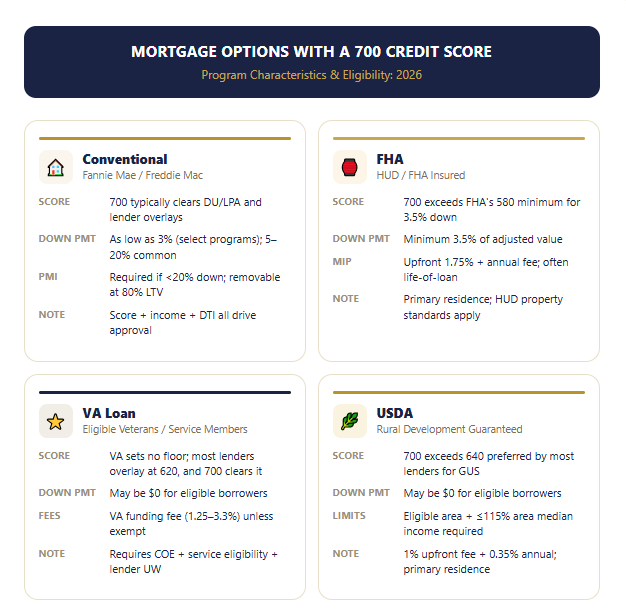
A 700 score may support several loan types, each with its own eligibility requirements, down payment considerations, and trade-offs.
| Loan Type | How a 700 Score May Help | Down-Payment Considerations | Important Eligibility Factors |
| Conventional | Exceeds most lender score minimums; supports DU and LPA underwriting | As low as 3% for some programs; 5–20% more common | Income, DTI, LTV, PMI if under 20% down, employment stability |
| FHA | Well above FHA’s 580 threshold for 3.5% down; supports lender overlays | Minimum 3.5% of adjusted value; closing costs separate | Primary residence only; HUD property standards; upfront and annual MIP regardless of score |
| VA | VA sets no minimum score; most lenders apply a 620 overlay, so 700 easily clears it | No down payment required for eligible borrowers under current program rules | Service/discharge eligibility; Certificate of Eligibility; VA funding fee unless exempt; lender underwriting |
| USDA | Exceeds the 640 score most lenders prefer for streamlined GUS approval | No down payment required for eligible borrowers | Property must be in USDA-eligible area; household income ≤115% of area median; primary residence only |
A few notes on the table. For conventional loans, Freddie Mac’s Loan Product Advisor (LPA) and Fannie Mae’s Desktop Underwriter (DU) drive approval outcomes for most conforming files. A 700 score with a 20% down payment and clean employment history is a very different underwriting profile than a 700 score with a 47% DTI and recent late payments. FHA loans carry both an upfront mortgage insurance premium (currently 1.75% of the loan amount) and an annual MIP, regardless of credit score. Borrowers comparing an FHA loan to a conventional option should evaluate total loan cost over their expected ownership period, not just the monthly payment.
It is also worth noting that some borrowers with a 620 credit score home loan need will find FHA more accessible than conventional, since conventional programs may require a larger down payment or carry stricter DTI limits at that credit level. A 700 score generally unlocks more favorable terms across both categories, but the choice between programs still depends on your individual situation.
For VA and USDA: a 700 score does not by itself establish eligibility. Both programs have program-level requirements that a credit score does not satisfy: service history and a Certificate of Eligibility for VA, and income and location eligibility for USDA.
How Much House Can You Afford With a 700 Credit Score?
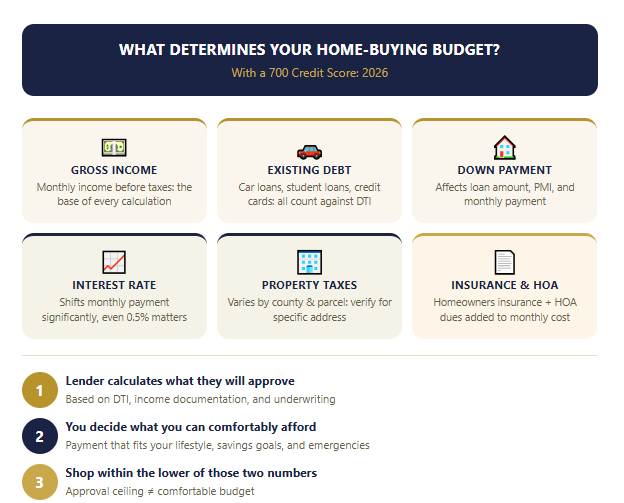
This is where a lot of buyers get misled. A credit score has almost nothing to do with a realistic home-buying budget. It affects which programs you can apply for and potentially how mortgage pricing is structured, but how much house you can comfortably afford is driven by income, debt, and total monthly costs.
Lenders will calculate a maximum loan amount based on your gross monthly income, existing monthly debts, interest rate, and property-related costs. That number is a ceiling, not a target. The payment a lender will approve and the payment that fits your actual life are two different things, and buyers who buy at the top of their approval range sometimes find themselves short on funds for repairs, emergencies, or basic savings.
What goes into affordability:
- Gross monthly income (before taxes)
- All recurring monthly debt obligations (auto loans, student loans, credit card minimums, personal loans)
- Estimated mortgage payment (principal + interest)
- Property taxes for the specific property
- Homeowners insurance (varies by location, age, and property type)
- Mortgage insurance, if applicable
- HOA dues, if applicable
- Loan term (30 vs. 15 years affects P&I payment)
- Cash reserves required at closing
Note: The following table illustrates hypothetical scenarios for illustration only, not loan quotes, approvals, or predictions. All figures assume a 30-year fixed rate of 7.0% and simplified property tax and insurance of approximately $500/month combined. Actual housing costs, rates, taxes, insurance, and mortgage insurance will vary. Always build your budget using actual lender estimates and current local costs.
| Scenario | Gross Monthly Income | Existing Monthly Debt | Assumed Down Payment | Illustrative Housing Budget (Purchase Price) |
| A | $7,500 | $300 | 5% | ~$330,000–$370,000 |
| B | $9,500 | $800 | 10% | ~$360,000–$400,000 |
| C | $12,000 | $1,200 | 20% | ~$430,000–$480,000 |
These ranges reflect what a lender might approve, not what any particular borrower should spend. The difference between the low and high end of each range reflects uncertainty in taxes, insurance, mortgage insurance, and DTI tolerance. Readers should run their specific numbers using real lender estimates and a mortgage calculator before forming any expectation about what they qualify for.
How Does a 700 Credit Score Affect Mortgage Rates?
Mortgage rates are not a fixed output of a credit score. A 700 score is one factor in how a lender prices a loan, but it works alongside loan-to-value ratio (LTV), loan type, loan term, property type, occupancy, and market conditions on the day the rate is locked.
Credit-score-based pricing adjustments (often called loan-level pricing adjustments, or LLPAs, in the conventional market) can cause borrowers with higher scores to receive modestly better pricing than borrowers with lower scores, all else equal. A borrower with a 760 score and 20% down may access different pricing than a borrower with a 700 score and 5% down. How much that difference translates to in rate depends on current market conditions, the lender, and the rest of the loan structure.
One thing that matters significantly at this credit level: LTV. A 700-score borrower putting 20% down will often see better pricing than the same borrower putting 3% down, because the LTV-based pricing adjustments compound with the credit-score adjustments.
Do not rely on any published “average rate for a 700 credit score” figure as a prediction of what you will receive. Rate quotes are specific to a loan scenario on a given day. The right approach is to request a Loan Estimate from multiple lenders for the same loan scenario, compare the Annual Percentage Rate (APR) and total cost across offers, and evaluate the full Loan Estimate, not just the headline rate.
How Much Down Payment Do You Need With a 700 Credit Score?
A 700 credit score does not determine the required down payment on its own. Required down payments vary by program, by lender, and by the specifics of the loan file.
By program:
- Conventional: As low as 3% for some programs (Fannie Mae HomeReady, Freddie Mac Home Possible, Conventional 97). Standard options are 5% or more. Putting less than 20% down generally means private mortgage insurance (PMI) is required until the loan-to-value ratio reaches 80%.
- FHA: HUD’s minimum required investment is 3.5% of the adjusted value for borrowers with a 580+ credit score. At 700, this threshold is easily cleared, but closing costs, prepaid expenses, and reserves are separate from the minimum investment and also require planning.
- VA: Eligible borrowers may finance the full purchase price without a down payment under current program rules. A VA funding fee applies unless the borrower qualifies for an exemption (most commonly a service-connected disability rating). No PMI, but the funding fee is a real cost.
- USDA: Eligible borrowers may also finance the full purchase price without a down payment. USDA charges an upfront guarantee fee and an annual fee, which function similarly to mortgage insurance.
A larger down payment generally reduces the monthly payment, may improve mortgage pricing (particularly LTV-related adjustments), and eliminates or reduces mortgage insurance on conventional loans sooner. The trade-off is less liquidity after closing. Buyers should calculate how a larger down payment affects total cash needed at closing versus what they need to retain for reserves and emergencies.
For Arizona buyers, FHA down-payment assistance programs may help cover the required minimum investment. Review FHA down-payment requirements in Arizona to understand how assistance programs interact with FHA’s minimum investment rules, and explore no-down-payment home-buying resources for context on VA and USDA options.
What Debt-to-Income Ratio Do You Need for a Mortgage?
Debt-to-income ratio (DTI) measures what portion of your gross monthly income goes toward recurring debt obligations. Lenders use it to assess whether you can manage the proposed housing payment alongside existing debts.
The formula:
DTI = Total Monthly Debt Payments ÷ Gross Monthly Income × 100
Example: A borrower earns $8,000 per month gross. They have a $450 car loan, $150 in credit card minimums, and $200 in student loan payments, for total existing debt of $800/month. If the proposed housing payment (PITI: principal, interest, taxes, insurance) is $2,100, total monthly obligations are $2,900. DTI = $2,900 ÷ $8,000 = 36.25%.
Lenders typically evaluate two DTI figures: the “front-end” ratio (housing costs only) and the “back-end” ratio (all monthly obligations including housing). Most underwriting guidelines focus on back-end DTI.
Program-level guidelines vary. Conventional loans run through automated underwriting may accept DTIs in the mid-40s or higher for borrowers with compensating factors like strong reserves and a larger down payment. FHA’s published guidelines allow back-end DTI up to 43% in many circumstances, and higher with compensating factors. VA uses a combination of DTI and residual income analysis. USDA’s standard DTI target is 41%, with flexibility for compensating factors.
A 700 credit score itself does not expand or contract DTI tolerance significantly. Compensating factors like a large down payment or substantial reserves may offset marginal DTI situations. But a borrower with a 700 score and 50% DTI will face a much harder qualification path than a 700-score borrower at 38% DTI. Managing debt before applying is one of the most direct ways to improve qualification prospects.
Can You Get a Conventional Loan With a 700 Credit Score?
A 700 credit score will generally clear the score requirements for a conventional mortgage. For files run through Fannie Mae’s Desktop Underwriter or Freddie Mac’s Loan Product Advisor, the credit score threshold is part of a broader automated analysis, and a 700 score is a positive factor in that evaluation.
For manually underwritten conventional loans, Fannie Mae guidelines maintain a 620 minimum score. A 700 score exceeds that threshold comfortably.
What a 700 score does not guarantee:
- Automated approval (AUS outcomes depend on the full file, not just the score)
- A specific interest rate
- Waiver of private mortgage insurance on low-down-payment loans
- Approval if other qualifying factors (income documentation, employment gaps, or high DTI) create underwriting issues
Borrowers considering a conventional loan should gather two years of income documentation, understand their back-end DTI, and plan for PMI if putting less than 20% down. PMI costs vary by lender, LTV, and program, but typically add somewhere between 0.2% and 2% of the loan amount annually depending on the file. It can be removed once the loan reaches 80% LTV (subject to lender rules and payment history).
Can You Get an FHA Loan With a 700 Credit Score?
A 700 credit score easily clears FHA’s credit guidelines. HUD requires a minimum score of 580 for the 3.5% minimum down payment, and 500–579 for a 10% minimum down payment. At 700, a borrower meets the credit threshold for the 3.5% minimum investment.
FHA loans are insured by the Federal Housing Administration and administered by HUD. Key program characteristics:
- Primary residence only. FHA cannot be used for investment properties or second homes.
- HUD Minimum Property Requirements. The property must meet safety, structural, and livability standards under a HUD-approved appraisal.
- Mortgage insurance is permanent on most modern FHA loans. Upfront MIP is currently 1.75% of the base loan amount, added to the loan balance at closing. Annual MIP is charged monthly and ranges approximately 0.40%–0.75% depending on loan-to-value ratio and term. For most FHA loans originated after June 2013 with a down payment below 10%, MIP continues for the life of the loan.
At a 700 credit score, a borrower may qualify for a conventional loan with PMI on a comparable down payment. The comparison worth doing is total loan cost, not just monthly payment. FHA MIP is structured differently from PMI, and the conventional option may be less expensive over the expected ownership period for a borrower whose score and profile support conventional underwriting. Neither is universally better; the right answer depends on down payment, loan amount, rate difference, and how long the borrower plans to stay in the home.
Can You Get a VA or USDA Loan With a 700 Credit Score?
VA Loans
The Department of Veterans Affairs does not set a minimum credit score for the VA home loan program. VA Pamphlet 26-7 (the VA Lender’s Handbook) does not contain a numeric floor. Every minimum score a borrower encounters is a lender overlay: the lender’s own requirement applied on top of VA program guidelines.
In practice, most VA lenders apply an overlay of 620 as their minimum score for VA purchase loans. A 700 credit score clears that threshold at virtually every VA lender. However, a 700 score does not establish VA eligibility. To use a VA loan, a borrower must:
- Have eligible military service, veteran status, or be a qualifying surviving spouse
- Obtain a Certificate of Eligibility (COE) from the VA
- Use the loan for a primary residence
- Meet the lender’s full underwriting requirements
- Pay the VA funding fee (currently 1.25%–3.3% of the loan amount for purchase loans, depending on down payment and prior VA loan usage) unless exempt. Exemptions apply most commonly due to a service-connected disability rating
VA loans may allow no down payment for eligible borrowers, carry no PMI, and are generally competitive on pricing. They are among the most valuable mortgage benefits available to those who have earned them.
USDA Loans
The USDA Rural Development Guaranteed Loan Program does not set a hard federal minimum credit score. However, most lenders require a 640 or higher for streamlined approval through USDA’s Guaranteed Underwriting System (GUS). A 700 score exceeds that threshold and supports clean GUS processing.
Files below 640 typically require manual underwriting and are subject to tighter lender review. A 700 score avoids that complication.
USDA eligibility depends heavily on factors unrelated to credit score:
- Property location: The home must be in a USDA-eligible rural or semi-rural area. Much of the Phoenix metro does not qualify, though some outlying Arizona communities may. Check the USDA eligibility map at the USDA Rural Development website.
- Household income limits: Total household income (all adult members, not just borrowers) cannot exceed 115% of the area median income for the county and household size. Limits vary by location.
- Primary residence: USDA financing is for owner-occupied primary residences only.
- USDA fees: A 1% upfront guarantee fee (financeable) and an annual fee of 0.35% apply.
What Other Costs Should You Consider When Buying a House?
The monthly principal-and-interest payment is the number most buyers focus on, and it is probably the smallest slice of the true cost of homeownership.
At closing:
- Closing costs (lender fees, title, escrow, recording, etc.) typically run 2%–5% of the loan amount depending on lender, location, and loan type
- Prepaid homeowners insurance premium (usually 12 months upfront)
- Property tax escrow deposits (often 2–3 months)
- Prepaid interest (from closing date to end of the month)
- Home inspection: typically $300–$700, paid before closing and not refundable if you walk away
- Appraisal fee: typically $500–$800 for a standard single-family home
Ongoing monthly costs:
- Property taxes (varies significantly by location; in Arizona, varies by county, city, and parcel)
- Homeowners insurance (affected by home age, roof condition, location, and replacement value)
- HOA dues, if applicable. In Arizona these can range from zero to several hundred dollars per month depending on the community, and master-planned communities sometimes carry multiple association fees
- Mortgage insurance (PMI on conventional under 20% down; MIP on FHA)
- Utility costs (particularly relevant in Arizona where summer cooling costs can be substantial)
After closing:
- Maintenance and repairs (common rule of thumb is 1%–2% of home value annually, though actual costs vary widely by age and condition)
- Moving costs
- Immediate needs (appliances, repairs the seller would not cover)
Buyers who plan only for the down payment and mortgage payment regularly find themselves financially stressed in the first year. The Arizona mortgage pre-approval checklist covers what to gather before applying and includes a framework for estimating total cash to close.
How to Improve Your Mortgage Approval Chances With a 700 Credit Score
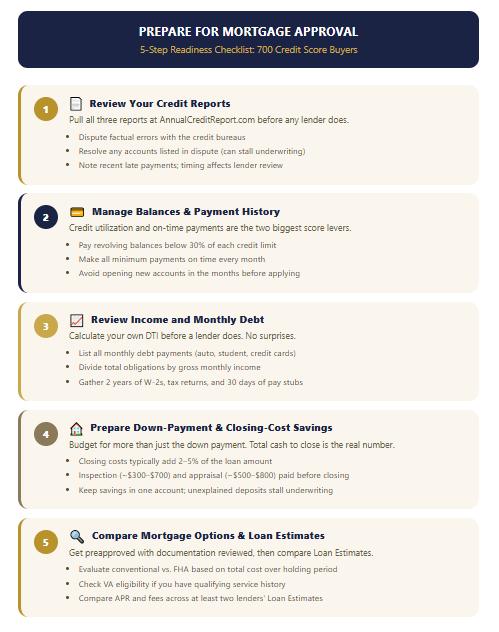
A 700 score is a useful starting point. What follows can make the application more competitive:
- Pull all three credit reports from AnnualCreditReport.com and review them for errors, accounts you don’t recognize, or disputes that could stall underwriting. Dispute factual errors with the bureaus, not merely unfavorable items.
- Pay all bills on time every month. Recent payment history is one of the most heavily weighted factors in credit scoring.
- Reduce revolving credit utilization. If any credit card is above 30% of its limit, paying it down before your credit is pulled can improve your score meaningfully and quickly. This is often the fastest leverage point available.
- Avoid opening new credit accounts in the months before applying. New accounts reduce average account age and generate inquiries.
- Do not close old accounts unless there is a specific reason. Closing cards reduces available credit and can raise utilization ratios.
- Reduce monthly debt obligations where practical. Paying off a small car loan or personal loan before applying can make a meaningful difference in DTI and qualifying income.
- Document income carefully. Self-employed borrowers should have two years of returns, a current profit-and-loss statement, and business bank statements organized before the first lender conversation.
- Build savings. Lenders look at reserves (how much remains in savings after closing), and strong reserves can act as a compensating factor on borderline files.
- Compare multiple lenders. Mortgage pricing varies by lender, and Loan Estimates are the only apples-to-apples comparison tool. Rate shopping within a 14–45 day window (depending on the scoring model used) is generally treated as a single inquiry.
- Get prequalified or preapproved before seriously shopping. Making offers without a letter puts you at a disadvantage. Understanding why pre-qualification matters in Arizona’s market explains why this step is particularly important in competitive submarkets.
These steps can strengthen an application but cannot guarantee approval or a particular score outcome. Some lenders also have overlays that change what compensating factors they accept.
Should You Improve Your Credit Score Further Before Buying?
This is a legitimate question, and the honest answer is that it depends on circumstances that vary by borrower.
Arguments for improving further before buying:
- Moving from 700 to 740+ or 760+ may unlock modestly better pricing on conventional loans, particularly where LTV-based pricing adjustments stack with credit-score adjustments. The dollar impact depends on loan size and the specific pricing environment.
- If your DTI is marginal, taking time to pay down debt improves both DTI and potentially your credit profile.
- If you have any recent late payments or a credit event that is still relatively fresh (within 12–24 months), additional time can meaningfully change how underwriters view the file.
Arguments for proceeding at 700:
- Waiting costs time, and time has a price: rent paid instead of equity built, and home prices that may move in either direction.
- Mortgage pricing adjustments between 700 and 740 may be modest enough that the benefit is smaller than assumed, particularly on smaller loan amounts.
- If reserves and income are strong, a 700 score may produce approval and pricing that is functionally comparable to what a 740 score would.
- Rates and market conditions change regardless of your credit. Improving your score for six months does not lock in today’s rates.
The right answer requires running actual numbers with a lender: get a Loan Estimate at 700, understand what rate improvement might come with a higher score, and calculate whether the projected savings outweigh the cost of waiting. Do not accept a generic prediction. Run the specific scenario for your loan size and down payment.
Step-by-Step: Buying a House With a 700 Credit Score
Step 1: Review your credit reports.
Pull all three reports at AnnualCreditReport.com (free). Look for errors, inaccurate collection accounts, or anything in dispute that would stall underwriting. Note any recent late payments.
Step 2: Establish a realistic monthly budget.
Calculate what monthly housing payment (including taxes, insurance, HOA, and mortgage insurance) fits your take-home pay without eliminating savings or creating stress. This is different from what a lender might approve.
Step 3: Calculate existing debt obligations.
List every recurring monthly payment: car loans, student loans, credit card minimums, personal loans, and any child support or alimony. This is the DTI calculation a lender will run.
Step 4: Compare relevant mortgage programs.
Based on your income, down payment, and whether you have VA eligibility, identify which programs fit. Discuss tradeoffs between FHA and conventional if both are accessible. VA and USDA eligibility should be confirmed before including them in your plan.
Step 5: Gather income and asset documentation.
Two years of W-2s and tax returns, 30 days of pay stubs, and two months of complete bank statements (all pages). Self-employed borrowers need business returns and a year-to-date profit-and-loss statement.
Step 6: Research down payment and closing-cost requirements.
Model total cash to close, not just the down payment. Include closing costs, prepaid expenses, and any minimum reserve requirement.
Step 7: Get prequalified or preapproved.
Submit documentation to one or more lenders. A fully documented preapproval carries more weight than a soft prequalification. Learn how long mortgage preapproval takes so your timeline is realistic. For Arizona buyers, use the mortgage pre-approval checklist to organize documents before the first conversation.
Step 8: Compare Loan Estimates.
When shopping lenders, the Loan Estimate is the standardized form that lets you compare interest rate, APR, fees, and total cost. Compare at least two Loan Estimates before deciding.
Step 9: Shop for homes within your budget.
Search within the price range that your preapproval supports and that fits your comfortable monthly payment, not the maximum. If you are exploring the Phoenix area, the best places to buy a home in Phoenix may help narrow your search by community characteristics.
Step 10: Complete underwriting and prepare for closing.
After an offer is accepted, avoid opening new credit, changing jobs, or making large purchases. Respond promptly to lender requests. Review the Closing Disclosure at least three business days before closing and compare it to your Loan Estimate.
Frequently Asked Questions
Can you buy a house with a 700 credit score?
Yes. A 700 credit score generally clears the minimum credit requirements for conventional, FHA, VA, and USDA mortgage programs and most lender overlays. Whether you receive final approval depends on your complete financial profile (income, debt, down payment, employment stability, and the property), not the credit score alone. It is a useful starting point, not a guarantee.
Is 700 a good credit score for a mortgage?
700 falls in the range that FICO and VantageScore classify as “good.” For mortgage purposes, it typically satisfies lender overlays on conventional and FHA programs and comfortably exceeds the 620 overlays most VA and USDA lenders apply. Higher scores may access somewhat better pricing on certain loan products, but 700 is a functional score for mortgage qualification at most lenders.
How much house can I afford with a 700 credit score?
Your credit score does not determine how much house you can afford. Affordability depends on gross income, existing monthly debts, down payment, interest rate, property taxes, insurance, HOA dues, and mortgage insurance. Two buyers with identical 700 scores can afford very different homes depending on those other factors. Use actual lender estimates and a mortgage calculator to model your specific situation.
What mortgage rate can I get with a 700 credit score?
There is no universal rate for any credit score. Mortgage pricing depends on your score, loan-to-value ratio, loan program, loan term, property type, and market conditions on the day you lock. The only way to know what rate you qualify for is to get a Loan Estimate from a lender for your specific loan scenario. Comparing multiple Loan Estimates is the most reliable way to find competitive pricing.
Can I get a conventional loan with a 700 credit score?
Generally yes. Conventional loans following Fannie Mae and Freddie Mac guidelines typically clear at a 700 score for automated underwriting files, and exceed the 620 threshold applied to manually underwritten loans. Approval still depends on income, DTI, down payment, and underwriting findings. Lenders may also have their own overlay requirements.
Can I get an FHA loan with a 700 credit score?
Yes. FHA’s minimum for the 3.5% down payment is 580. A 700 score easily exceeds that. FHA loans carry both upfront and annual mortgage insurance premiums regardless of credit score. At 700, a borrower should compare FHA and conventional costs over their expected holding period, since conventional PMI can be removed when LTV reaches 80%, while FHA MIP generally remains for the life of the loan on most current FHA loans.
How much down payment do I need with a 700 credit score?
The required down payment depends on the loan program, not the credit score alone. Conventional options start as low as 3%; FHA requires a minimum of 3.5%; VA and USDA may allow no down payment for eligible borrowers. A 700 score does not by itself set the down payment requirement. It determines which programs you can qualify for, each of which has its own down payment rules.
Does a 700 credit score guarantee mortgage approval?
No. Credit score is one factor in a multi-factor underwriting review. Lenders also evaluate income, employment stability, DTI, down payment, assets, reserves, and the property. A borrower with a 700 score can be declined for insufficient income, excessive debt, or an ineligible property. Score eligibility and loan approval are different questions.
Will improving my credit score lower my mortgage payment?
Potentially, but the impact depends on the loan amount and how much the rate improves. Moving from 700 to a higher tier may reduce pricing adjustments, particularly on conventional loans. Run the specific scenario with your lender: get a rate quote at your current score and ask what the quote would look like at a higher score, then calculate whether the savings justify waiting.
Should I pay off debt before applying for a mortgage?
Reducing debt can improve your DTI, which directly affects how large a mortgage you can qualify for. Paying down revolving credit balances also tends to improve credit scores relatively quickly by reducing utilization. Whether to pay off installment debt (car loans, personal loans) before applying depends on how the payoff affects DTI, available cash for the down payment, and whether any minimum reserve requirement remains satisfied. Discuss the specific trade-off with a lender.
Can eligible veterans get a VA loan with a 700 credit score?
A 700 score clears the 620 overlay that most VA lenders apply. Eligible veterans, active-duty service members, and qualifying surviving spouses can use VA financing at this credit level. VA eligibility, a Certificate of Eligibility, and meeting the lender’s full underwriting requirements are all still required. A 700 score establishes credit readiness for VA lending; it does not establish VA eligibility.
How do I compare mortgage offers?
Request a Loan Estimate from each lender you are considering for the same loan amount, down payment, and property type. Compare the interest rate and APR (which includes certain fees), the cash to close, and the total interest paid over the loan term. Review Section A (lender fees), Section B (services you cannot shop for), and Section H (other costs). Do not compare one lender’s rate to another’s APR.
Know Where You Stand Before You Shop
A 700 credit score can open several mortgage options, but knowing your score is only the beginning. Your income, monthly debt, down payment, and total cash to close all shape what you actually qualify for and what you can comfortably afford.
Qualify Before You Buy is built around one principle: understand your complete financial picture first, then shop for homes within a range you can realistically finance. That means knowing your estimated rate options, your monthly payment range including taxes and fees, and how much cash you need on closing day, before you write a single offer.
Ready to get a clear picture of where you stand? Start your preapproval review or contact the team directly with your questions. No pressure, no obligation. Just the information you need to buy with confidence.